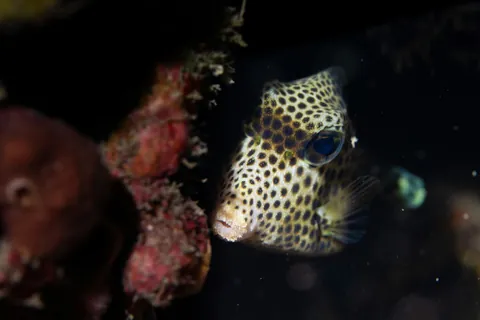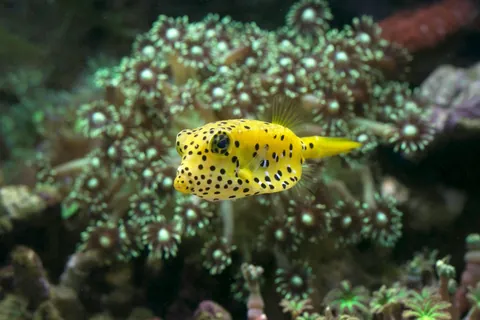
Boxfish
box_fish
Ostracion cubicus
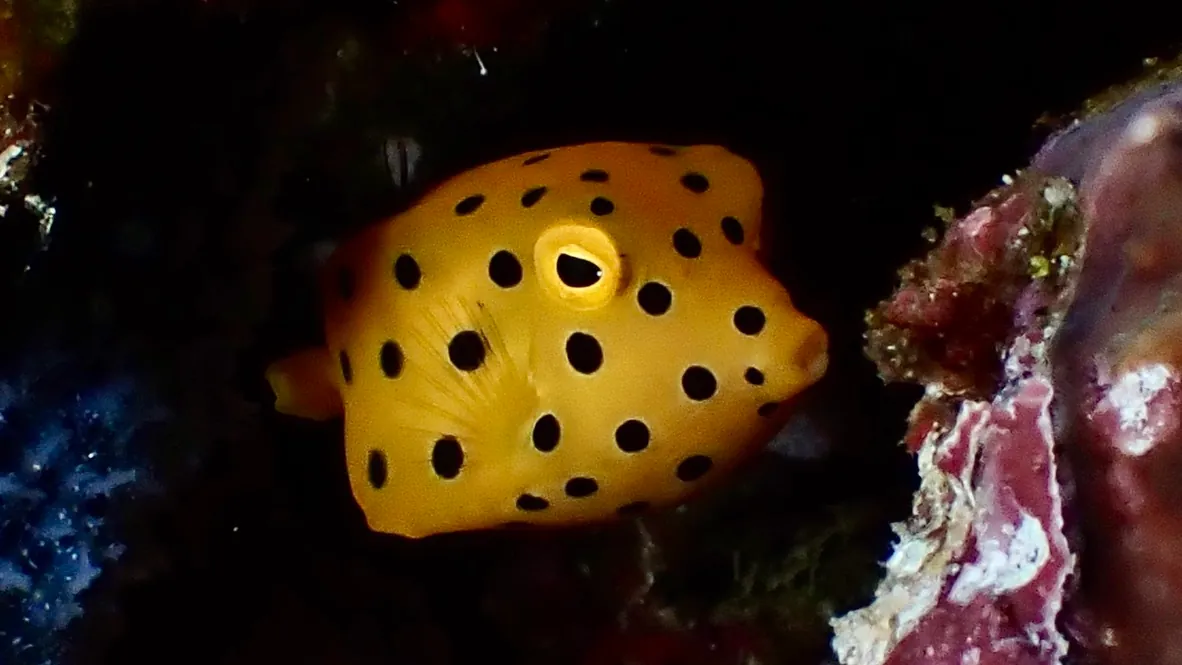
The yellow boxfish is a slow-looking, cube-shaped reef fish with a hard outer shell and bold black spots. It grows to about 45 cm. Most sightings are between 1 and 50 m, though it has been recorded down to 280 m. It is best known for its box shape, its bright warning colours, and the poisonous slime it releases when it is stressed.
Also known as: ostracion cubicus, black-spotted, black-spotted boxfish, blue-spotted boxfish, box fish, boxfish, boxy, cofferfish, cowfish, cube trunkfish, cubical boxfish, ocellated box fish, polkadot boxfish, spotted box fish, Ostracion cubicum
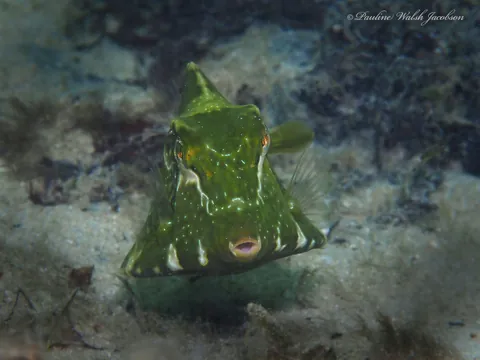
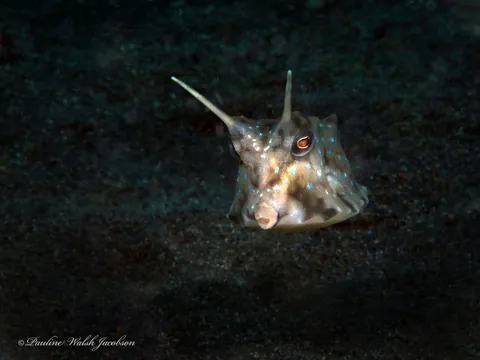
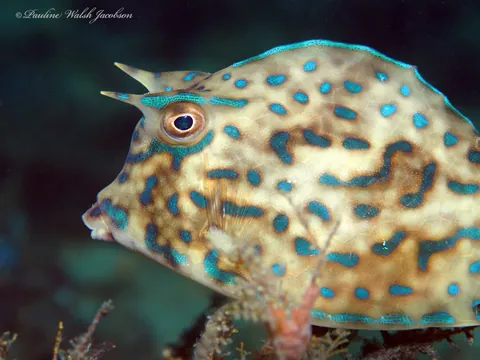
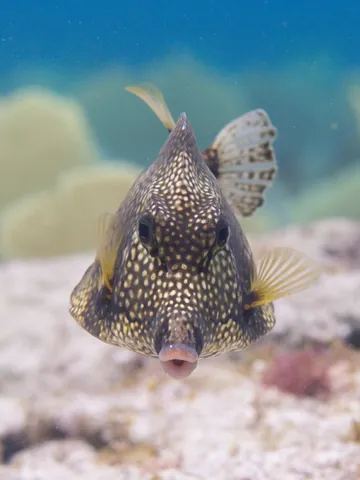
Nothing else on the reef has this outline. Look for a small, hard-edged box with a square cross-section, fins poking out of the corners of the shell, and a tail that does all the work while the body stays completely rigid. The whipping, rowing fins and stiff body give it away even in poor light. The yellow-and-black spotted pattern confirms it, but the shape alone is enough.
The head and body are enclosed in a rigid armoured case called a carapace, so the fish really is box-shaped, with flat sides and hard edges. There are only gaps in the case for the mouth, nostrils, gill opening, vent, fins and tail stalk. Nothing about the body flexes. The fish is yellow with black spots, and juveniles are the brightest of all. These strong colours are a warning to predators.
It ranges widely through the tropical Indo-Pacific, from the Red Sea and the East African coast across to Hawaii and from Japan south to New Zealand. Since 2011 it has also turned up in the eastern Mediterranean, most likely arriving through the Suez Canal. Look for it on sheltered coastal and offshore coral reefs, in lagoons and on semi-sheltered seaward reefs, and over patches of flat seabed. It works its way along channels and cracks in the reef.
Despite the stiff, blocky body it is a strong and agile swimmer, driving itself with its tail while the body stays still. It also makes sounds, humming and clicking by using the muscles around its swim bladder. These calls are thought to be either a way of talking to other boxfish or a way of putting predators off. When the fish is stressed it releases a slimy poison called ostracitoxin into the water. The poison is strong enough to kill other fish nearby, and a bacterium living in the slime seems to be part of this defence.
It feeds mainly on algae and on small animals living on and in the bottom. The list is broad: worms in the sand, sponges, crustaceans, molluscs, tiny single-celled organisms, and small fish.
It is listed as Least Concern. One concern is that wild reef fish, this species included, gather around sea-cage fish farms to feed on the waste, which can expose them to disease escaping from the farms and draws tourism pressure to those spots.
It talks. The yellow boxfish hums and clicks by working the muscles around its swim bladder, and it is louder and clickier than its close relative, the spotted boxfish. Males keep their calls going for longer than females and young fish do.
Describe what you saw and we name it, then keep every species you find in your Oceandex.