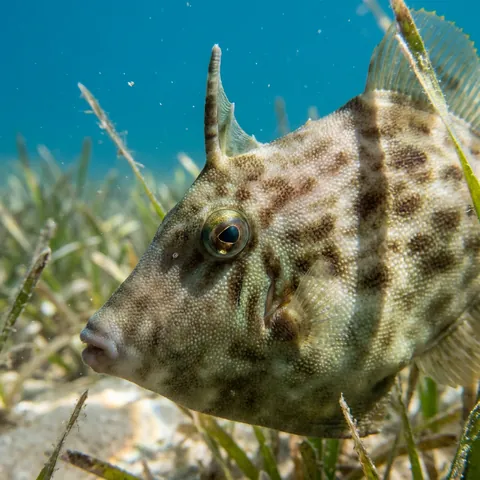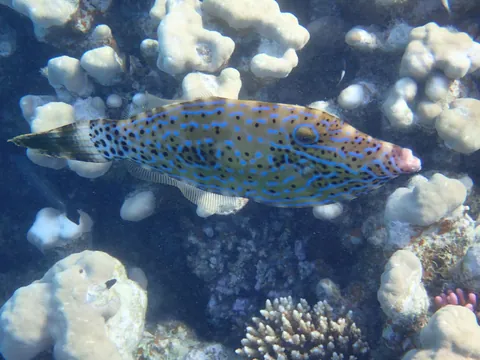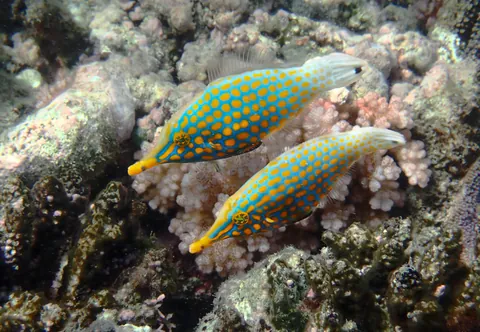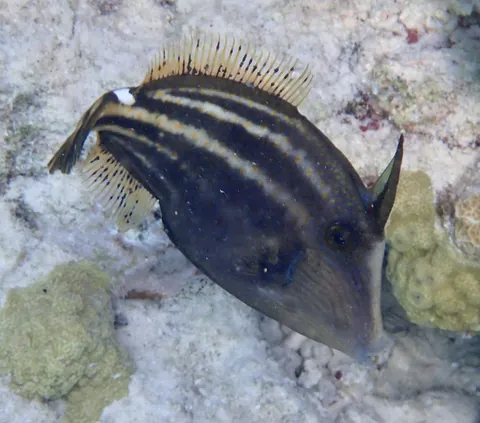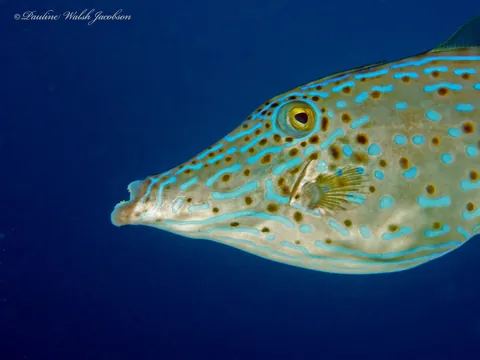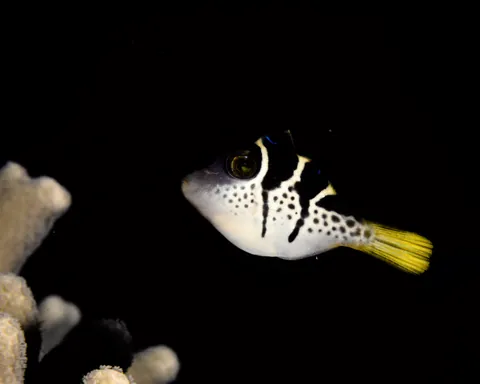
False puffer
Paraluteres prionurus
Cantherhines dumerilii
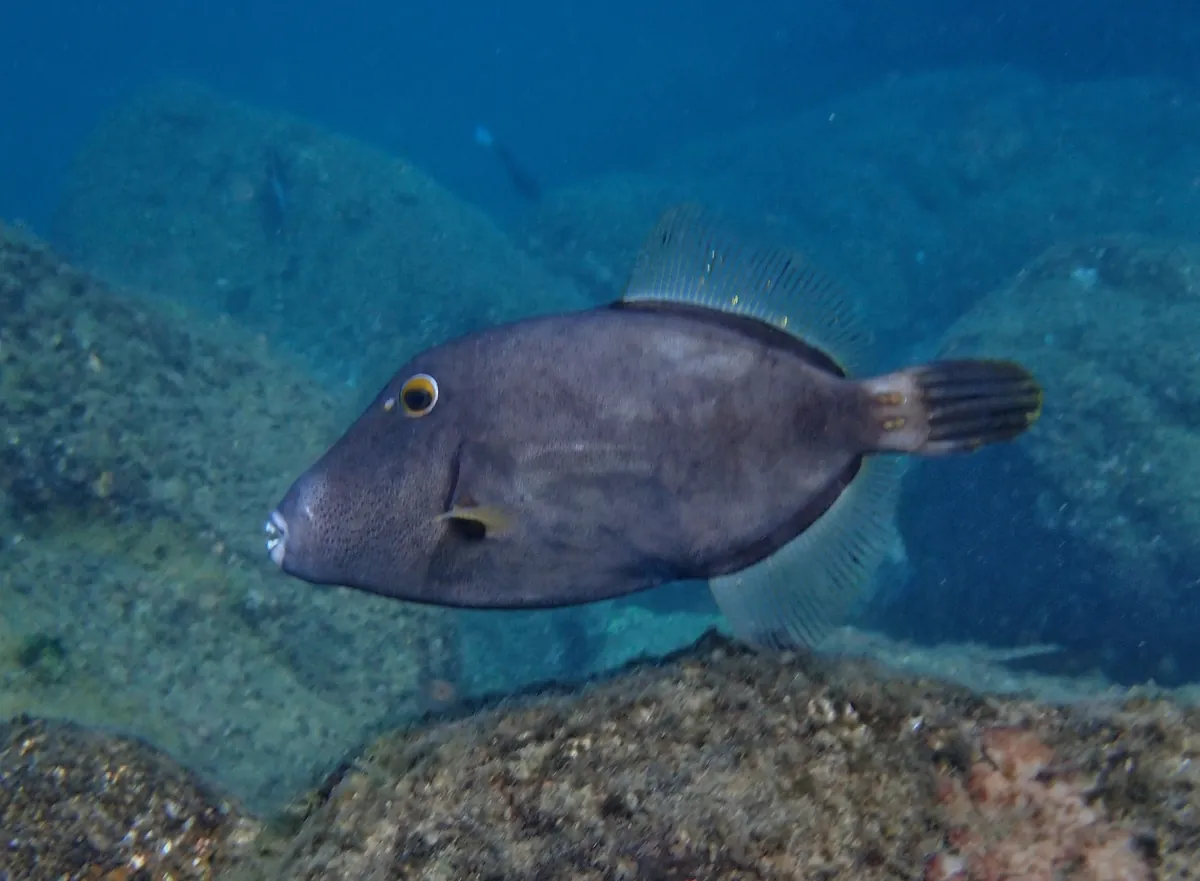
A shy reef fish that darts for cover the moment it feels threatened, this filefish grows to about 38 cm, though most divers see it closer to 25 cm.
Also known as: barred filefish, whitespotted filefish, yelloweye leatherjacket, yelloweye leatherjacket, whitespotted filefish, orange-fin file, white-spotted filefish, yelloweye filefish, barred leatherjacket, dumeril's leatherjacket, whitespotted filefish
Several filefish in this genus share a barred, brownish body. Check the colour of the tail-base spines and tail fin: they glow bright orange, more deeply so in males, unlike the duller spines of similar filefish.
The body is greyish or yellowish-brown with about twelve vertical dark bars. The eyes are yellow and the fleshy lips are white. The small, rounded tail fin is orange, and the other fins are pale yellow. A pair of spines projects backward from each side of the tail base.
It is found on coral reefs across the Indo-Pacific, from East Africa to French Polynesia, Japan, and Hawaii, as well as off Mexico and Colombia in the eastern Pacific. It favors reefs with rock crevices and caves to retreat into, at depths of 6 to 70 m, though usually shallower than 35 m. Juveniles drift in open water and hide under floating objects.
It is a shy fish, usually seen alone or in pairs, that darts into a cave or crevice at the first sign of danger. It feeds by nibbling the tips of branching corals, along with algae, sponges, sea urchins, and molluscs (shelled invertebrates).
Males can be told apart from females by colour: they grow longer, more deeply orange spines at the tail base, and a darker orange tail and eyes.
Describe what you saw and we name it, then keep every species you find in your Oceandex.