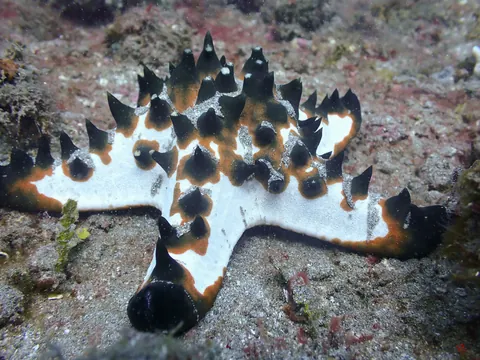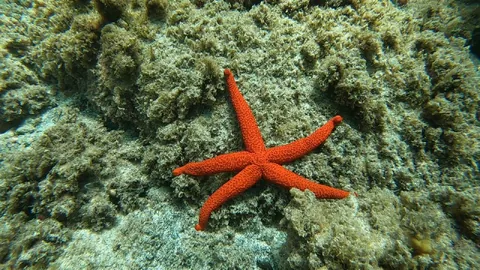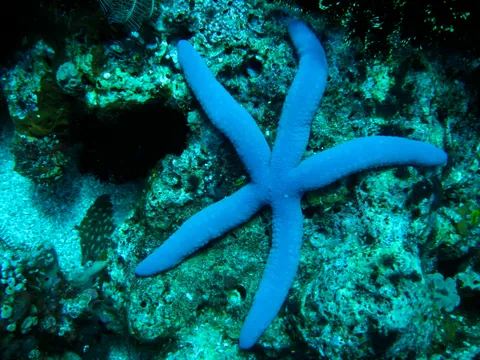
Blue sea star
Linckia laevigata
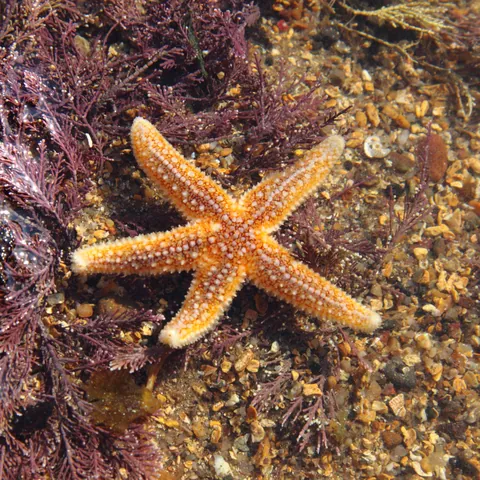
Coscinasterias tenuispina
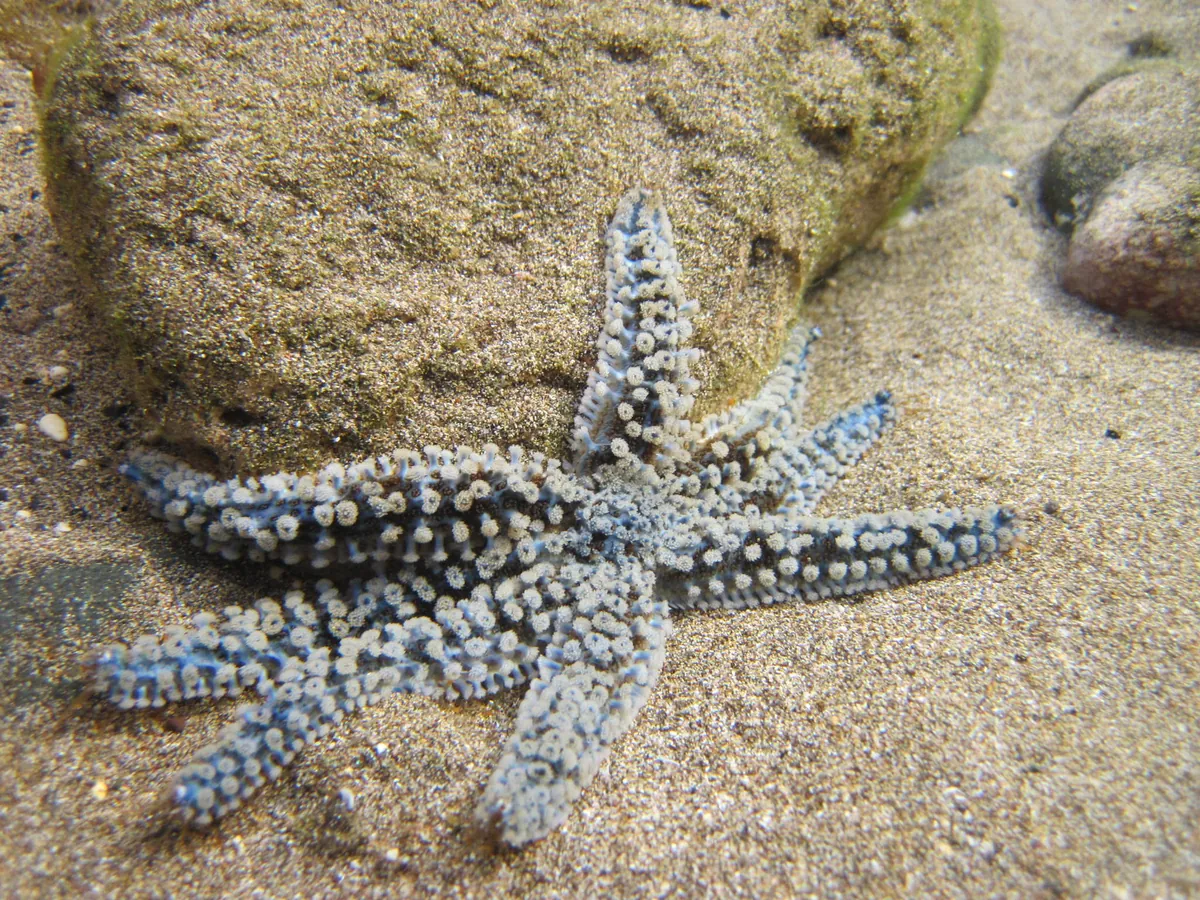
This starfish breaks the usual five-armed rule. The white sea star can grow six to twelve arms, often of different lengths, and it can even split its own body in two to make a second animal. It grows to about 20 cm across and is a common sight on hard seabeds in the Mediterranean and the Atlantic.
Also known as: white spiny starfish, spiny starfish, blue spiny starfish, Coscinasterias tenuispina
Most sea stars you meet underwater have five even arms. The white sea star instead usually has 7, and they are often clearly mismatched in length, a sign that it split itself in two recently and is still regrowing.
The white sea star has 6 to 12 arms, usually 7, and they are often of noticeably uneven length. It reaches about 20 cm across, though most are closer to 12 cm. The body is a creamy, slightly bluish colour with brown blotches, and the skin feels rough, covered in short spines.
It lives on hard bottoms and tucks under stones and seaweed, on the lower shore down to deeper water. You can find it across the Mediterranean Sea and along the Atlantic coast, from Western Europe to the Caribbean and down to Brazil.
This starfish is a predator and an omnivore, feeding mainly on other echinoderms (the group that includes starfish and sea urchins) and on bivalve molluscs such as clams. Across most of its range it reproduces sexually in winter. In summer it can also reproduce asexually by fission: its central disc tears itself into two pieces, and each piece slowly grows the missing arms to become a whole new starfish.
Harmless to humans.
In Brazil, every white sea star found has been male. That population still reproduces there all year round, just by tearing itself in two.
Describe what you saw and we name it, then keep every species you find in your Oceandex.