Tralhoto
Anableps microlepis
About
This small fish spends its life at the waterline, and its eyes are built for exactly that. It lives along the Atlantic coast from Trinidad and Tobago down to southeast Brazil, in estuaries, mangrove swamps and tidal mudflats near river mouths. It grows to about 32 cm, though 15 cm is more usual. Groups travel up and down the shore hunting organic scraps, small animals, sand crabs and little bivalve shellfish.
Also known as: foureyes, finescale foureyed fish, finescale foureyes, foureyes, foureyes, finescale foureyed fish, foureye, finescale four-eyed fish, finescale foureyed fish, finescale foureyes
- Length
- 15 cm · max 32 cm
- Weight
- max 500 g
How to tell it apart
At the surface, those split eyes riding on the waterline tell you the fish at once. What they will not tell you is which of the two four-eyed fishes you are looking at, because a close relative shares the same mudflats. The only difference on record is scale size: this one has smaller, more numerous scales. That is not something you can judge at viewing distance, so in the water treat the two as one and do not call it either way.
Appearance
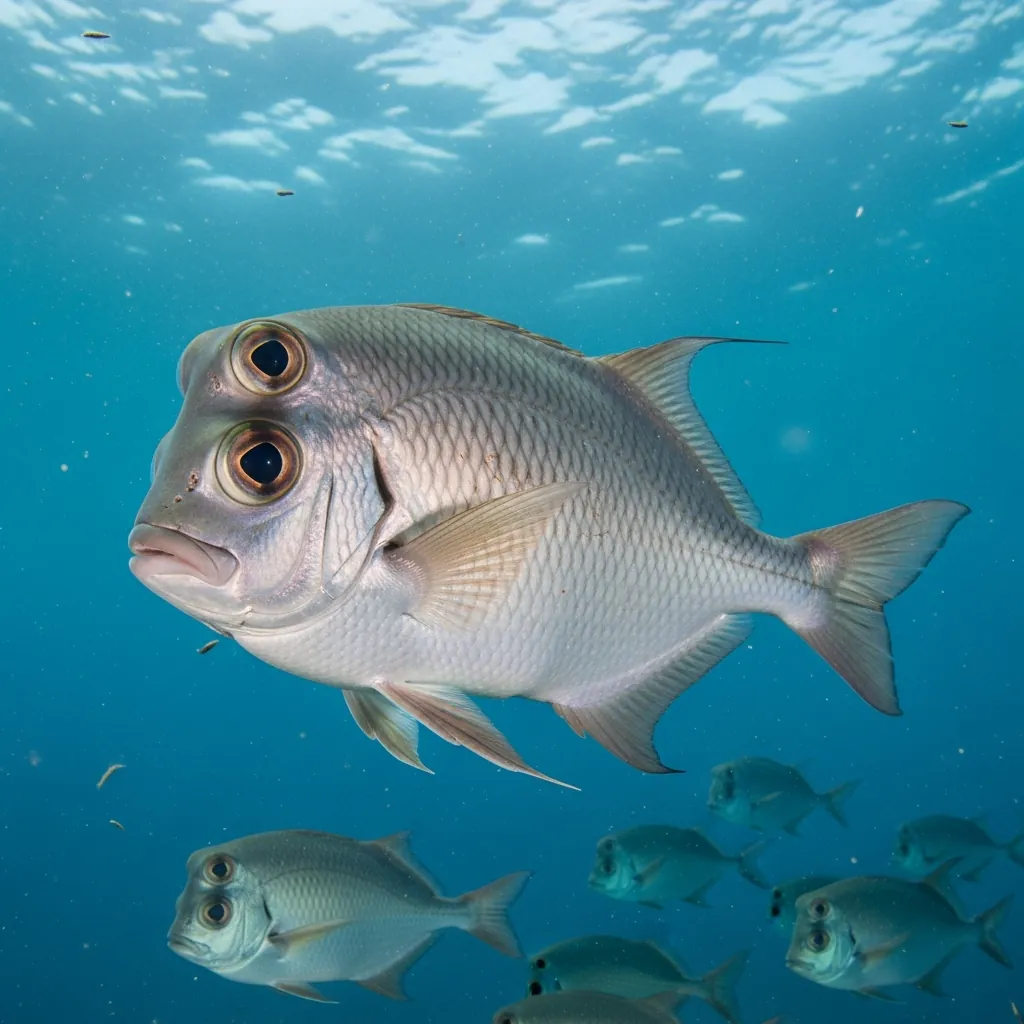
A slim fish with eyes that bulge above the top of the head. Each eye is split into two lobes, so the fish can watch the air and the water at the same time. The scales are small and packed closely together. Males carry a long rod in place of the anal fin, called a gonopodium, and it leans to the left or the right. Females give birth to live young rather than laying eggs. Schools are usually around a dozen fish, but they can run past a hundred, and single fish or pairs also turn up.
Log it in Into the Blue
Describe what you saw and we name it, then keep every species you find in your Oceandex.