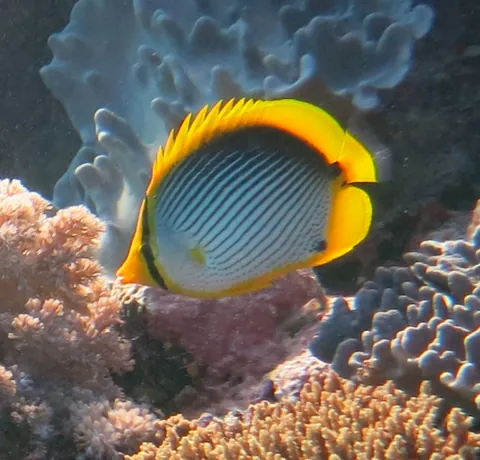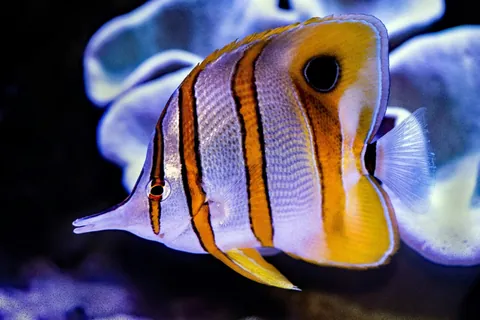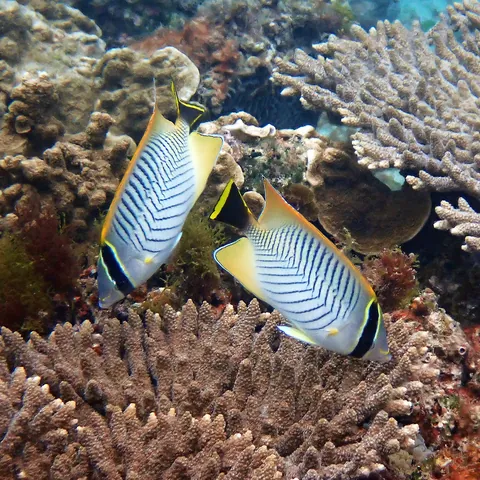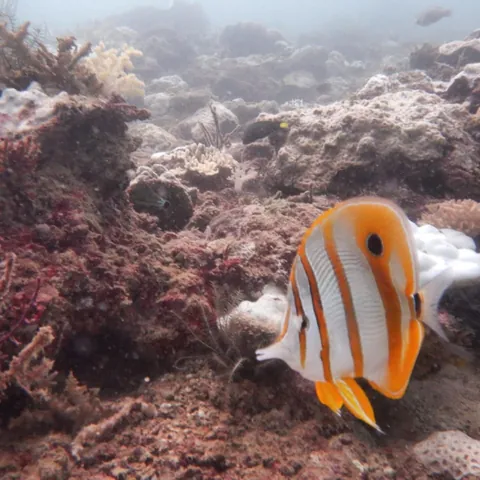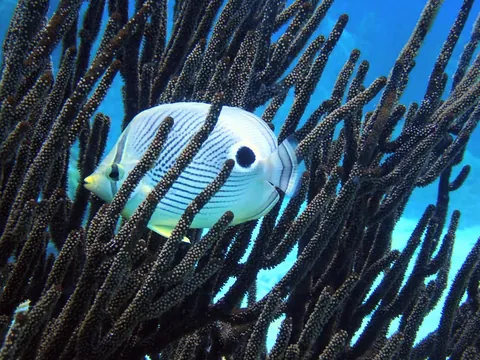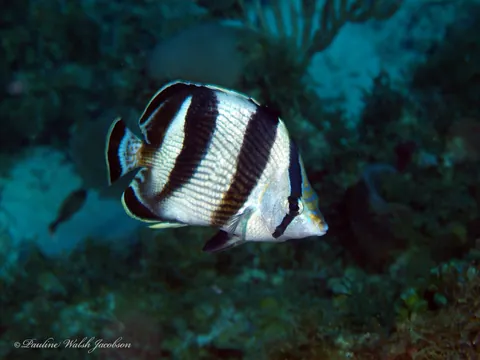
Banded Butterflyfish
Chaetodon striatus
Chaetodon citrinellus
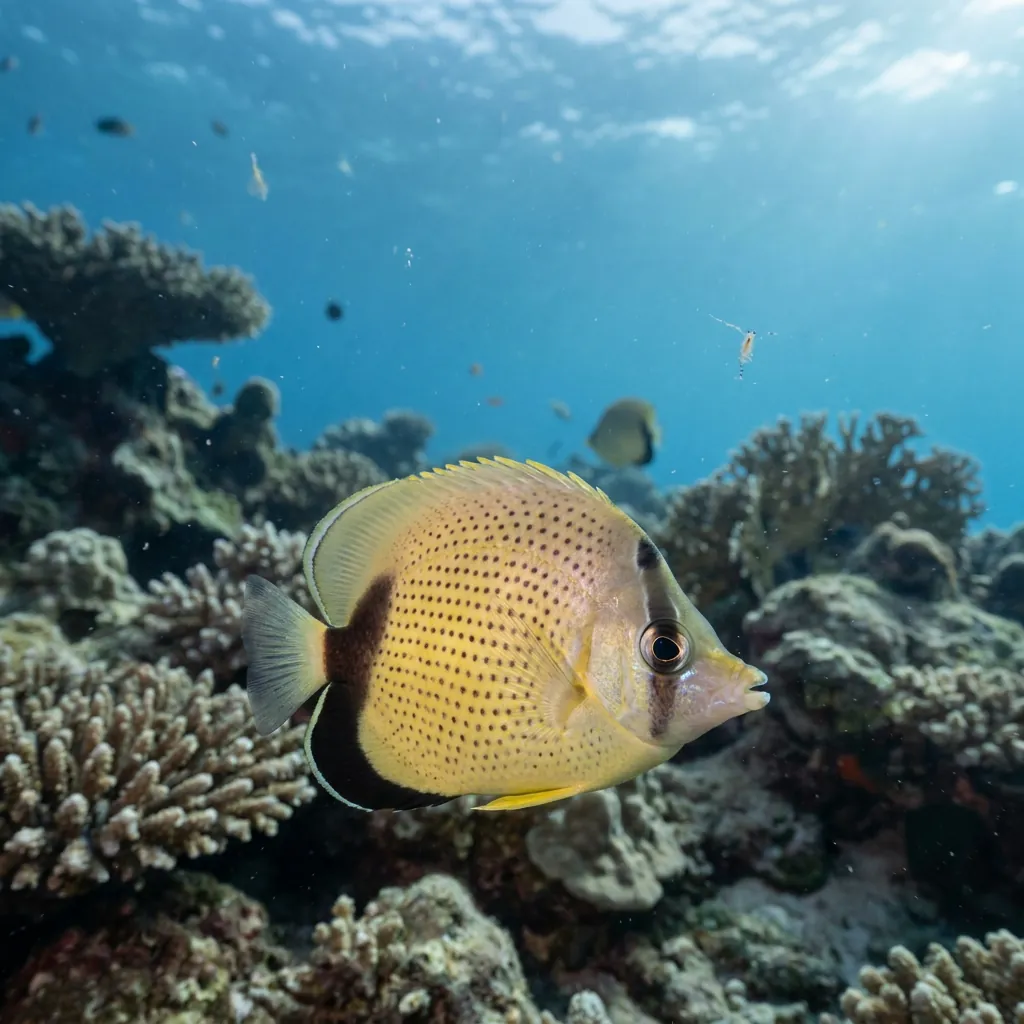
The speckled butterflyfish is a small, disc-shaped reef fish of the Indo-Pacific, reaching about 13 cm. It is found from the Red Sea and East Africa across to the central Pacific islands, north to southern Japan and south to Australia. It is a shallow-water fish: most sightings are between 1 and 5 m, although it has been recorded down to 36 m. It picks at small worms, small bottom-living invertebrates, coral polyps and fine hair-like algae. Adults usually swim in pairs; young fish gather in small groups.
Also known as: citron butterflyfish, citron coralfish, lemon butterflyfish, speckled butterflyfish, speckled butterflyfish, lemon butterflyfish, citron butterflyfish, speckled butterfly-fish, citron coralfish
Two fixed marks do the work at viewing distance: the black bar through the eye, and the sharp black border along the anal fin on the underside. Between them the body reads as a pale, finely speckled yellow disc with no bold bands or blotches. Many butterflyfish have an eye bar, so check the dark edge on the underside fin before you decide.
The body is pale yellow and covered with many small dark spots, which give the fish its name. A black bar runs over the head, crossing the eye above and below it. The anal fin, the fin on the underside just before the tail, has a clean black edge. The body is a rounded disc, deeper than it is long in profile, with a short snout.
Young speckled butterflyfish do not stay with their own kind. They join loose groups of other young butterflyfish of the same size, most often the sunburst butterflyfish, so a small mixed cloud of juveniles over a shallow reef may contain both species.
Describe what you saw and we name it, then keep every species you find in your Oceandex.