snaggletooth
Astronesthes niger
About
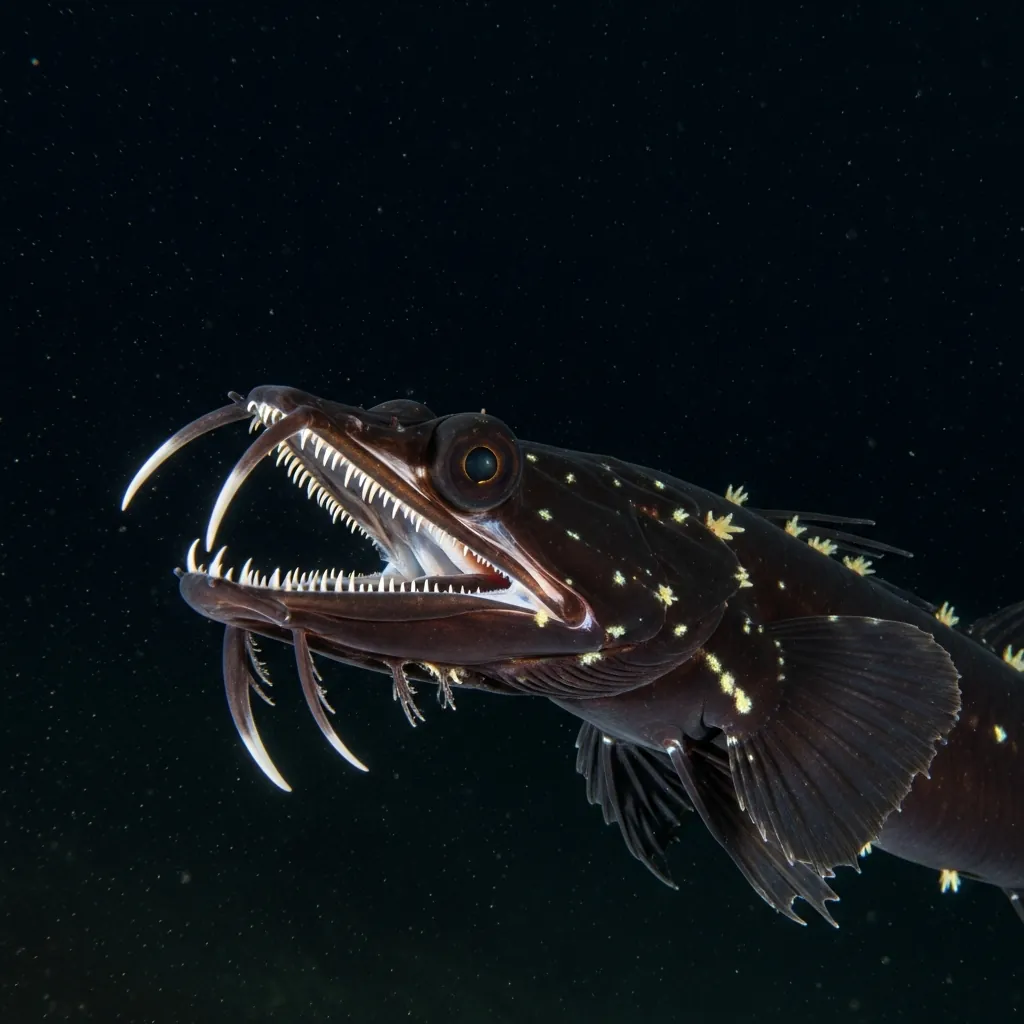
The snaggletooth is a 16 cm hunter of the dark middle waters, black from nose to tail and armed out of all proportion to its size. A long barbel, a fleshy whisker, hangs from its chin with a knob on the end. Fang-like teeth fill a mouth that looks too big for the head. It takes krill, small shrimp-like amphipods and lanternfish.
- Length
- 16 cm
- Depth
- up to 1000 m
How to tell it apart
Several close relatives share the black body, the fangs and the chin barbel. The snout settles it: look at the profile running from the eye to the mouth. On this species it runs straight out, with no turned-up tip, while its relatives carry a snout that tilts up at the front.
Appearance
The body is slim and slightly long, and the colour is black. The mouth is large and lined with long, fang-like teeth. The chin barbel is long, with a swollen section along it and a knob at the tip. Two lines of photophores, the small organs that make light, run along each flank. Pale glowing patches sit in front of the eye, above the eye, above the nostrils and in a large blotch above the pectoral fin.
Habitat
This is an open-ocean fish of the middle depths, with no tie to reef or seabed. It lives in the warm Atlantic, the Caribbean and the Gulf of Mexico, and also in the Indian Ocean and the western Pacific, including Australian waters. Its range reaches down to 1,000 m, and by day it usually stays below the halfway mark of that. At night it rises, and it is then the fish most often scooped up in surface nets.
Did you know?
It only comes right to the surface layer when both the sun and the moon are below the horizon. That leaves it a narrow window each month, near the first and third quarter moons: it seems to need moonlight for the climb, yet keeps away from lit water at the top.
Log it in Into the Blue
Describe what you saw and we name it, then keep every species you find in your Oceandex.