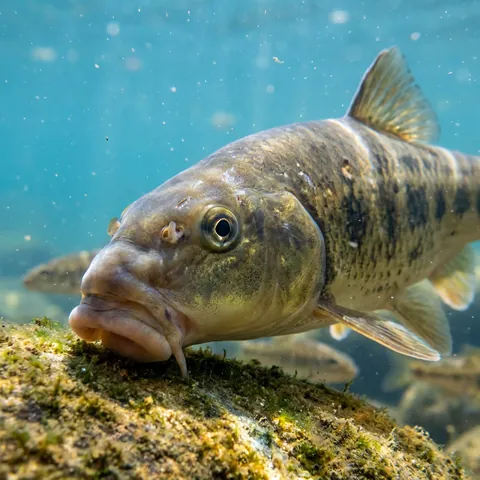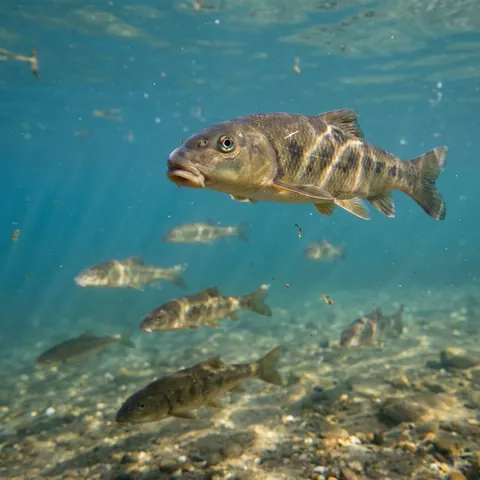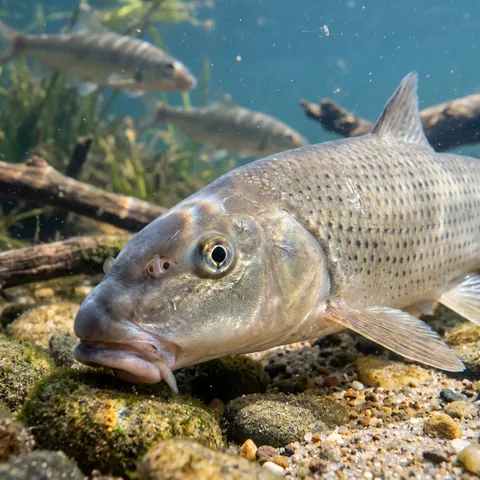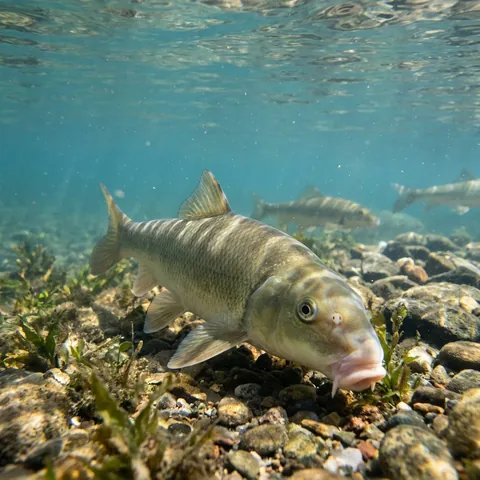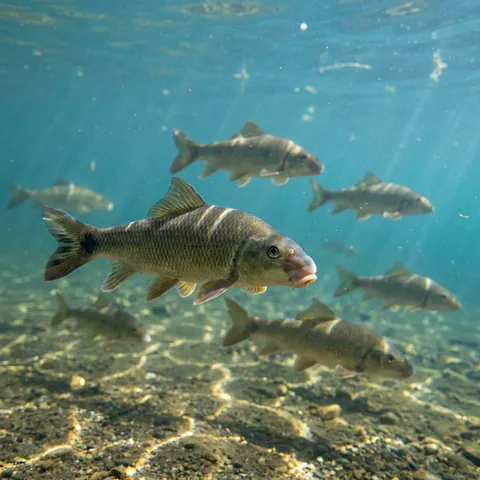
Blacktail Redhorse
Moxostoma poecilurum
Ictiobus bubalus
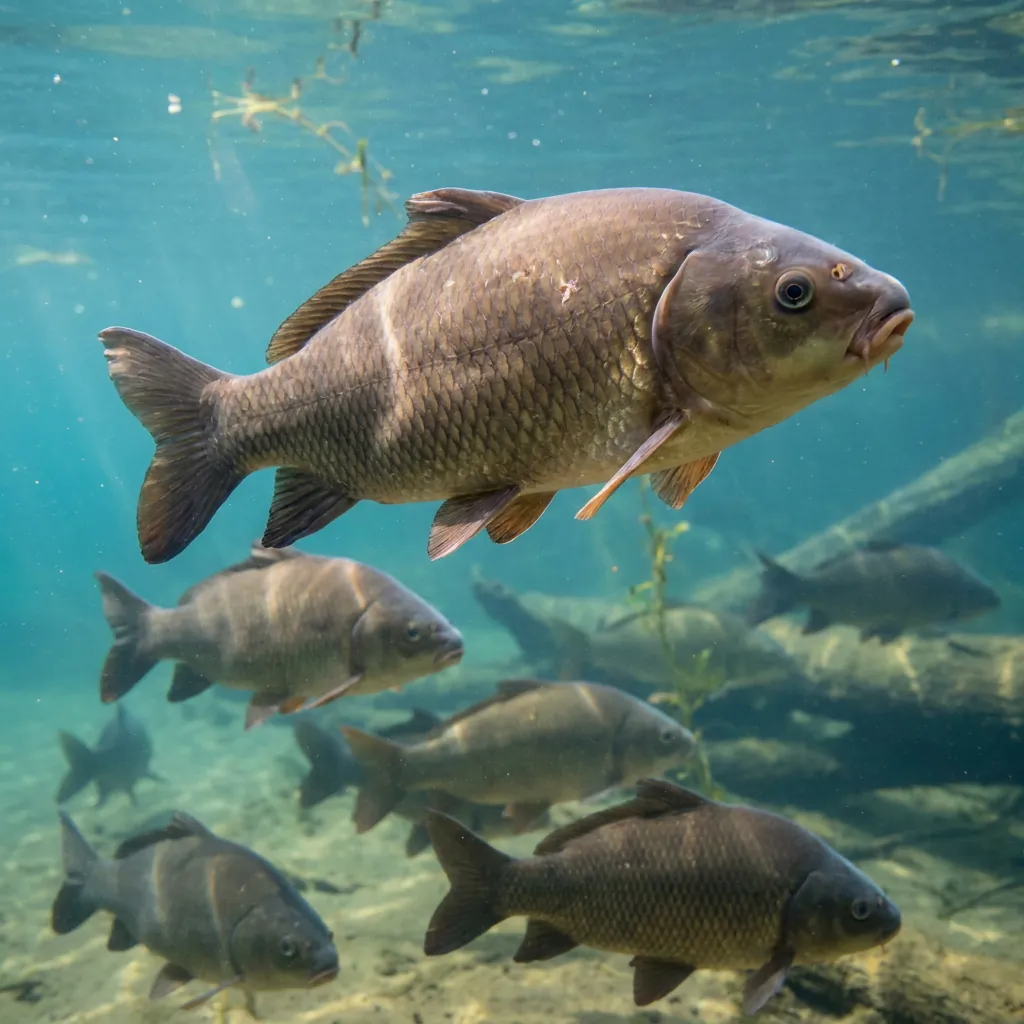
The smallmouth buffalo is a stocky freshwater fish from the Mississippi River system, built to outlast almost any fish you will meet on a dive. It can live for decades, quietly working the silty bottom of slow rivers and lakes.
Also known as: razorback, highback buffalo, humpback buffalo, thick-lipped buffalo
It can be confused with common carp, but carp have barbels near the mouth and this fish does not. It can also be confused with the bigmouth buffalo, whose mouth opens forward rather than facing down.
This fish is deep-bodied and stocky, with a hump rising behind its head. Colour runs from gray, brown, or coppery green on the back to pale yellow or white on the belly, and the fins darken toward their tips. The dorsal fin rises to a blunt point over the hump, then runs low along the rest of the back. Its mouth sits on the underside of the head, angled down to feed off the bottom, and it has no barbels (the whisker-like feelers seen on some other fish).
It lives in clear, moderate to fast-moving streams of the Mississippi River system, and sometimes in lakes and ponds. It favours spots with thick underwater plants and a silty bottom, and can tolerate hard water.
Spawning happens in spring and summer, usually in shallow stream sections where eggs can stick to plants and gravel. A female can lay a huge number of eggs at once, and neither parent guards them after they hatch. Young fish hide among plants to avoid predators. This species is known for living a very long time.
It feeds mainly by picking vegetation and other organic matter off the bottom with its downturned mouth, and scrapes algae from rocks. It also eats small animals such as zooplankton, insect larvae, mollusc larvae, and small crustaceans.
For years, scientists misjudged how long this fish lives because they were reading the wrong body parts to tell its age. Once researchers studied its earbones instead, this slow bottom-feeder turned out to be one of the longest-lived freshwater fish known.
Describe what you saw and we name it, then keep every species you find in your Oceandex.