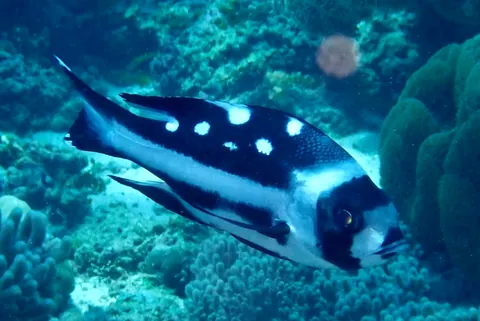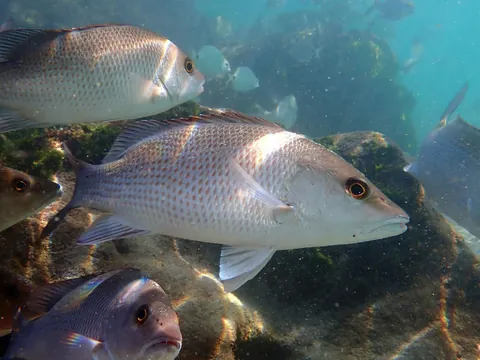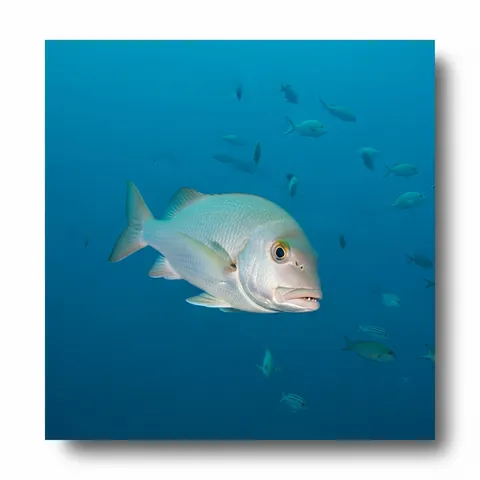
African forktail snapper
Apsilus fuscus
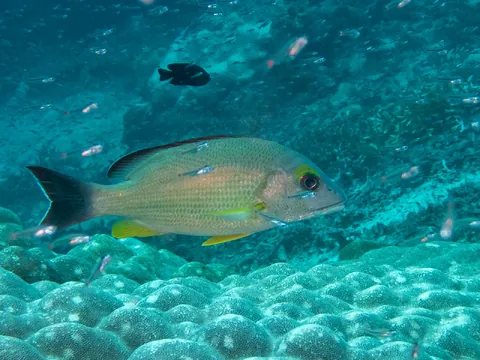
Lutjanus apodus
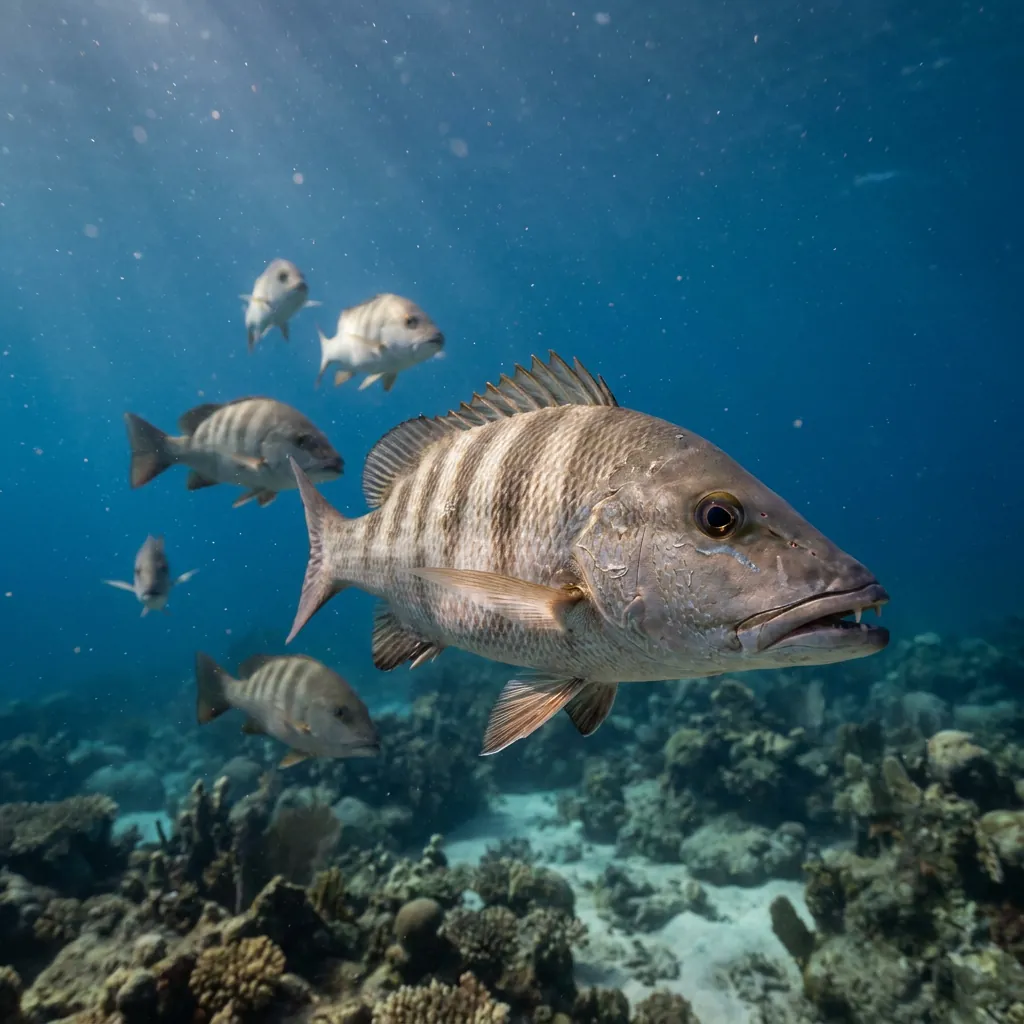
The schoolmaster snapper is a common sight on Caribbean reefs, often hanging in loose schools just off the coral. It grows to about 35 cm on average, though some reach nearly 80 cm.
Also known as: dogtooth snapper, schoolmaster, schooly
Several Caribbean snappers look similar at a glance. Check for the schoolmaster's single oversized upper canine tooth, which pokes out past the lip even with the mouth closed.
This snapper has a deep, sturdy body with a long, pointed snout and a large mouth. One upper canine tooth is noticeably bigger than the others and stays visible even when the mouth is shut. The single dorsal fin runs the length of the back with a slight notch in the middle, and the tail is only lightly forked. Colour ranges from olive-grey to brownish.
It lives on shallow, clear reefs in the western Atlantic and Caribbean, from Florida and the Bahamas through the Gulf of Mexico. Adults shelter near elkhorn and gorgonian corals, the branching and fan-shaped corals common on reef slopes. Young fish instead settle over sand or seagrass beds, sometimes in muddy areas.
By day, schoolmaster snappers gather in large resting schools, a habit that likely helps protect each fish from predators. At night the school breaks up and the fish spread out to feed, ranging further afield, often into nearby seagrass beds.
Young snappers feed mostly on crustaceans such as amphipods and crabs. As they grow, they switch to eating more fish, along with shrimp, crabs, and stomatopods, since larger jaws let them take bigger prey.
Males and females release eggs and sperm together into open water, mostly during mid to late summer. The fertilised eggs drift down and settle on the bottom unguarded. This is a slow-growing fish that can live for many years.
The IUCN lists the schoolmaster snapper as Least Concern, since it is not a major target of commercial fisheries. Still, young fish depend on mangroves and shallow reefs that are at risk from coastal building, and local threats like illegal dynamite fishing have hurt some populations.
This fish's scientific name, apoda, means "footless." The naturalist who first described it in 1792 worked only from a drawing that left out its pectoral fins, so he assumed it had none.
Describe what you saw and we name it, then keep every species you find in your Oceandex.