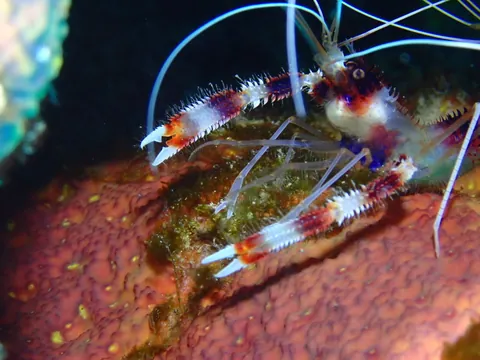
Banded Coral Shrimp
Stenopus hispidus
Lysmata amboinensis
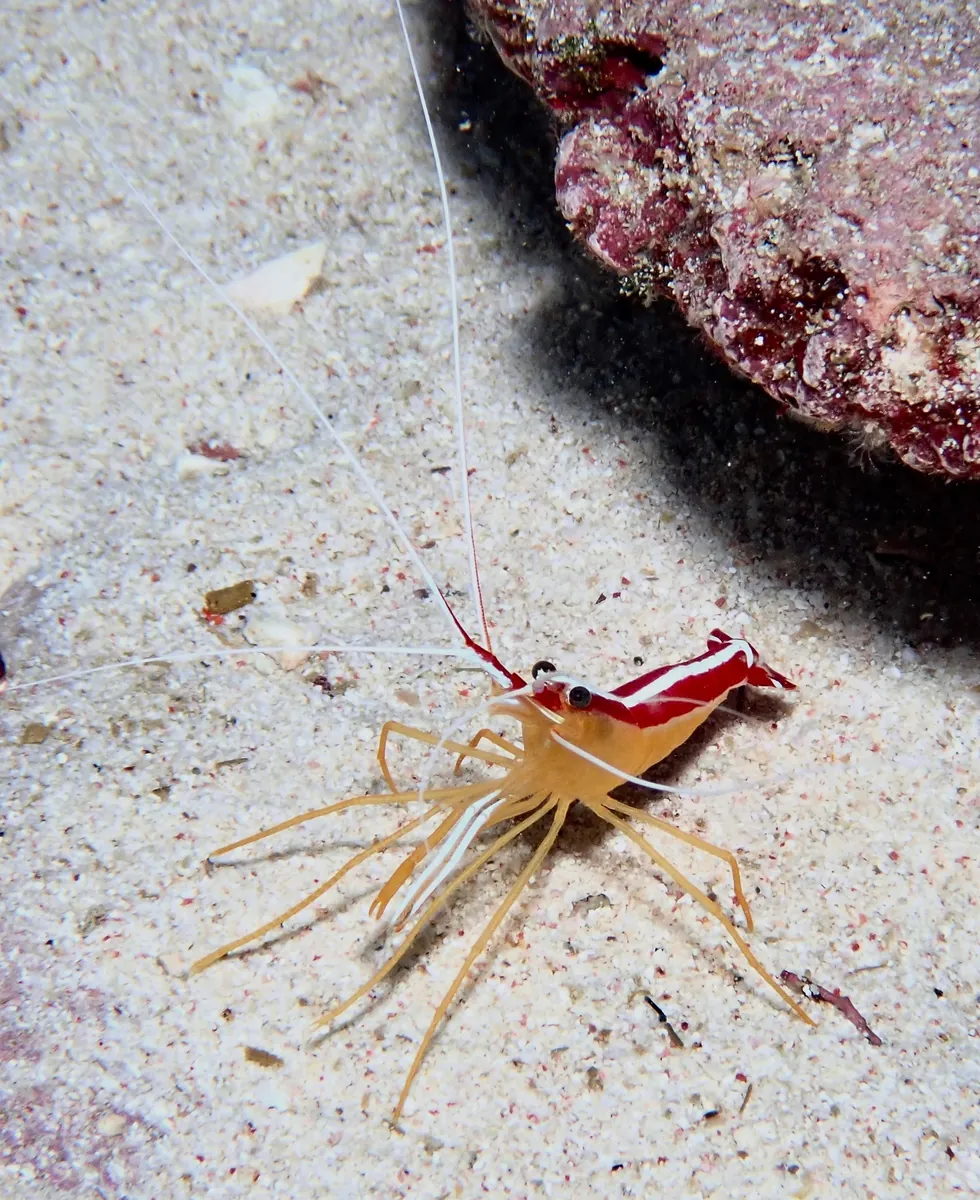
This little reef shrimp runs a cleaning business. Fish line up at its chosen spot on the reef so it can pick off their parasites and dead skin, a service both sides seem happy with.
Also known as: ambon cleaner shrimp, lysmata amboinensis, lysmata amboinensis (de man, 1888), pacific cleaner shrimp, scarlet skunk cleaner shrimp, skunk cleaner shrimp, white-banded cleaner shrimp, white-stripe cleaner shrimp
This shrimp is often sold and confused under the same name as a different species, Lysmata debelius. Its forked antennae are the mark to check for this one.
The scarlet cleaner shrimp has a pale amber body marked with long stripes: a white band down the centre of its back flanked by two wider scarlet red bands, and white spots scattered on its red tail. Its antennae are long and white. The front pair splits in two partway along, so at a glance the shrimp looks like it has three pairs of antennae instead of two. Like other shrimp, it has ten walking legs, with the front pair carrying small pincers. It also has a set of paddle-like limbs under its body, used for swimming and for carrying eggs.
This shrimp works as a cleaner, picking parasites and dead tissue off fish that visit its station. It signals that it is open for business with a side-to-side rocking dance. It usually lives in pairs rather than large groups, often sheltering in caves or reef ledges alongside a client fish such as a moray eel. In return, the eel's presence gives the shrimp protection from predators. Every shrimp starts life as a male and later becomes a hermaphrodite, able to act as either sex when it pairs up to mate.
This shrimp is thought to be colour blind, with vision too coarse to make out the bold stripes and spots on the fish and other shrimp around it.
Describe what you saw and we name it, then keep every species you find in your Oceandex.