Sand tiger shark
Carcharias taurus
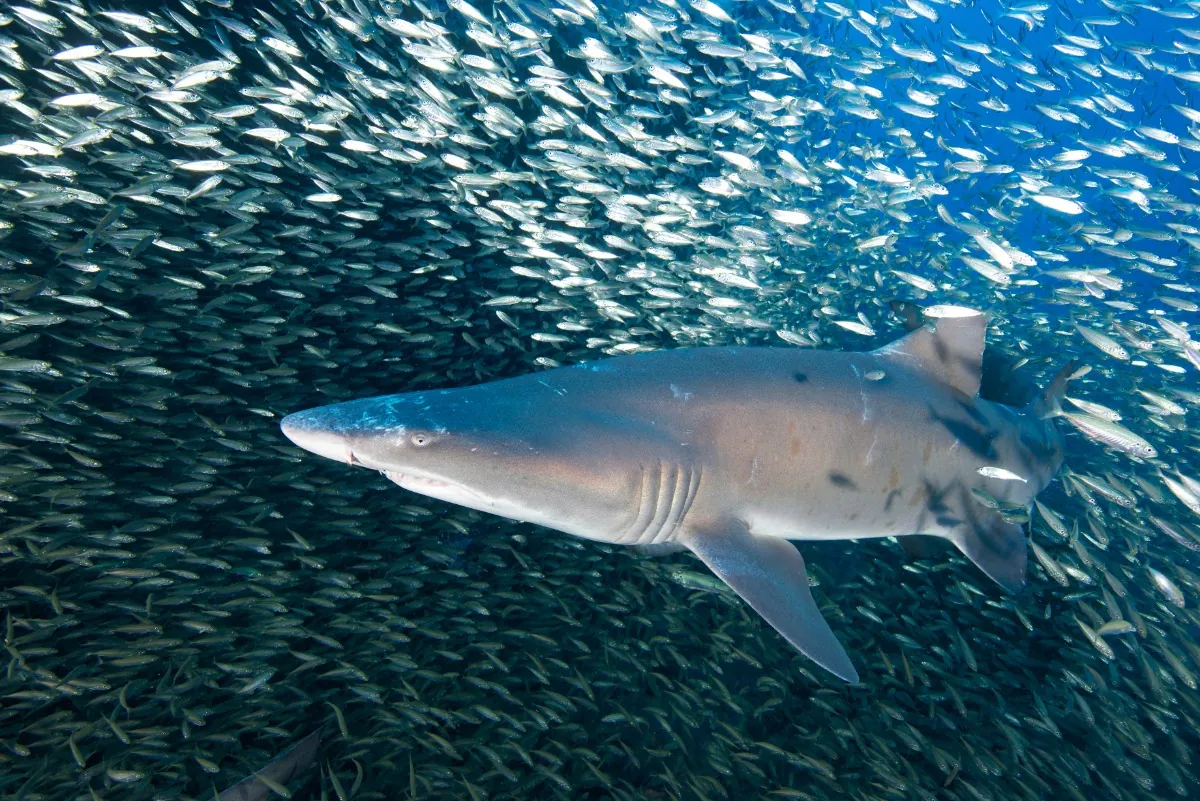
About
With its mouth often held open and three rows of jagged teeth on show, the sand tiger shark looks like the fiercest animal on the reef. In truth it is slow-moving and docile, and divers regularly share caves with it at close range. It can reach 330 cm long, though most are closer to 250 cm.
Also known as: carcharias taurus, blue nurse shark, blue-nurse sand tiger, dogfish shark, gray nurse shark, grey nurse, grey nurse shark, greynurse shark, ground shark, indian sand tiger, nuss shark, ragged tooth shark, sand shark, sand tiger, sand-tiger, sandtiger shark, shovel-nosed shark, slender-tooth shark, smalltooth sand tiger, spotted ragged-tooth, spotted ragged-tooth shark, spotted raggedtooth, spotted raggedtooth shark, spotted sand tiger shark
- Length
- 2.5 m · max 3.3 m
- Weight
- max 159 kg
- Depth
- 15–25 m
How to tell it apart
It can be confused with the rare, deep-water Odontaspis sand tigers. Check the two dorsal fins: on this species they are close in size, while the second is noticeably smaller on the deep-water species.
Appearance
It has a pointed head with a flattened, cone-shaped snout, and a stout, bulky body. The mouth extends past its small eyes, which have no eyelids, and usually stays open, showing sharp, smooth-edged teeth. Its back is grey-brown with a pale underside, and reddish-brown spots often cover the rear half of its body. It has two large dorsal fins set well back, and a long tail fin with an extended upper lobe.
Habitat
It ranges widely across the Atlantic, Indian, and Pacific Oceans, from sandy coastal waters and estuaries to rocky and tropical reefs. It lives from 1 to 191 m deep, usually between 15 and 25 m, and divers most often find it resting in sandy gutters and caves.
Behaviour
By day it tends to hover almost motionless near the seabed, sheltering under ledges, in caves, or along reefs. Some populations in South Africa and Australia make long seasonal migrations between mating and pupping grounds. It is found alone or in schools, and sometimes hunting groups gather to attack schools of smaller fish.
Diet
It feeds mainly at night, leaving its daytime shelter to hunt over the sea floor, often far from where it rests. It hunts by stealth, grabbing prey with a quick sideways snap, and eats mostly fish and other animals that live near the bottom.
Breeding
Mating happens around August to December in the northern hemisphere and August to October in the southern hemisphere. This shark reproduces slowly: females have no more than two pups at a time and breed only every second or third year.
Is it dangerous?
generally harmless despite fearsome looks — observe calmly
Conservation
This species is listed as Critically Endangered. Its slow reproduction leaves it unable to recover quickly from fishing pressure, and it has long been targeted for its fins, hide, and liver oil. It is now protected in some countries, including Australia.
Did you know?
It is the only shark known to gulp air at the surface and hold it in its stomach, using the trapped air to hover almost motionless while it hunts.
Log it in Into the Blue
Describe what you saw and we name it, then keep every species you find in your Oceandex.