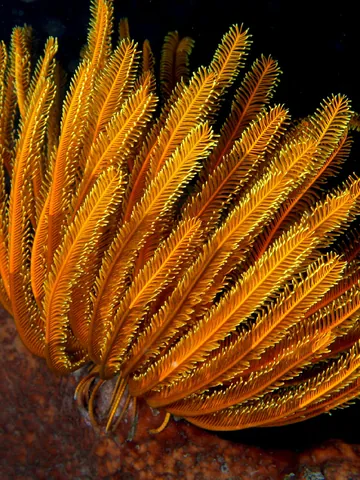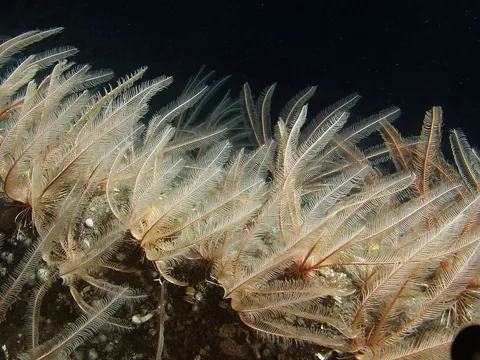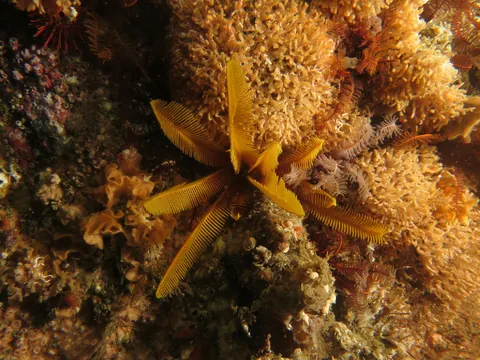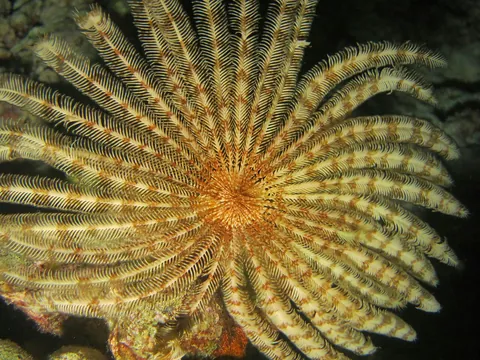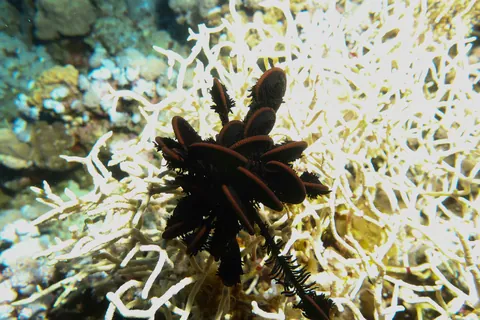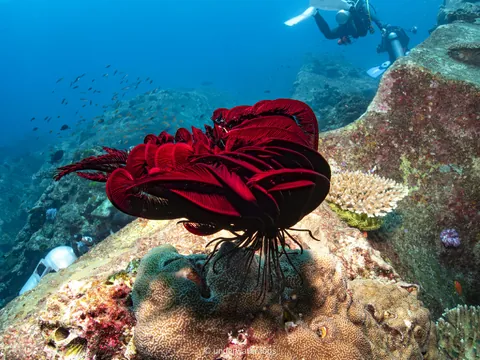
Beautiful feather star
Himerometra robustipinna
Antedon bifida
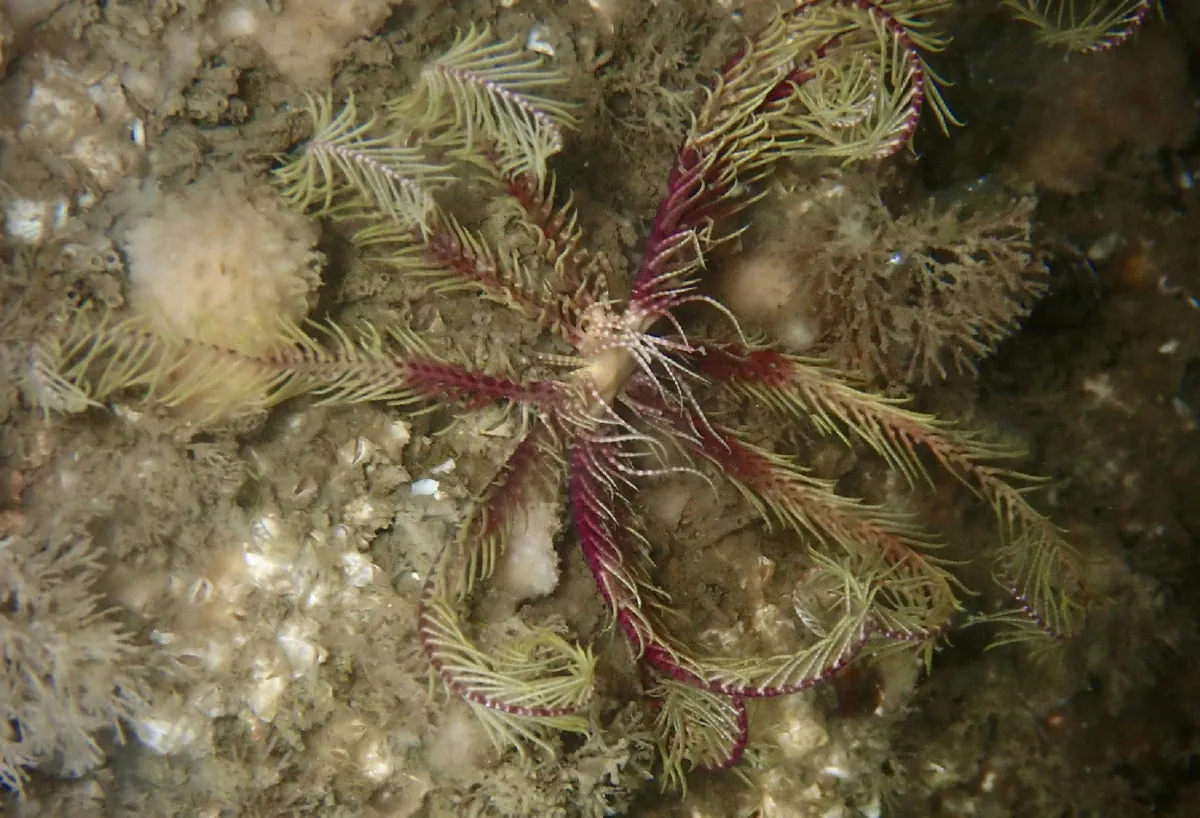
The rosy feather star is a feather star of north-west European coasts. Its ten feathery arms give it a fern-like look.
Also known as: antedon bifida, atlantic feather star, rosy feather-star, sea feather
Ten fern-like arms in yellow, pink or deep purple with paler pinnules. The similar Antedon petasus is usually larger, has up to 50 cirri, looks neater and has no ridges on the undersides of its arms.
Ten pinnately divided arms, up to 10 cm long but usually shorter, surround a concave central disc. The arms vary from yellow or pink to deep purple, sometimes spotted or blotched, and the pinnules are usually paler or white. Underneath are about twenty short, banded cirri.
It is found mainly on the coasts of north-west Europe, from the Shetland Islands south to Portugal, and has also been reported from Algeria, Tunisia, West Africa and Venezuela. It lives from the low tide mark to about 200 m, often together with other crinoids and bryozoans, in places with strong currents, and is often found in gullies.
It clings to rocks, seaweed and molluscs with its clawed cirri and can crawl around very quickly. It can also swim short distances by flapping its arms. Where it occurs it may dominate its habitat. It spawns mostly between May and July, and the female holds the developing embryos on her arms.
A suspension feeder: it catches detritus and plankton with its pinnules as they float past.
A small worm, Myzostoma cirriferum, lives on it: the feather star catches the worm larvae like food particles, and they settle in the grooves of its arms and grow up there.
Describe what you saw and we name it, then keep every species you find in your Oceandex.