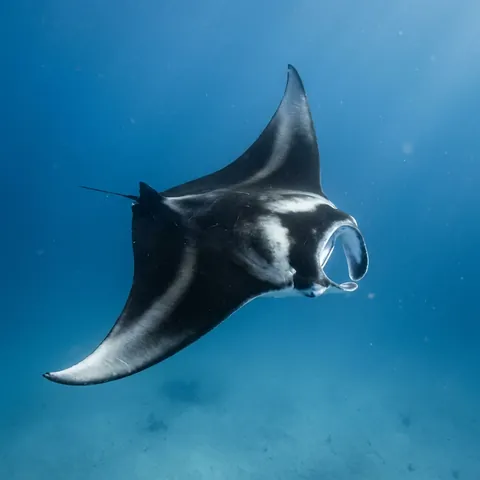
Giant Oceanic Manta Ray
Mobula birostris
Mobula alfredi
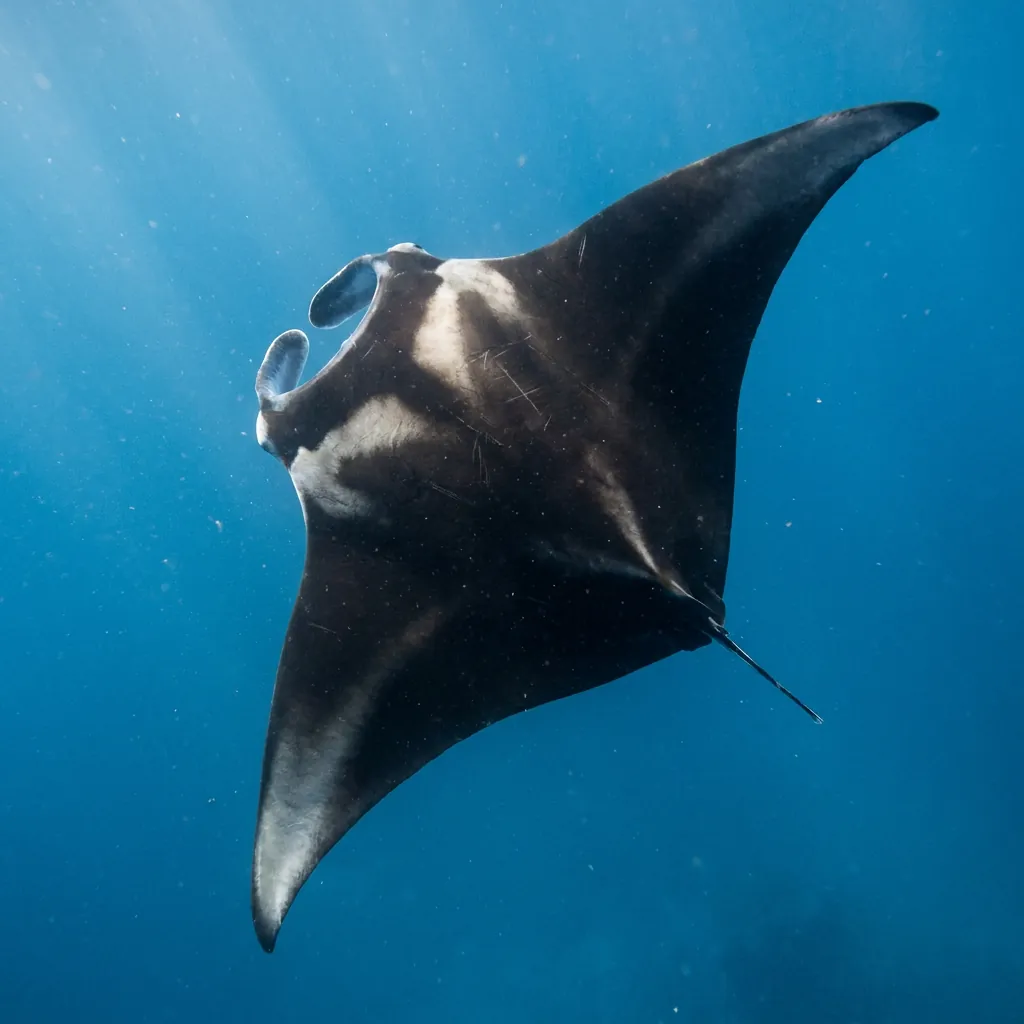
The reef manta ray is one of the largest rays in the world and one of the most wanted sightings on a dive. It is a filter feeder: it swims with its mouth open and strains zooplankton, the tiny drifting animals in the water, out of the seawater. Unlike its bigger open-ocean relatives, it keeps close to coasts and reefs. It was described as a species in 1868, but for a long time it was counted as the same animal as the giant oceanic manta ray; it was only confirmed as separate in 2009. The IUCN lists it as Vulnerable.
Also known as: alfred manta, coastal manta ray, inshore manta ray, manta ray, mobula alfredi, prince alfred's ray, reef manta ray, alfred manta, inshore manta ray, prince alfred's ray
Look at the front of the head. A manta has two soft, flexible flaps sticking forward, one on each side of the wide mouth. They are curled into spirals while the ray cruises and unroll into two broad paddles when it starts feeding. Nothing else you meet on a reef has them. The overall shape is a flat diamond with long, pointed, triangular wings and a thin tail.
The body is a huge flat disc, pressed down from top to bottom, with a big triangular fin like a wing on each side. It grows to about 500 cm across. At the front of the head are two cephalic fins, forward extensions of the wings that look like a pair of soft horns. The ray can roll these into tight spirals when swimming or spread them wide open.
Reef mantas live in tropical and subtropical waters of the Indo-Pacific, with a few records from the warm eastern Atlantic. They stay near the coast, usually within a few kilometres of land, around coral and rocky reefs, atolls, island groups, bays and coastlines where upwelling brings up rich, cold water. They are recorded from 1 to 120 m, and divers meet them in the shallow part of that range.
This is a fairly settled animal. A population tends to stay in one broad area and use the same feeding spots and the same cleaning stations, where small fish pick parasites off its skin. It makes only short moves, mostly following the zooplankton it eats. It also makes deep dives into cold water to feed. A rete mirabile, a dense network of blood vessels in the pectoral fins, is thought to help it keep warm down there. Females give birth to live young. The egg develops inside the mother, and after it hatches the pup stays in her body and feeds on a milky fluid she produces. Usually there is a single pup. It is born near the coast and stays in shallow water while it grows.
harmless to humans (no sting; keep a respectful distance)
In some places, reef manta rays have been confirmed to form social communities, so the animals around you may be long-term company for each other rather than a chance crowd.
Describe what you saw and we name it, then keep every species you find in your Oceandex.