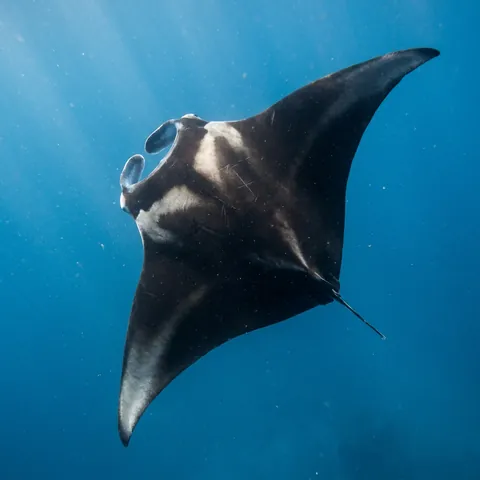
Reef Manta Ray
Mobula alfredi
Mobula birostris
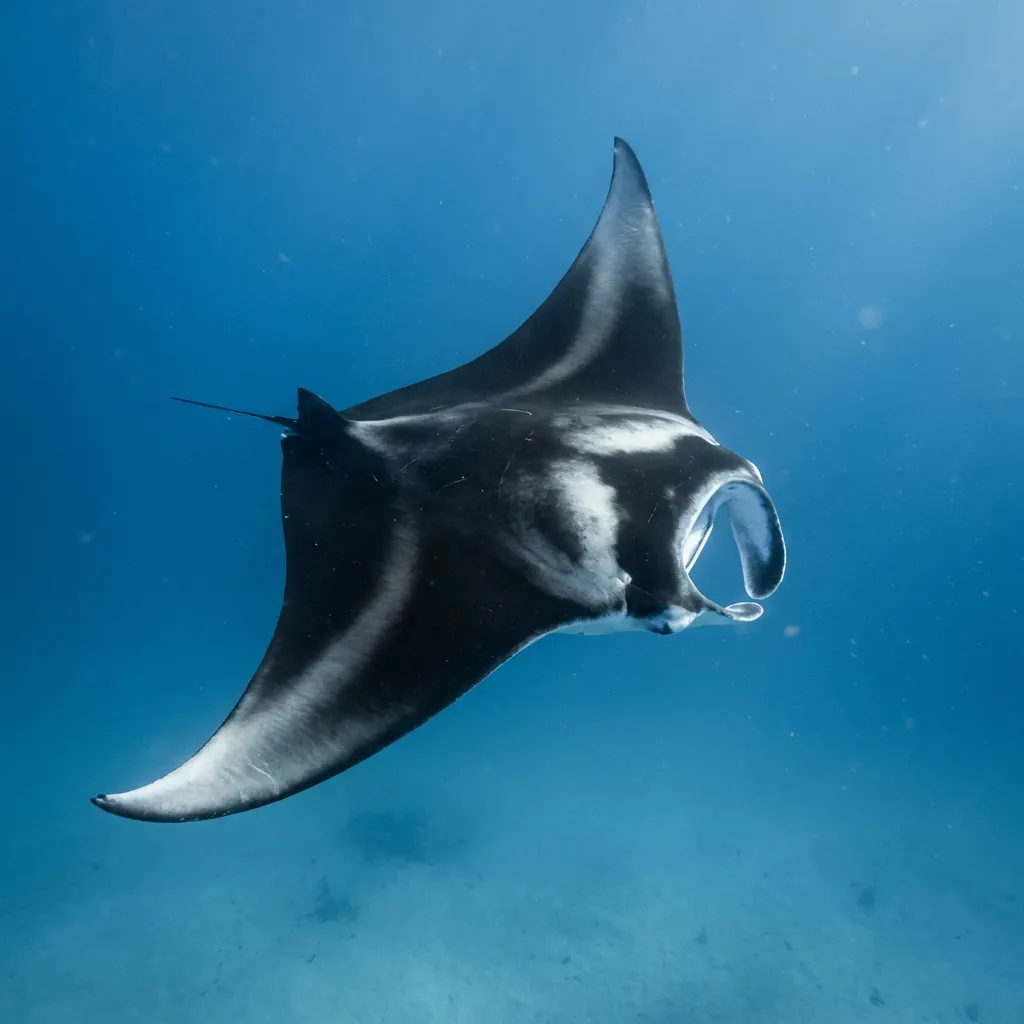
The giant oceanic manta ray is one of the largest fish in the ocean, a slow, graceful filter feeder that can grow to over 9 metres across. Meeting one on a dive, often gliding in from open water, is an unforgettable moment.
Also known as: atlantic manta, australian devilray, blanketfish, chevron manta ray, devil fish, devil ray, devil-ray, devilfish, eagleray, giant atlantic manta, giant devil ray, giant manta, giant manta ray, giant manta ray, pacific manta ray, devilfish, chevron manta, pelagic manta, oceanic manta, great devil fish, manta, manta ray, mantaray, mobula birostris, munguna, oceanic manta ray, pacific manta, pacific manta ray, pelagic manta ray, prince alfreds ray, sea devil, skeete, Manta birostris
It can be mistaken for its smaller relatives, the devil rays. Unlike them, the giant oceanic manta ray has no spine on its tail, only a small knob-like bulge at the base.
This ray is flattened top to bottom, with huge, triangular pectoral fins that form a wide disc. At the front of its head, a pair of cephalic fins, forward extensions of the pectoral fins, can be rolled into a spiral for swimming or flared open to funnel water into its wide, forward-facing mouth while feeding. It has a small dorsal fin and a long, thin, whip-like tail with a knob-like bulge at the base. Its skin is smooth, scattered with small conical and ridge-shaped bumps. The upper side is black, dark brown, or steely blue, often with a pale edge, while the underside is white, sometimes marked with dark spots and blotches. It can reach about 9 m across and weigh up to 3,000 kg, though most individuals are closer to 4.5 m across.
This is an open-ocean species that spends most of its life far from shore, drifting with currents and migrating toward areas where nutrient-rich water wells up and feeds dense plankton blooms. It is often found near offshore islands, and it also visits shallower coastal reefs, bays, and even river mouths to feed and to use cleaning stations. It occurs across tropical and temperate seas worldwide.
In open water it swims steadily in a straight line; closer to shore it often basks or cruises slowly. It may travel alone or in groups, and sometimes associates with other fish, seabirds, or marine mammals. When feeding, it circles slowly around a patch of plankton, herding it into a tight ball, then speeds through with its mouth wide open and its cephalic fins spread to channel prey inside. It also visits cleaning stations on reefs, holding almost still while small fish pick parasites from its skin.
Before mating, one or more males swim in a line behind a receptive female. During mating, a male grips the female's pectoral fin with his teeth and the pair swim belly to belly while he passes sperm to her. The fertilised eggs develop inside the female, and the pup is born fully formed and able to swim, resembling a small adult, after a long gestation.
harmless to humans (has no sting; keep a respectful distance)
For a long time, scientists assumed this species fed only on plankton near the surface. Later research showed that much of its diet actually comes from deeper water, including fish it catches well below the surface.
Describe what you saw and we name it, then keep every species you find in your Oceandex.