Indian Lionfish
Pterois miles
Pterois volitans
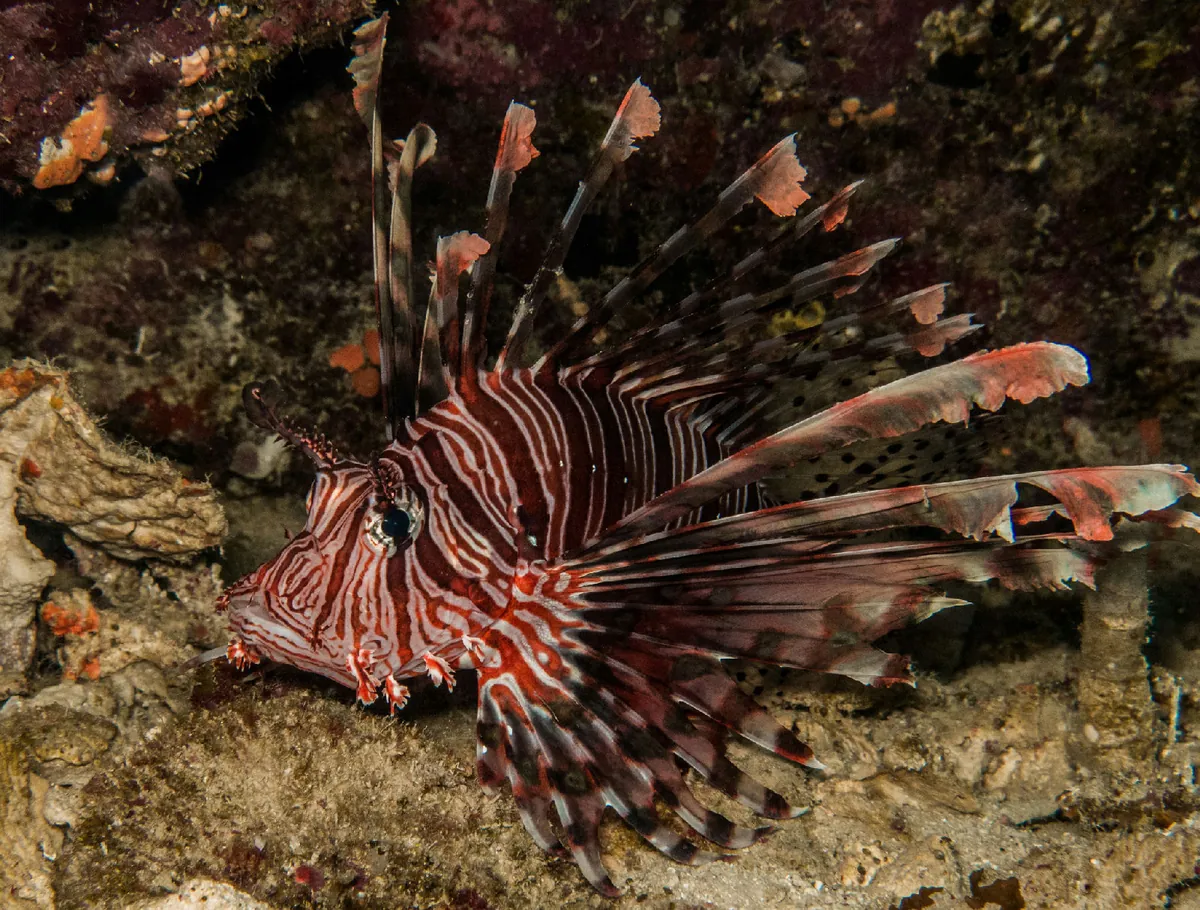
The red lionfish hides motionless by day. At night it hunts, cornering prey with a fan of oversized fins before swallowing it whole.
Also known as: pterois volitans, butterfly cod, common lionfish, featherfins, fire fish, lion fish, lionfish, ornate butterfly-cod, peacock lionfish, red firefish, scorpion volitans, scorpion-cod, scorpionfish, turkey fish, turkeyfish, zebrafish
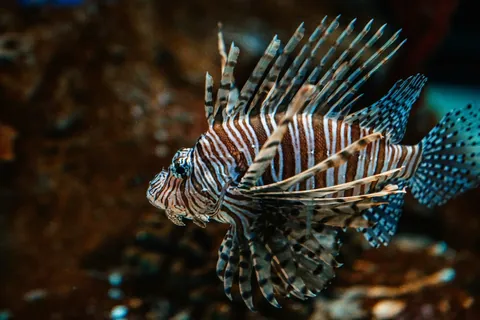
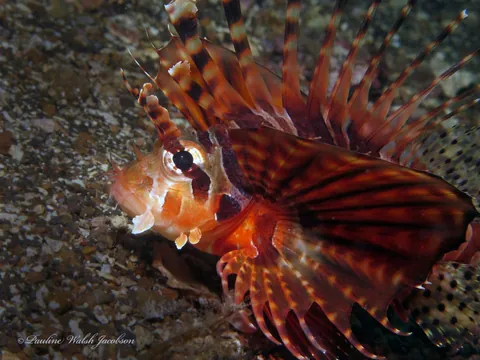
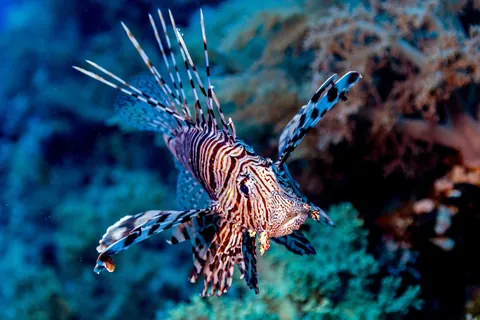
A closely related species, Pterois miles, looks almost identical and lives in an overlapping range. There is no reliable way to tell the two apart by eye underwater. Either way, the red-and-white banding plus the huge, wing-like fins are enough to know you are looking at a lionfish - and one to keep well clear of.
This fish is covered in reddish-brown to maroon bars, mixed with white stripes across its head and body. Its pectoral fins, the fins just behind the head, are large and wing-like. Long, feathery tentacles often sit above its eyes. Its dorsal spines are venomous and used only for defence. Colour can vary with habitat: fish living in murkier coastal water or estuaries tend to be darker, sometimes almost black. It grows up to 38 cm and is found from 2 to 55 m deep, in water between 22 and 28°C.
It lives on lagoon and seaward reefs, from cloudy water close to shore out to deeper reef. It is native to the Indo-Pacific, but it has now also spread to the Caribbean, the Gulf of Mexico, and the western Atlantic coast, where it is an invasive species.
By day it lives alone and mostly hides in sheltered spots, often hanging head-down and staying almost still. It becomes active from late afternoon through the night, when it hunts. It corners prey with its large fins before striking. If threatened, it swims slowly, so instead it turns its venomous spines toward the danger, even flipping upside down to do so.
It feeds mainly on small crustaceans such as shrimp and crabs, plus other invertebrates and small fish, including its own young. It hunts by herding prey into a corner with its fins, then striking fast to swallow it whole.
It mostly lives alone and only gathers to court, usually one male with several females, mainly after nightfall. Courtship involves circling, sidewinding, and one fish following or leading the other. Afterward, the female releases two floating egg masses. The male fertilises them, and a single female can lay up to 30,000 eggs in one session, with more laid during warmer months. The eggs are coated in sticky mucus that lets them stick to nearby rocks and corals before hatching.
venomous
In the Atlantic and Caribbean, where lionfish are new invaders, about 93% of the invasive population is this one species, the red lionfish, not its lookalike relative.
Describe what you saw and we name it, then keep every species you find in your Oceandex.