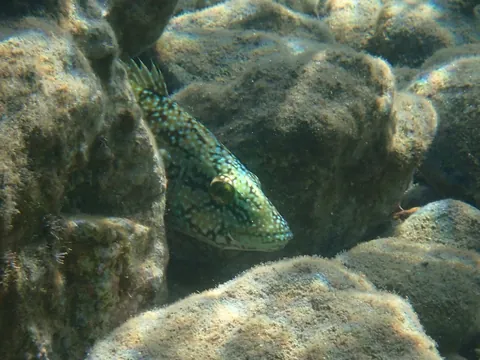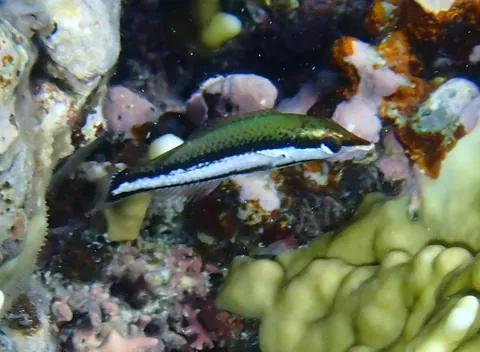
Bird wrasse
Gomphosus varius
Xyrichtys novacula
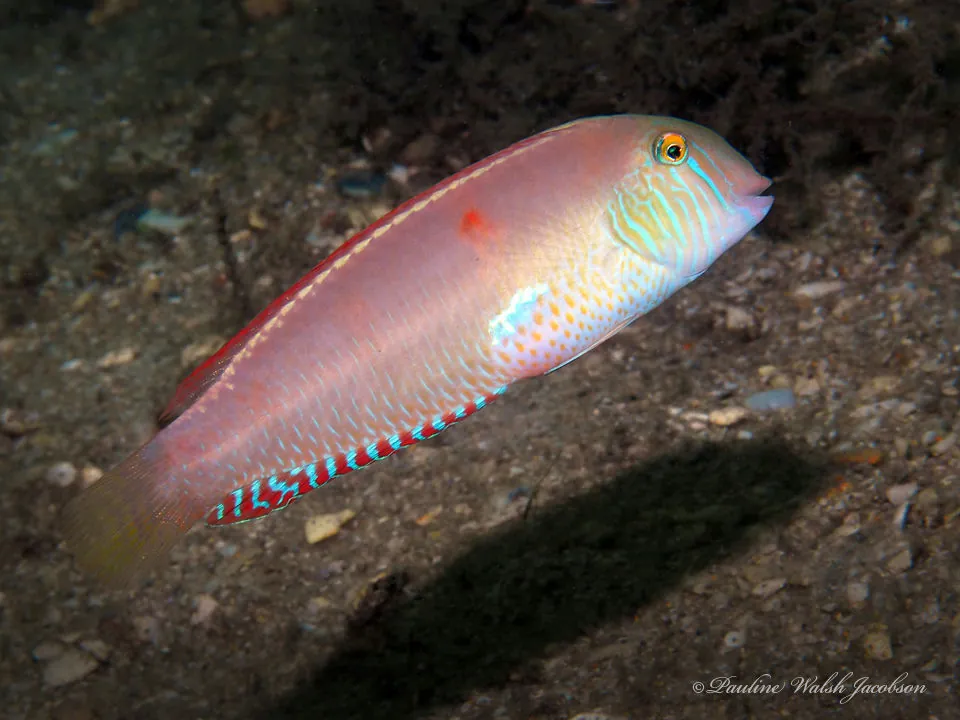
Watch a sandy patch near a reef for a moment and this fish may vanish before your eyes. The pearly razorfish, also called the cleaver wrasse, grows to about 20 cm on average, though large ones reach 38 cm, and it spends its days hovering just above open sand, ready to disappear into it in an instant.
Also known as: pearly razorfish, razorfish, cleaver wrasse, raor, Xyrichtys novacula, Xyrichthys novacula, Hemipteronotus novacula
Other wrasses on the same sand flats have a more rounded head. The pearly razorfish's steep, wedge-shaped forehead, dropping almost straight down to the snout, is the mark to check for.
This wrasse has a long, flat-sided body and a strikingly steep, blade-like forehead that slopes down to a pointed snout. Its color runs yellow-orange to reddish-pink, darker along the back and paler on the belly, sometimes broken up by faint green and grey stripes. The head carries alternating vertical lines of light blue and yellow-orange, and the scales on its belly can flash bright reflections in the light.
Look for it over clear, shallow sand and mud flats close to seagrass beds and reef edges, usually between 3 and 30 metres. It can range from just below the surface down to 90 metres, moving into deeper water in winter.
Harmless.
When startled, the pearly razorfish dives head first straight into the sand and vanishes, rather than swimming away to open water like most reef fish.
Describe what you saw and we name it, then keep every species you find in your Oceandex.