Palebelly searsid
Barbantus curvifrons
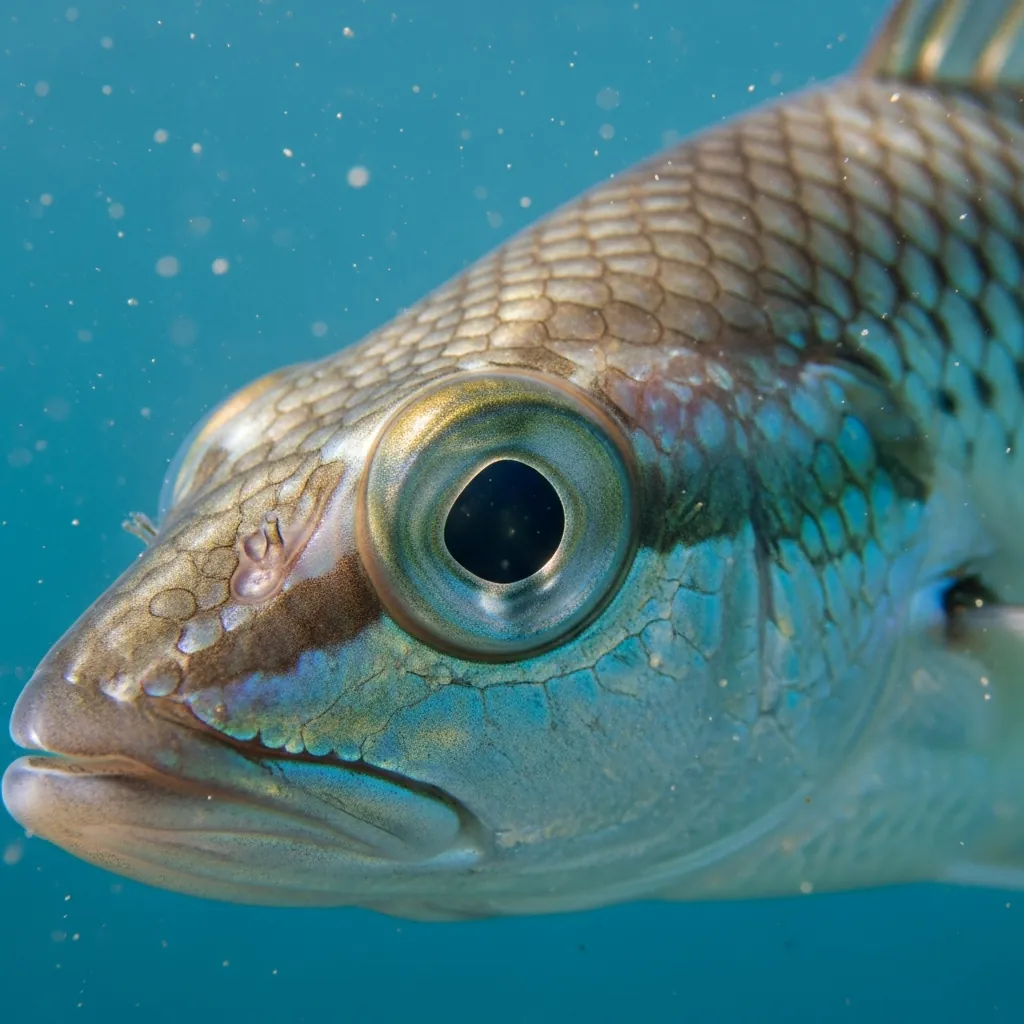
About
The palebelly searsid is a small dark fish of the deep open ocean. It reaches about 13 cm and spends its life far below the reach of divers, mostly a kilometre or more down. Almost everything about it is plain and dark, apart from one bright line of scales along the belly that gives the fish its name.
Also known as: palebelly tubeshoulder
- Length
- 13.1 cm
- Depth
- up to 4500 m
How to tell it apart
In the deep there are many plain dark fish of this size and shape, so body form will not name it. Look low along the belly: a single row of pale opalescent scales stands out against otherwise even dark colour. No other feature is needed once you see that line.
Appearance
The body is fairly long and flattened from side to side. The colour is an even dark tone over the whole fish, broken only by a row of pale, shining scales low along the belly. The small pelvic fins sit halfway along the body. The dorsal fin starts just behind them, and the anal fin starts under the middle of the dorsal fin. Near the tip of the lower jaw there is a short spine on each side, pointing outwards.
Habitat
This fish lives in open water far from the bottom, in the deep dark layer of the ocean. It is found in subtropical and tropical parts of the Indian and Pacific Oceans, and in the eastern Atlantic from the Bay of Biscay south to Angola. It is missing from the western Atlantic. Most records come from below 1000 m, and it has been taken as deep as 4500 m. Shallower catches suggest it rises a little at night and drops back by day.
Conservation
The IUCN lists the palebelly searsid as Least Concern. Its range is wide, though it does not appear to be a common fish anywhere. Fisheries have no interest in it, and the depths it lives at keep it away from most human pressure.
Did you know?
During an unusually warm run of years, this warm-water fish turned up off Greenland, far north of the range it normally keeps to.
Log it in Into the Blue
Describe what you saw and we name it, then keep every species you find in your Oceandex.