Orange Cup Coral
Tubastraea coccinea
About
This coral, often called the orange cup coral, does not build reefs on its own. Unlike most tropical corals, it has no algae living in its tissue to feed it with sunlight, so it survives by catching food from the water instead.
Also known as: red cup coral, sun coral, orange coral
- Depth
- up to 37 m
How to tell it apart
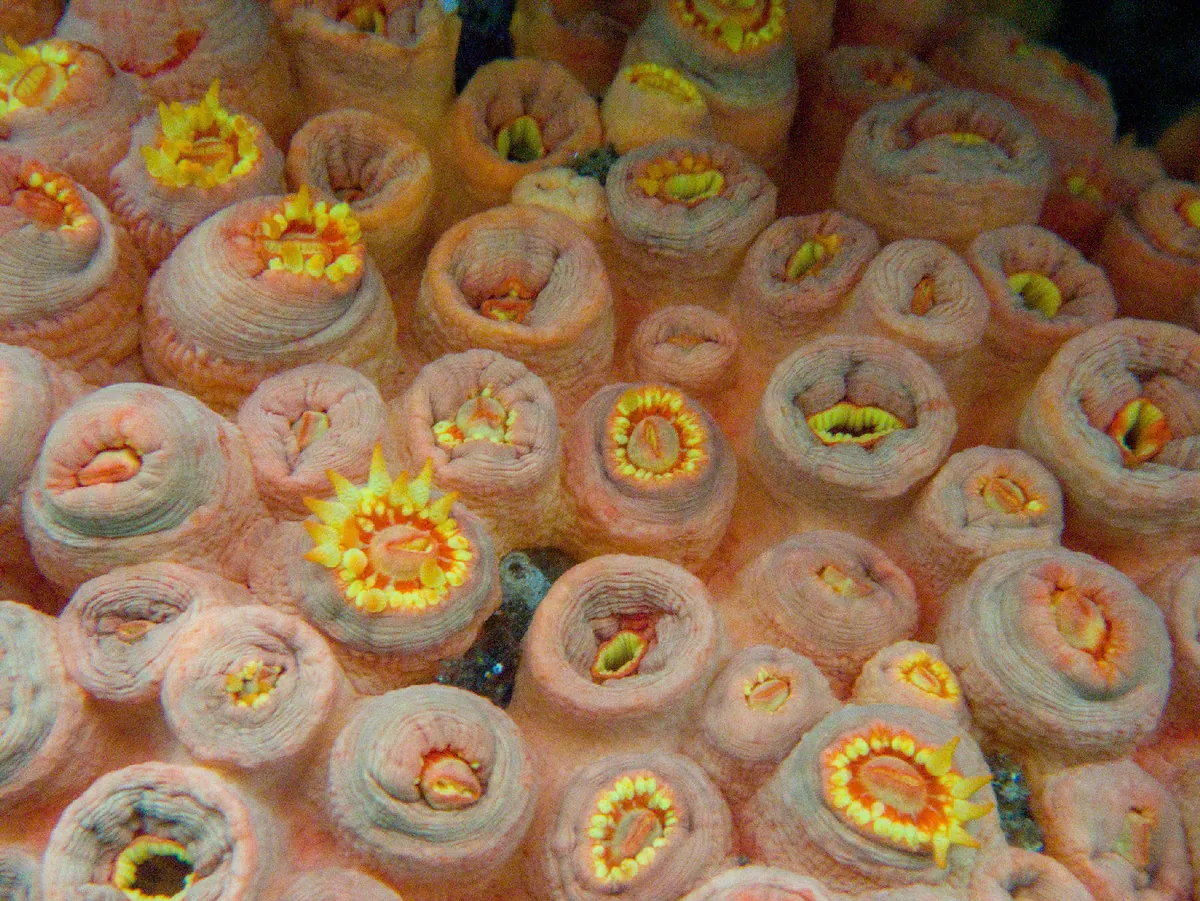
Look on shaded rock faces, cave walls, and wreck surfaces for clusters of small white cup-shaped skeletons. At night these open into bright orange or yellow tentacles; by day they close back into plain white cups.
Appearance
It grows as a colony of small cup-shaped skeletons, white with faint ribs, clumped on a common base. Each cup holds a red polyp with bright yellow-orange tentacles that reach out at night. Depending on the site, colonies can look tightly packed together in rough, shallow water or loosely spaced in calmer, deeper water.
Habitat
It grows on shaded vertical surfaces and inside caves and overhangs, including under ledges on reefs and on man-made structures such as wrecks, at depths down to about 37 m.
Behaviour
By day the polyps stay closed inside their hard cups. At night they open translucent, yellow-orange tentacles to catch drifting zooplankton, which lets this coral survive in dark spots where light-dependent corals cannot.
Did you know?
Since it does not need sunlight to feed, it can spread by clinging to ship hulls and ballast water. First found outside its native range in 1830, it has since travelled around the world this way and now grows as an invasive species on wrecks and rigs as far as the Gulf of Mexico, the Caribbean, and Brazil.
Log it in Into the Blue
Describe what you saw and we name it, then keep every species you find in your Oceandex.