Ogrefish
Anoplogaster cornuta
About
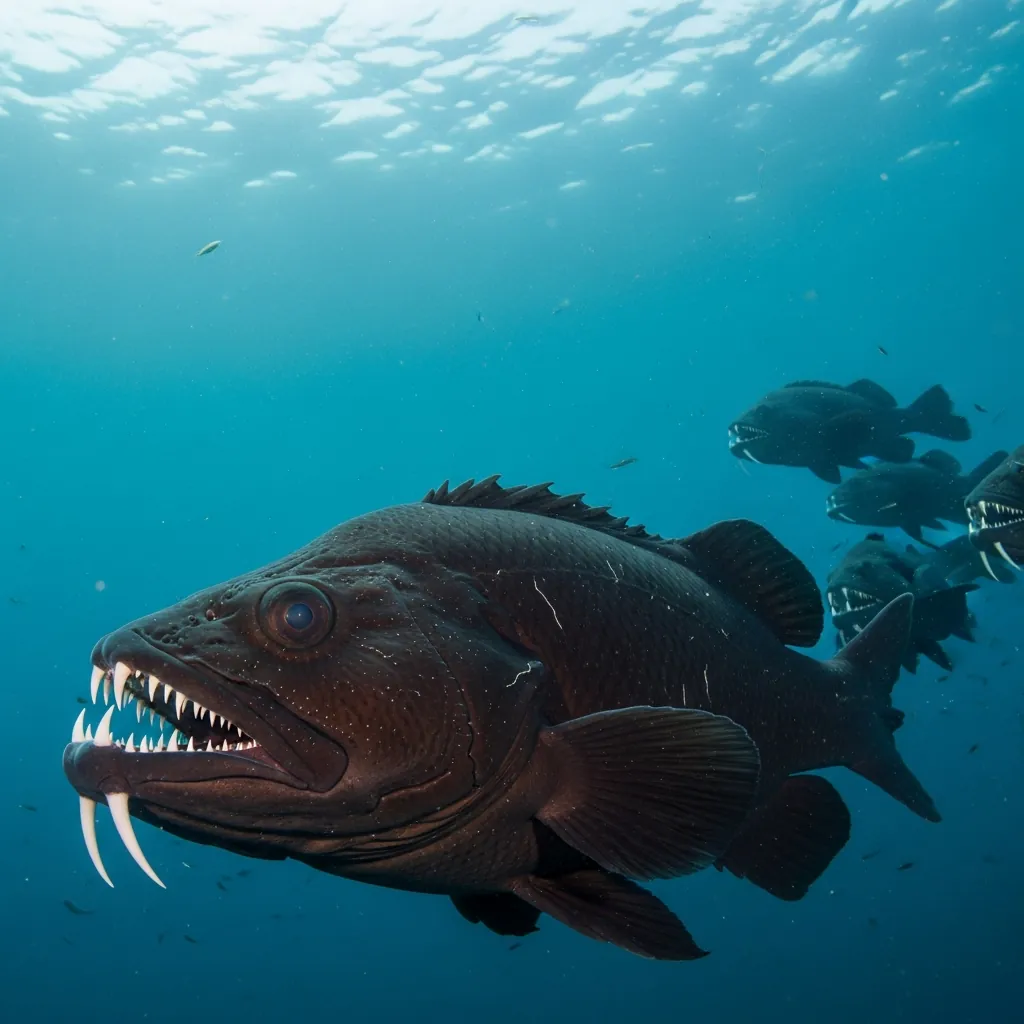
The common fangtooth is one of the strangest fish in the open ocean. It is small, under 18 cm, but the mouth is full of long sharp fangs. It lives in the dark middle waters of the sea, far below normal diving depth. Young fish look so unlike the adults that science treated them as two different animals for over a hundred years.
Also known as: common fangtooth, horned fang-tooth fish, ogrefish, fangtooth, fangtooth, horned fang-tooth fish, common fangtooth
- Length
- 18 cm
- Depth
- 500–2000 m
How to tell it apart
The main confusion is between the two life stages of the same fish, which look like different species. Check the head: adults have a bare bony head with no spines, while young fish carry several long spines there and are far paler. Body colour alone will not settle it, but the head spines will.
Appearance
Adults are dark brown to black. The head is very large, bony and finely sculptured, with a small eye set into it. The body is deepest just behind the head and then tapers fast to a narrow tail base. The jaws carry long fangs, and the skin feels grainy. The dorsal and anal fins have no spines, only soft rays. The lateral line, the sensory stripe along the side, is an open groove rather than a row of pores. Young fish are much paler and look triangular in cross section, with big eyes and several long spines on the head.
Habitat
This is an open-water fish with a worldwide range, in tropical and temperate seas of the Atlantic, Indian and Pacific Oceans. It has been recorded from 2 m down to about 4992 m. Adults usually stay between 500 and 2000 m, well below the reach of divers. Young fish live nearer the surface. There is no reef or bottom tie here, just deep open water.
Behaviour
The common fangtooth is a hunter. Young fish feed mainly on crustaceans, while adults take mostly fish, and cephalopods such as squid are also eaten. It may form schools, swim in small groups, or travel alone. Larger hunters eat it in turn, including tuna, albacore and marlin. Off the west coast of North America it seems to breed in summer. The eggs are laid in the water and the larvae drift as plankton. Growth rings in the ear bones show that the fish lives at least three years.
Did you know?
Its skin absorbs about 99.5 percent of the light that hits it, packing the dark pigment melanin into dense granules that cover almost the whole skin. That makes it close to invisible in the deep, and very hard to photograph where it lives.
Log it in Into the Blue
Describe what you saw and we name it, then keep every species you find in your Oceandex.