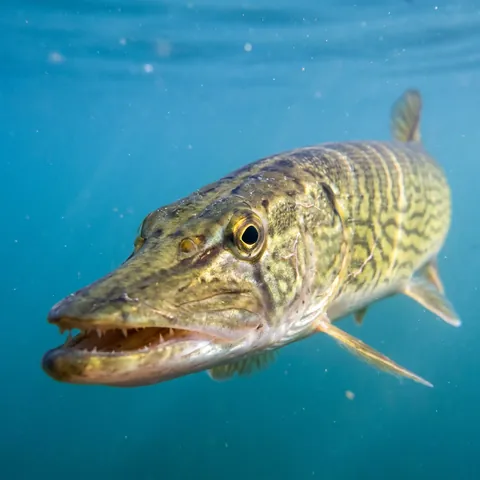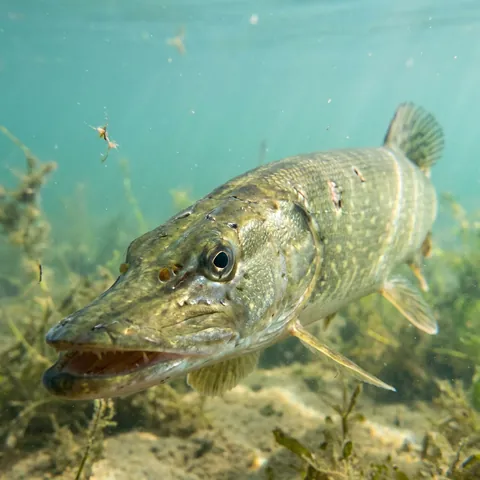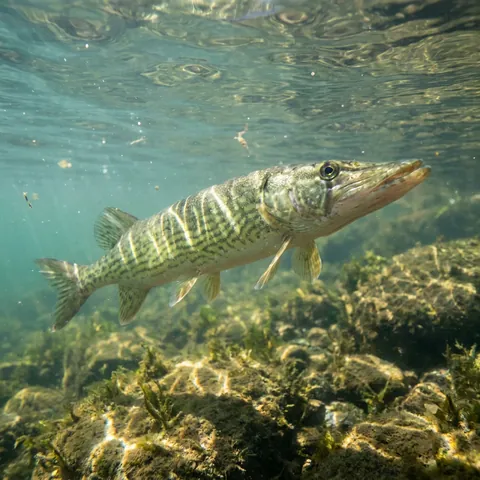
American Pickerel
Esox americanus
Esox masquinongy
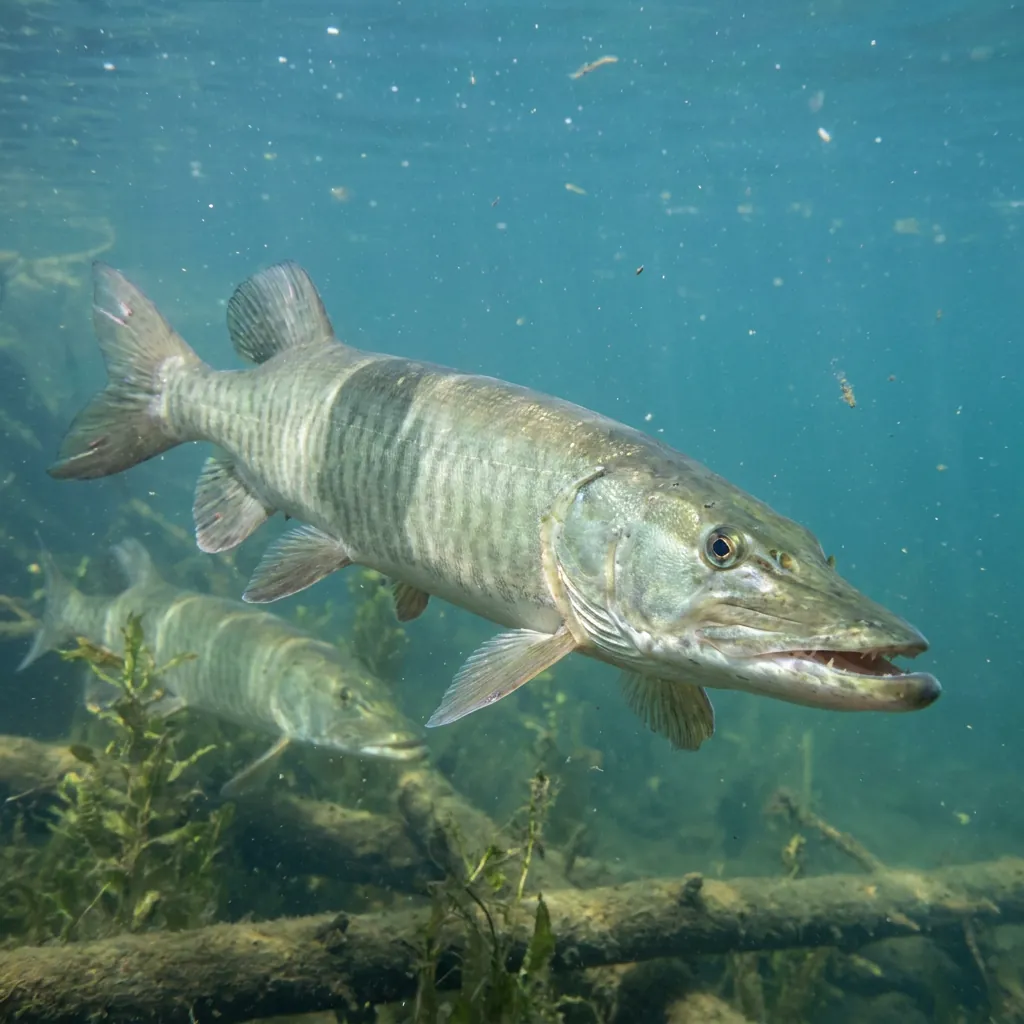
The muskellunge lurks motionless beside weeds or rocks, waiting to ambush anything that swims too close. It is one of the largest predatory fish in North American lakes and rivers.
Also known as: muskie, musky, lunge, ski, great lakes muskellunge, spotted muskellunge
Muskellunge closely resemble northern pike. The clearest sign is the tail fin: a muskellunge's fin lobes come to a sharp point, while a northern pike's are more rounded.
This fish has a long, torpedo-shaped body, a flat head, and a large mouth full of sharp teeth. Its dorsal, pelvic, and anal fins sit far back near the tail. Colour ranges from silver to brown or green, often with dark vertical stripes or spots on the flanks, though some fish show no markings at all.
Muskellunge live in clear lakes and large rivers, staying close to weed beds, rock outcrops, and other structure to rest and ambush prey. A single fish patrols both a shallow range and a deeper one, moving between them as the water warms.
Muskellunge sometimes gather in small, loose schools within a shared territory. They feed more actively around the full and new moon, when extra moonlight makes conditions feel more like daytime.
This fish is an ambush predator that strikes fast and swallows prey head first. It eats mostly other fish, including smaller muskellunge, but will also take frogs, muskrats, and even ducks.
The muskellunge's growth follows an unusually steep curve: as it gets longer, its weight increases faster than in most fish, so a slightly longer muskellunge can be noticeably heavier than expected.
Describe what you saw and we name it, then keep every species you find in your Oceandex.