Devil ray
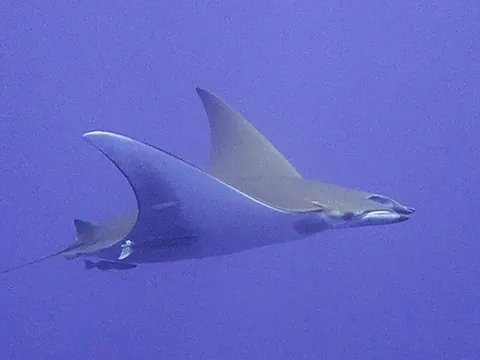
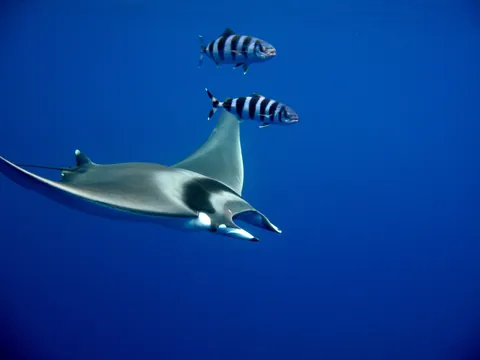
Mobula mobular
Mobula munkiana
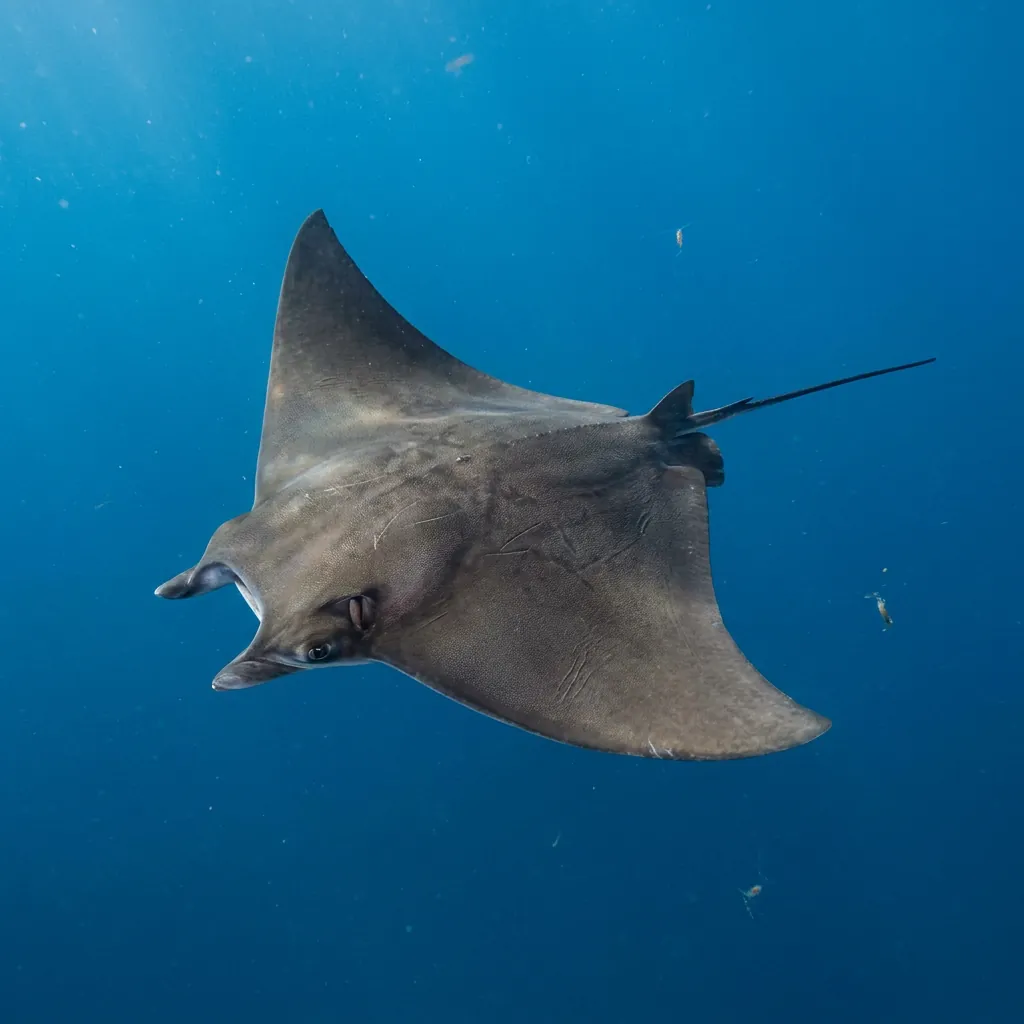
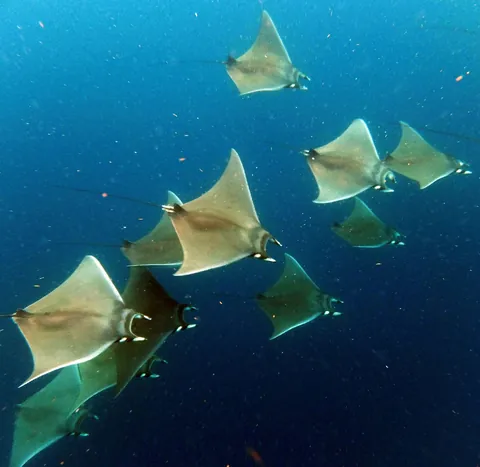
Munk's pygmy devil ray is the smallest of the devil rays, yet it often turns up in the hundreds, forming schools that glide together near the surface. Divers who find one of these schools rarely forget the sight.
Also known as: smoothtail mobula, smoothtail devil ray
It can be confused with other small devil rays. Look for the dark grey stripe crossing the front of the head like a collar, a mark other similar species do not share.
This ray has a flat, wing-like body with bulging eyes on the sides of its head and a pair of fleshy lobes at the front that help funnel food into its mouth. Its pectoral fins are wide and pointed, and a long, slender tail trails behind with no spine at the end. The upper side is lavender-grey to dark purple-grey, the underside is white, and a dark grey stripe crosses the front of the head like a collar. A small dorsal fin has a darker rim around a paler centre.
It lives in tropical parts of the eastern Pacific, from the Gulf of California down to Peru, including waters around the Galapagos, Cocos, and Malpelo islands. It stays in water no deeper than 15 metres, usually near the surface in coastal areas, though it also feeds near the seabed. It is thought to migrate, though its movements are not well understood.
It filter-feeds on plankton as it swims, mainly zooplankton, along with mysids and krill, and sometimes takes small schooling fish. Water flows into its mouth and out through the gill slits, where filter pads trap the food. It favours areas of strong upwelling, where plankton gathers close to the surface.
Mating groups form a slow, circling 'courtship vortex' that can last for hours before pairs split off to mate. A male signals interest by biting the female's pectoral fin, and an uninterested female curls her fin above her head to refuse him. Breeding runs from March to August, peaking in May. The species is ovoviviparous, producing only one pup per cycle, which develops inside the mother and is nourished first by yolk and later by uterine fluid.
This species is listed as Vulnerable. It is rarely targeted directly, but large numbers are caught as bycatch by boats fishing for other species, and its schooling habit means many can be netted at once. Its low birth rate of a single pup per cycle makes losses hard to recover from, and coastal development, pollution, and boat strikes threaten the shallow waters it uses to breed.
Before mating, groups of Munk's pygmy devil rays circle together for hours in a slow-moving 'courtship vortex', a ritual unique to this species.
Describe what you saw and we name it, then keep every species you find in your Oceandex.