Monkfish
Lophius piscatorius
About
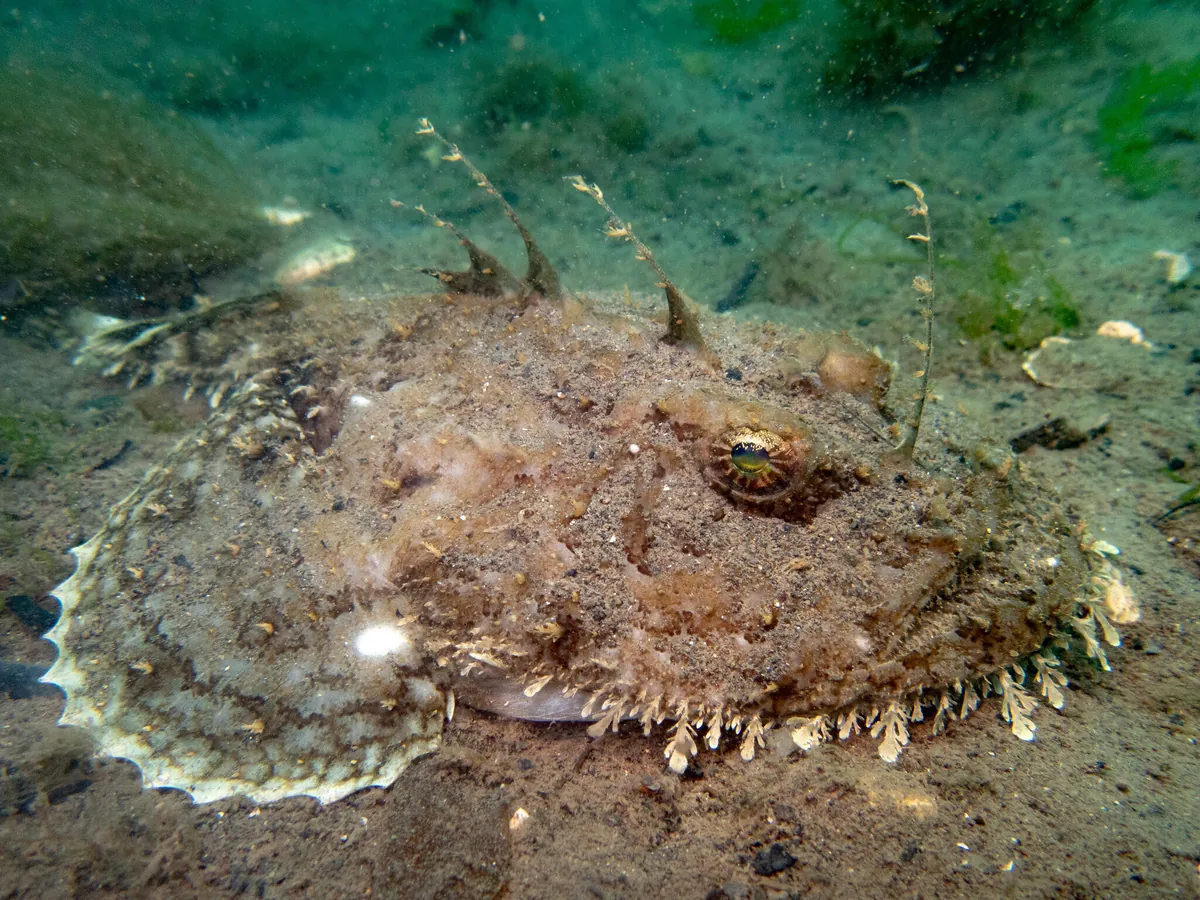
Half-buried in the sand, the monkfish looks like nothing more than a lump of seabed until its jaws snap shut. This ambush hunter can grow to 200 cm and weigh close to 58 kg.
Also known as: lophius piscatorius, angler, angler fish, angler(=monk), anglerfish, monk
- Length
- 1 m · max 2 m
- Weight
- max 58 kg
- Depth
- up to 1000 m
How to tell it apart
It is easy to swim right past this fish, since it looks like part of the seabed rather than an animal. The one giveaway is the fishing-rod lure on top of its head, something no other bottom-dwelling fish here carries.
Appearance
The monkfish has a huge, flat, broad head that makes the rest of its body look like an afterthought. Its wide mouth rings almost the whole front of the head and is lined with long, sharp teeth that angle inward to stop prey from backing out. The pectoral and pelvic fins are stiff and limb-like, letting the fish shuffle along the bottom. Fringed, frond-like flaps of skin around its head and body, along with a colour that matches its surroundings, help it vanish against sand or weed. It has no scales. On top of its head sits a thin, movable filament tipped with a fleshy lure.
Diet
The monkfish lies still, half-buried in sediment, and waggles the lure on its head to draw fish within striking range before swallowing them whole. Adults eat mostly fish, while younger monkfish feed more on invertebrates. Its stomach can stretch enough to take in prey nearly as big as itself.
Breeding
Females release a single huge sheet of clear, jelly-like egg mass that drifts freely near the surface, carrying each egg in its own tiny pocket. One spawning can produce between 300,000 and 2,800,000 eggs. Most spawning happens between February and June, with a smaller second season in November and December. Males mature at four years old, at around 40 cm long; females take two more years to mature.
Is it dangerous?
harmless
Did you know?
In 1940 one was found with a herring gull in its stomach; monkfish are known to surface and snatch seabirds resting on the water.
Log it in Into the Blue
Describe what you saw and we name it, then keep every species you find in your Oceandex.