Marbled Shrimp
Saron marmoratus
About
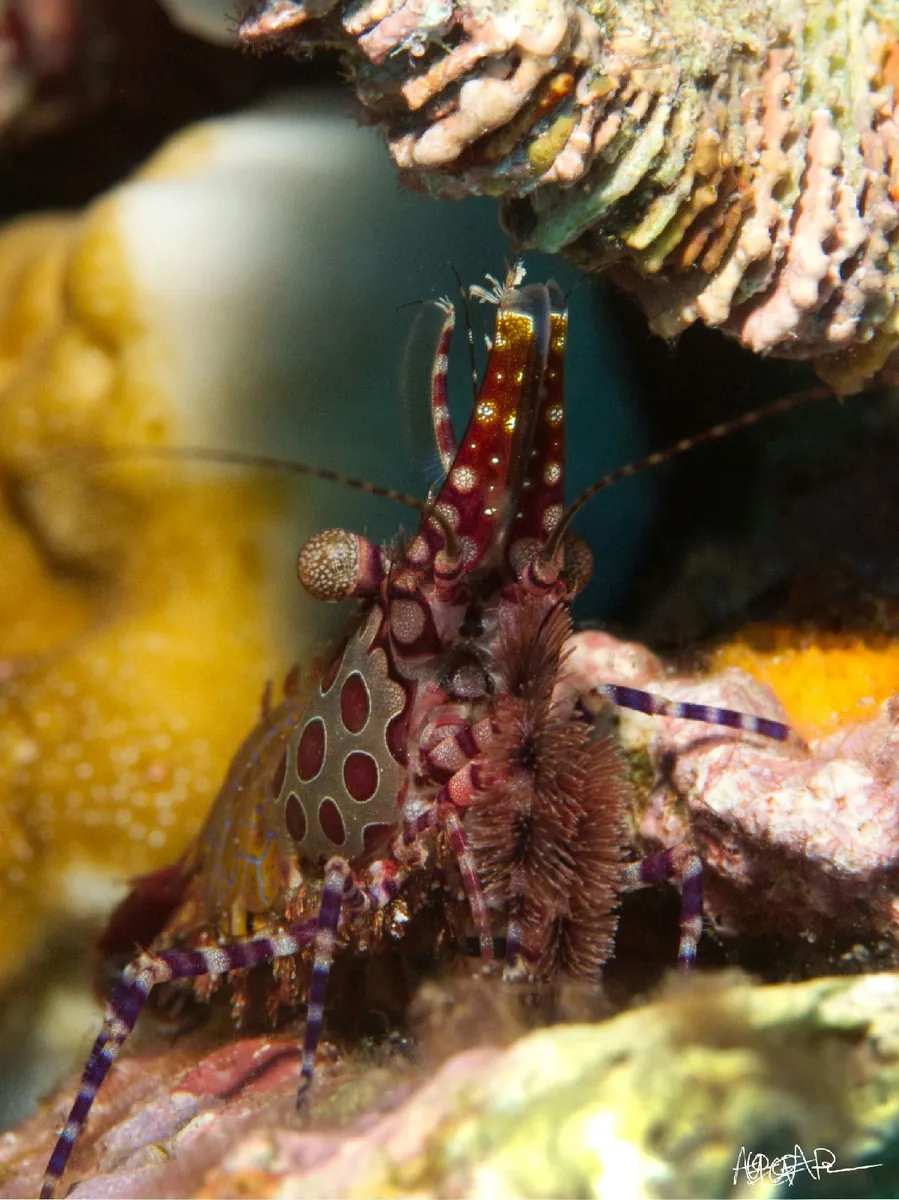
A shaggy, hunch-backed shrimp that hides in plain sight among coral rubble, changing its look with the light and using a set of oversized claws to signal it is a male.
Also known as: common marble shrimp
- Depth
- up to 17 m
How to tell it apart
The male's pair of claws, longer than its entire body, is the clearest identifying feature. Females lack these long claws but show a distinctive brush-like tuft of hairs on their first walking legs instead.
Appearance
A hunch-backed shrimp with a long, strongly curved rostrum (the spiked snout between the eyes) lined with spines, and more spines along the carapace. Tufts of bristly hairs cover the back and abdomen, denser on females. Males carry a pair of long claws, longer than their whole body, while females instead grow a brush-like tuft of hairs on their first pair of legs. Ground color is variable, red, blue, or brown, often mottled with brown or green, with the legs crossed by blue or brown bands.
Habitat
Lives in the Indo-Pacific from the Red Sea to Madagascar and Mozambique, east through the Persian Gulf and southeast Asia to Australia and Hawaii, and has more recently spread into the Mediterranean off Lebanon. It shelters among coral and coral rubble in lagoons, from about 1 to 17 m deep.
Behaviour
Mostly inactive by day, relying on camouflage against the encrusted rubble it sits on. It is nocturnal and turns mostly red at night, blending into the twilight. An omnivore, it sifts the sand after dark for detritus and plankton, and will scavenge dead fish or feed on coral polyps. If threatened it slips quietly into a hiding place, or shoots off fast if truly alarmed.
Did you know?
In 2013 this Indo-Pacific shrimp turned up off the coast of Lebanon, having likely swum through the Suez Canal from the Red Sea into the Mediterranean.
Log it in Into the Blue
Describe what you saw and we name it, then keep every species you find in your Oceandex.