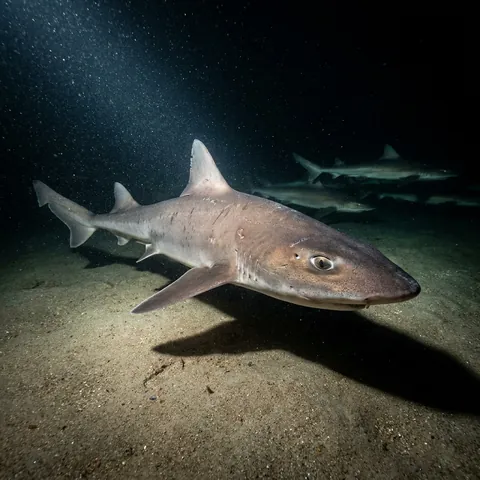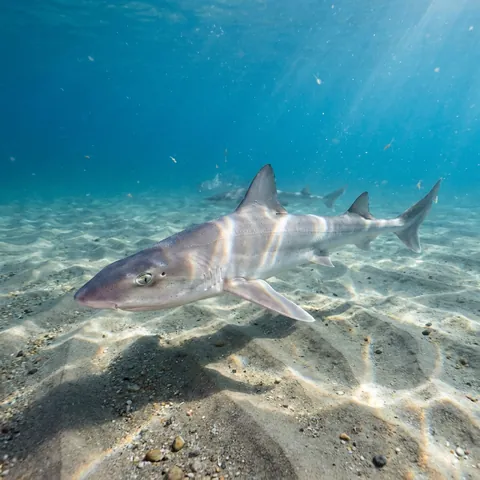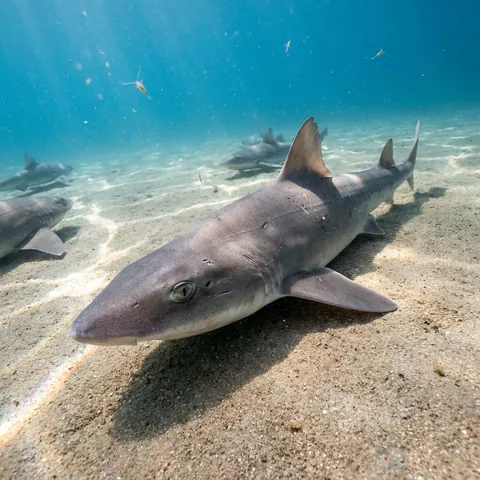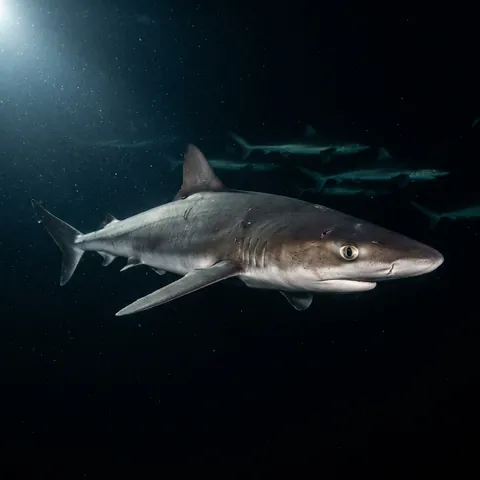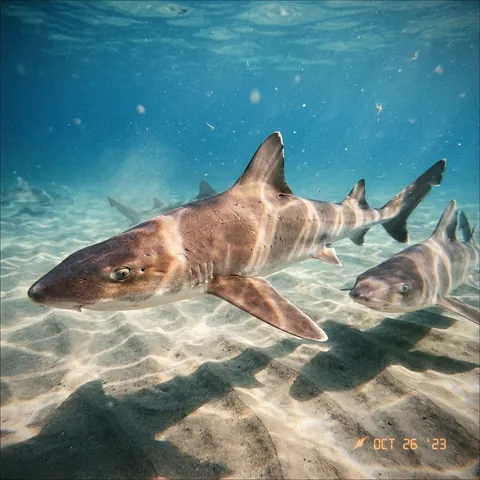
Brown Smooth-hound
Mustelus henlei
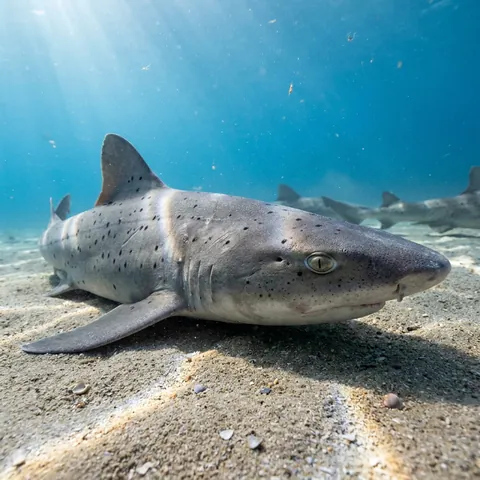
Triakis semifasciata
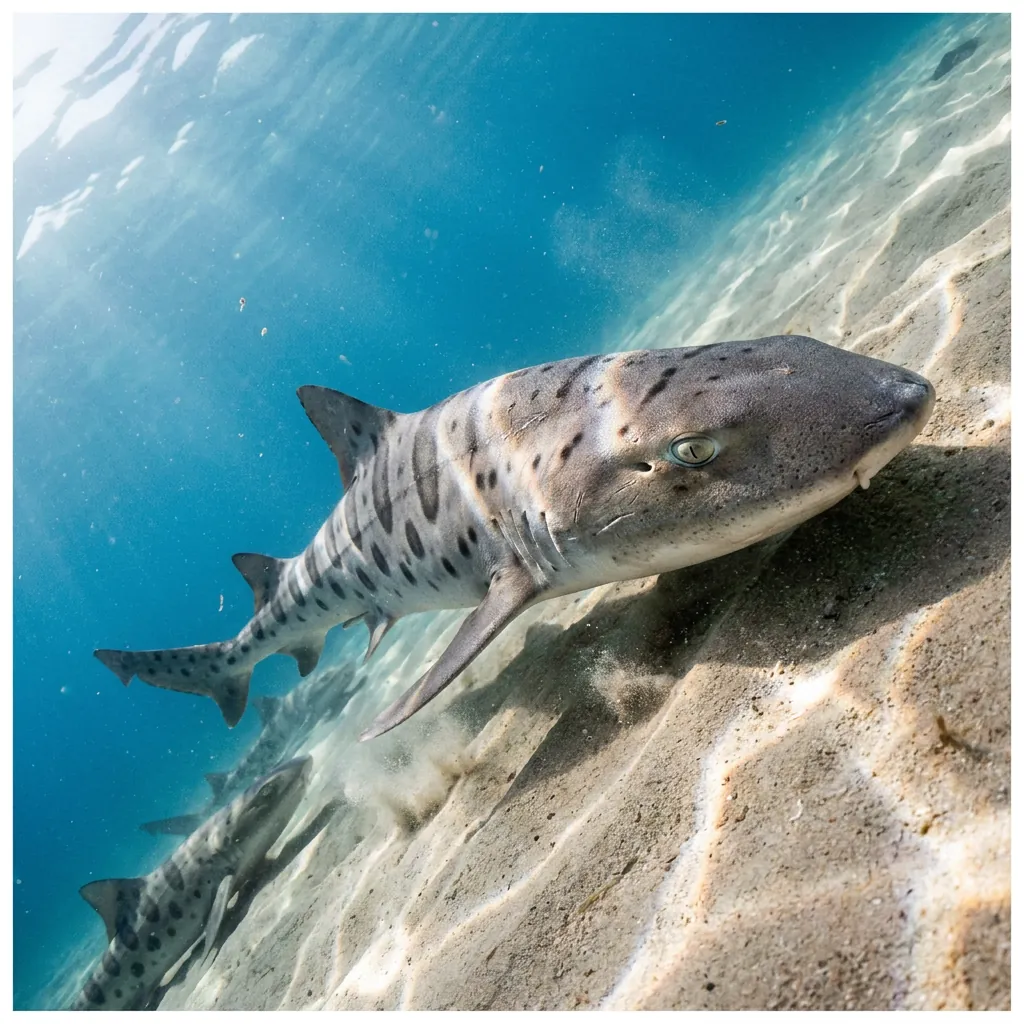
The leopard shark is a common, harmless sight in the shallow bays of the Pacific coast, easy to spot by its bold black markings. It grows up to 198 cm long, with most adults closer to 160 cm.
No other shark sharing these coastal waters carries this saddle-and-spot pattern; the markings alone are enough to confirm the species.
This shark has a moderately stout body and a short, rounded snout, with large oval eyes protected by a third eyelid. Its most striking feature is its colouring: prominent black saddle-shaped markings and large black spots run along its back on a silvery to bronze-grey background, with a plain whitish underside. The first and second dorsal fins are both large, and the pectoral fins are wide and triangular.
It lives in the northeastern Pacific, from Oregon down to Mexico, including the Gulf of California. It favours muddy or sandy flats in enclosed bays and estuaries, but also turns up near kelp beds, rocky reefs, and the open coast. It swims close to the bottom, usually in water 6 m deep or less, though it can range down to 156 m. Many northern sharks leave for warmer water in winter and return in spring.
An active swimmer with a strong side-to-side motion, the leopard shark is more active at night, though it will also lie still on the bottom during the day. It often follows the rising tide onto mudflats to forage, then retreats just ahead of the water to avoid being stranded. It forms large schools split by age and sex, sometimes mixing with smoothhound sharks and spiny dogfish, and these groups can appear in an area and vanish again within hours. In summer, groups of mature females gather in warm, shallow bays by day and scatter into deeper water at night.
This shark is an opportunistic feeder, eating crabs, shrimp, small bony fish, fish eggs, and clams, along with worms and the young of other sharks and rays. It sometimes swallows eelgrass or algae by accident while feeding. It hunts by expanding its mouth into a suction tube, then thrusting its jaws forward to grip prey.
Leopard sharks have been found with stomachs full of clam siphons, which they grip and then lever out of the shell with a twist of the body, sometimes tearing the whole clam free.
Describe what you saw and we name it, then keep every species you find in your Oceandex.