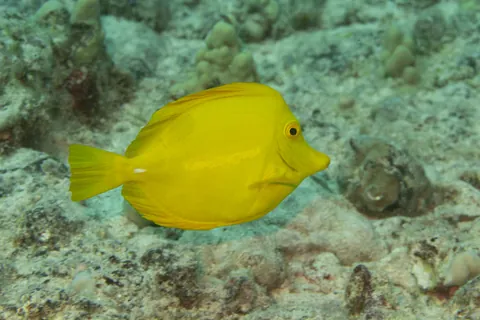
Yellow tang
Zebrasoma flavescens
Zebrasoma desjardinii
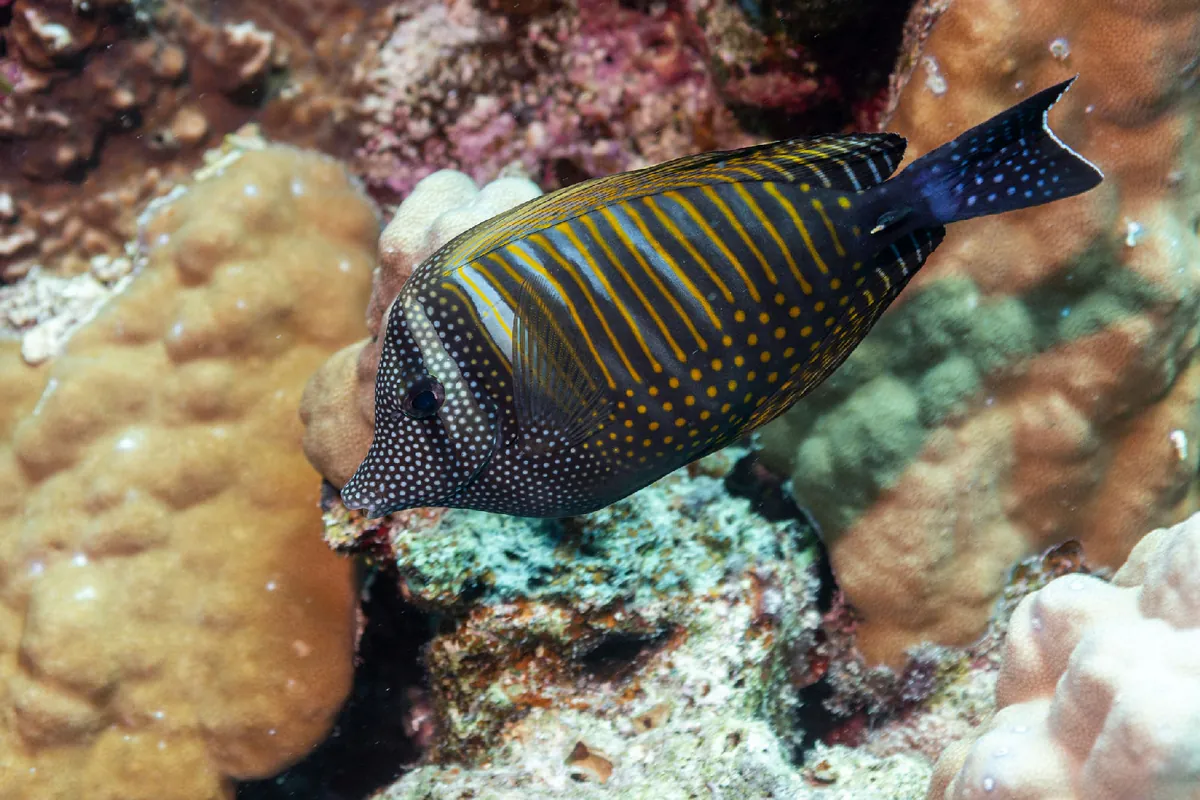
The Indian sailfin tang carries its name well: its dorsal fin rises tall like a sail, catching the eye long before the rest of its bold striped body does. It grows up to 40 cm, usually seen a little smaller, cruising reef slopes in pairs.
Also known as: red sea sailfin tang, desjardin's sailfin tang
Other tangs in this family also carry a tall, sail-like dorsal fin, but the combination of orange-lined dark bars on the body and the two dark bars crossing the head, one running through the eye, is a distinctive pattern for this species.
This tang has a deep, flattened body and an unusually tall, sail-like dorsal fin. Its mouth protrudes slightly, with a concave curve along the snout. The body is grey, crossed by around eight dark grey vertical bars, each containing a few thin orange or yellow lines that break into small spots lower on the body. Two dark brown bars cross the head, the first one running straight through the eye. A dense scatter of small, pale yellow spots covers the head and body, with a similar spotted pattern on the dorsal fin, and the tail fin carries pale blue spots. Young fish look different: they show slimmer grey and yellow bars on the body and only two black bars on the head. On the base of the tail sits a sharp, retractable spine used for defence.
It lives on lagoon and seaward reefs, generally between about 3 and 30 m deep. Juveniles tend to stay in more sheltered spots within the reef, while adults move out onto more open reef areas.
Adults are usually seen in pairs, while juveniles live alone. This tang feeds mainly on filamentous algae and other seaweed types, along with plankton, and sometimes gathers with others of its kind to feed on algae together.
In the Red Sea, this tang has been seen feeding on moon jellies and comb jellies, an unusual choice for a fish that normally lives on algae and plankton. A local predator, the slingjaw wrasse, has even been seen darkening its own colour to blend into feeding groups of this tang so it can sneak up on prey undetected.
Describe what you saw and we name it, then keep every species you find in your Oceandex.