Lionfish
lionfish
Pterois miles
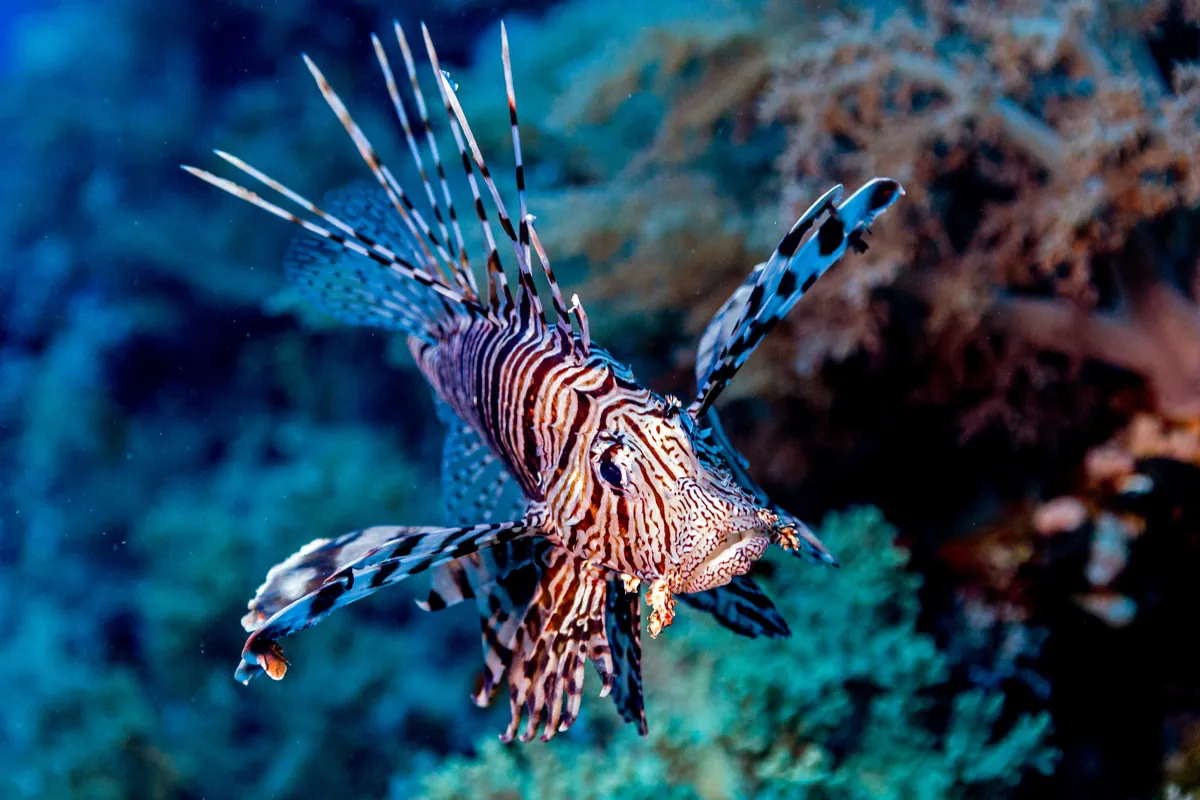
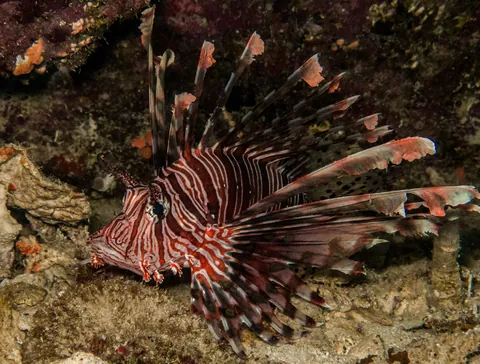
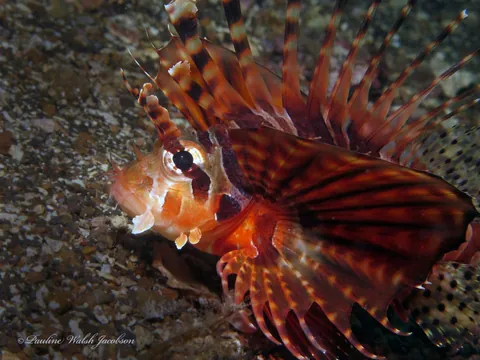
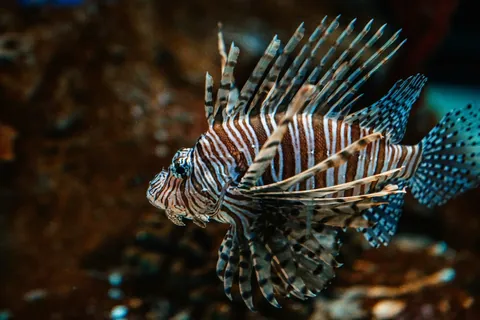
The Indian lionfish, or devil firefish, is a slow-moving reef predator with long, feathery fins and highly venomous fin spines. It has been recorded down to 85 m. It hides by day and hunts fish and small crustaceans, and it looks so much like the red lionfish that the two are often mixed up. A sting is very painful and is rarely but not never fatal, so never touch or corner one, and get medical help at once if you are stung.
Also known as: common lionfish, devil firefish
This species is a near-twin of the red lionfish and the two are routinely confused. The one physical mark that tells them apart is head shape: this species has a noticeably less angular head.
The colour ranges from reddish to tan or grey, and the head and body are crossed by many thin dark bars. The fin along the back is split into long spines that stand almost free of any skin, so the fin looks feathery. The pectoral fins, the paired fins behind the gill covers, are enlarged and wing-like, and their rays are free of skin along the outer half or more, so they fan out like separate fingers. A skin tentacle grows above each eye and may be faintly banded. Adults have a line of small spines along the cheek and small spots in the fins along the midline of the body.
This lionfish belongs to the Indian Ocean, from the Red Sea south to South Africa and east to Indonesia. It has since spread far beyond that: it passed through the Suez Canal into the Mediterranean, where it is now common in the eastern basin and has reached the waters around Sicily, and it lives as an invasive species off the east coast of the United States and in the Caribbean. Look for it where there are crevices to hide in, on outer coral reef slopes and in lagoons. It also lives in coastal water over muddy bottoms.
It is mostly a night hunter. During the day it sits tucked into a crack or under an overhang and does very little. At night it works over the reef for fish and small crustaceans. Few animals eat it, almost certainly because of the venomous spines, though larger lionfish will eat smaller ones. In the Red Sea moray eels take it, and groupers, reef sharks and the bluespotted cornetfish also prey on it.
Moray eels seem to shrug off its venom. In the Red Sea they have been found eating this lionfish, one of the few animals able to handle those spines.
Describe what you saw and we name it, then keep every species you find in your Oceandex.