Hatchetfish
Argyropelecus olfersii
About
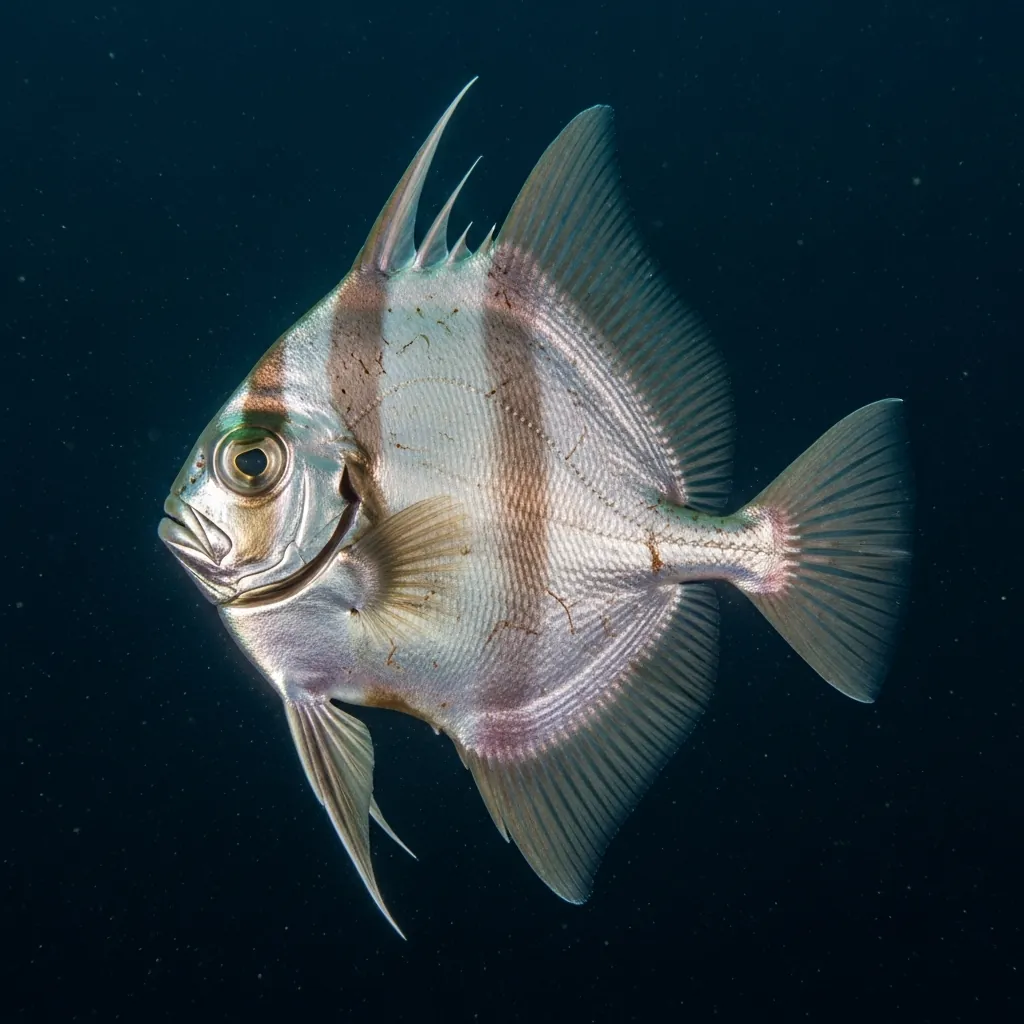
This hatchetfish is a 9 cm sliver of silver that spends its life in the dark middle waters of the open ocean. Seen head on it is almost nothing, a blade of a fish with no width at all. Its whole body is a piece of camouflage gear, built so that a hunter looking up from below sees only empty water.
Also known as: silver hatchetfish
- Length
- 9 cm
- Depth
- up to 800 m
How to tell it apart
Almost any small silver blade of a fish at these depths is a hatchetfish, so the work is telling it from its close relatives. Behind the belly sit two short spines. On this species they match each other, the same length and the same curve, while its relatives carry an unmatched pair.
Appearance
The body is very deep and pressed flat from side to side, which gives the blunt, axe-head shape the group is named for. The back is dark and heavily marked, while the flanks are bright silver. The eyes are tubular and point straight upwards; in a living fish they shine metallic blue, a colour that fades fast once the animal is dead. Along the belly sits a row of well developed photophores, the small organs that make light.
Habitat
It lives in cooler open-ocean water in every ocean except the Southern, though records from the Indian Ocean are few. This is a midwater fish of the open sea, never tied to a reef or the seabed. It ranges between about 100 and 800 m. Daytime is spent at the deep end of that band, and at sunset the fish rise towards the shallower end and drop again by morning. They hunt small fish and crustaceans.
Did you know?
Its belly glow is not set blindly. A separate light organ in the snout shines back towards the eye, so the fish can compare its own glow with the daylight coming down from above and match the two.
Log it in Into the Blue
Describe what you saw and we name it, then keep every species you find in your Oceandex.