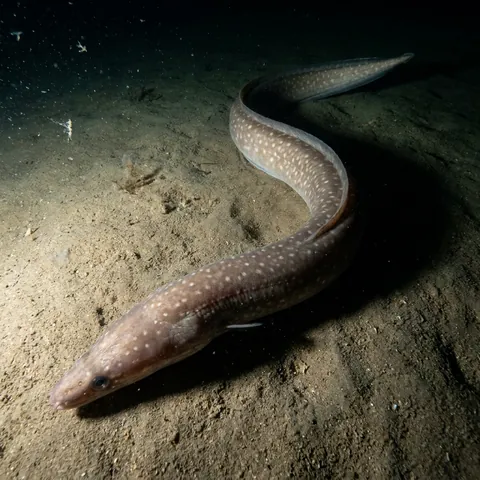
Giant Snake Eel
Ophisurus serpens
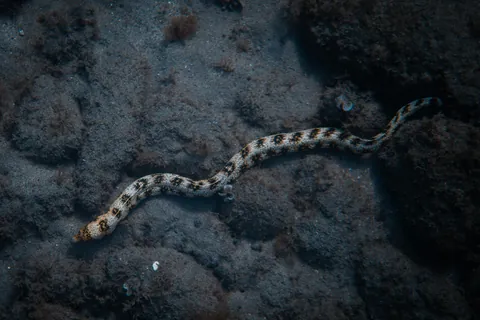
Myrichthys colubrinus
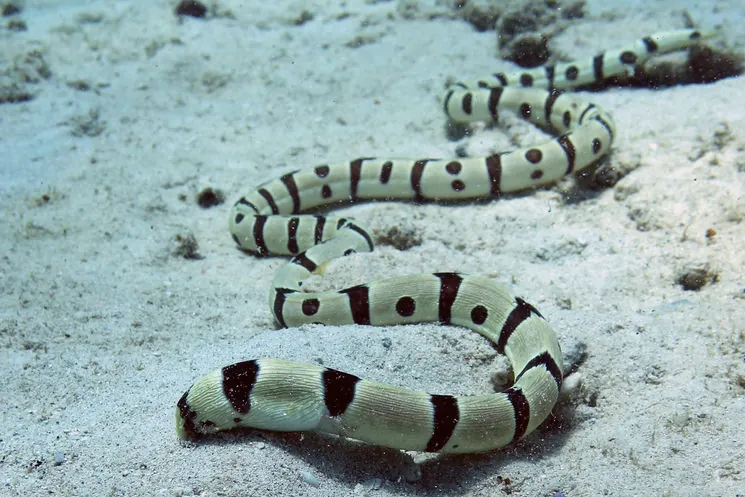
At first glance, this eel looks like it should not be there at all. Its bold black-and-white banding and snake-like glide across the sand make it one of the reef's best cases of mistaken identity: a harmless fish doing its best impression of a venomous sea snake.
Also known as: banded snake eel
Its black-and-white banding and undulating swim can be mistaken for a venomous sea krait, even by people who study them closely. The reliable tell is the fin: this eel carries a low fin running along most of its back and a small pair just behind the head, while a true sea krait, being a reptile, has no fins at all.
This eel has a long, tube-shaped body with a narrow head and a hard, pointed snout built for burrowing into sand. Broad bands of black and white run the full length of its body, from head to tail. Unlike most fish, it has no separate dorsal or tail fins in the usual sense; instead, a low, continuous fin runs along most of its back, paired with small fins just behind the head.
Look for it over open sand flats and seagrass beds on tropical coastlines, often with only its head showing above the sand it has buried itself into. It is widespread across the Indo-Pacific, from the Red Sea and East Africa to Hawaii and the islands of the central Pacific, and along coasts from Australia to Japan.
Unlike most of its close relatives, which hide by day and hunt at night, this eel is often seen out in the open during daylight. It hunts actively rather than waiting in ambush, probing sand and rock crevices with its head to sniff out crabs and shrimp. When prey is buried too deep to reach with its head, it drives its sharp tail into the burrow and whips its body back and forth to clear the sand away.
Very little is known about how this species breeds. Like other members of its family, it is thought to produce a flattened, drifting larva that spends a long time in open water before settling, but the details of courtship and egg-laying have not been studied.
First described in 1781, this eel has drawn little scientific attention since; there is no dedicated fishery for it, and solid population data are scarce because it spends so much time buried or hidden. As a species tied closely to healthy reefs, it is expected to decline if reef habitat and food supplies are lost to bleaching and other reef damage.
This eel does not just copy the sea krait's black-and-white pattern, it copies the snake's daytime habits too, staying out in the open in daylight even though its closest relatives stay hidden until dark, purely to keep the disguise convincing.
Describe what you saw and we name it, then keep every species you find in your Oceandex.