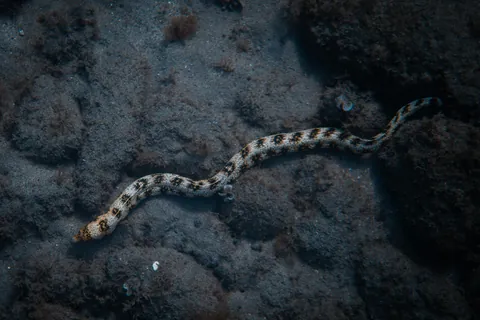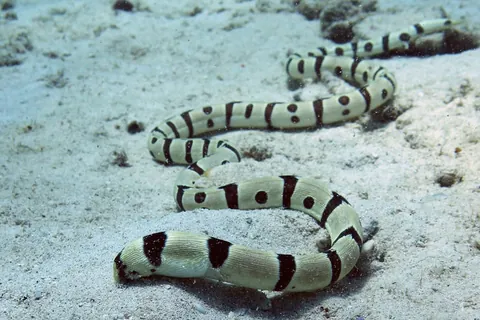
Harlequin Snake Eel
Myrichthys colubrinus
Ophisurus serpens
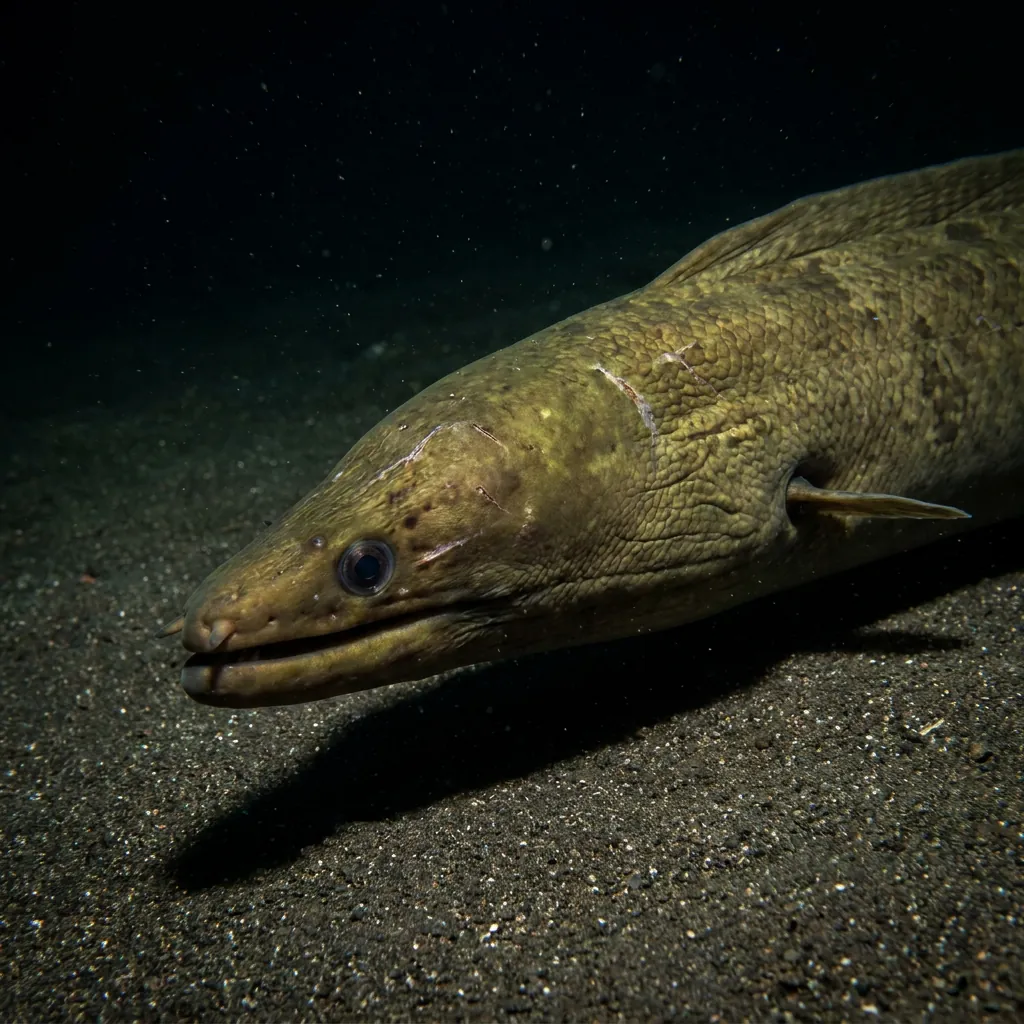
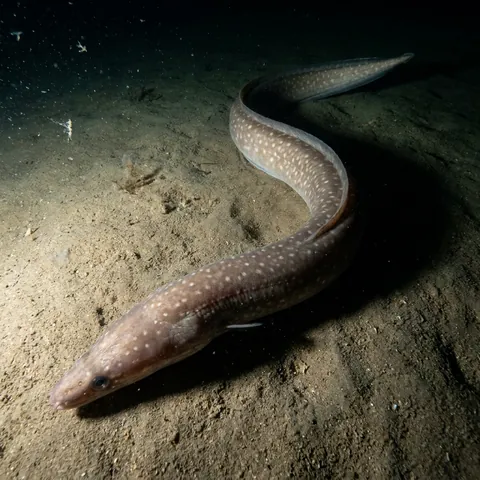
With no tail fin and a body that tapers to a whip-thin point, the giant snake eel looks more like a length of rope than a fish. By day it hides buried in the sand, with only its head showing above the seabed.
Also known as: serpent eel, snipe eel
Unlike moray eels and congers, whose fin wraps unbroken around the tail, this eel simply tapers to a bare, pointed tip with no tail fin at all.
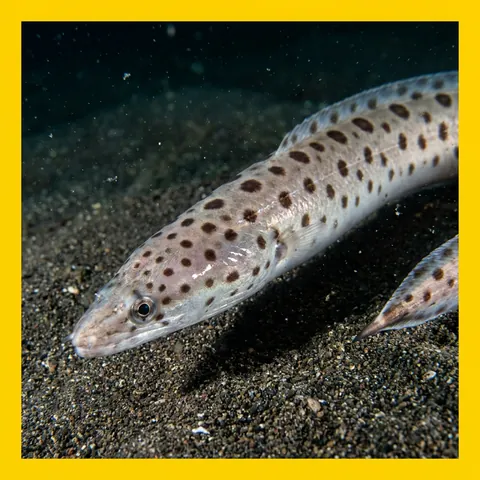
This eel has a long, slender body and a tapering snout, with the upper jaw longer than the lower and sharply pointed teeth usually visible. The dorsal and anal fins are long and low, starting well behind the small pectoral fins, and there are no pelvic fins or tail fin at all. Colour is pale brownish-green, with dark spots on the snout, silvery flashes along the flanks, and a pale belly. Juveniles are more silvery, with a shorter snout.
It lives across the eastern Atlantic from Senegal to Portugal, the Mediterranean, and parts of the Indian Ocean, Australia, and New Zealand. It stays buried in soft, sandy or muddy bottoms on the continental shelf, mostly out of sight.
This eel is nocturnal, spending the day buried in sediment with just its head poking out. It wriggles tail-first into the sand to hide, and often returns to the same burrow for weeks at a time. At night it emerges to hunt, feeding mainly on fish and crustaceans.
Its pupils change shape depending on the time of day: almond-shaped in daylight, and rounder at night.
Describe what you saw and we name it, then keep every species you find in your Oceandex.