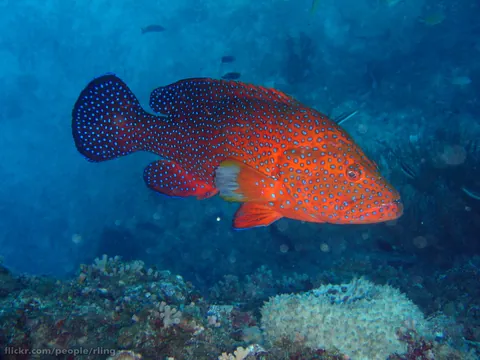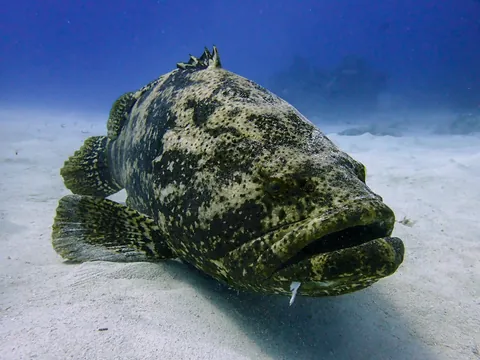
Atlantic goliath grouper
Epinephelus itajara
Epinephelus lanceolatus
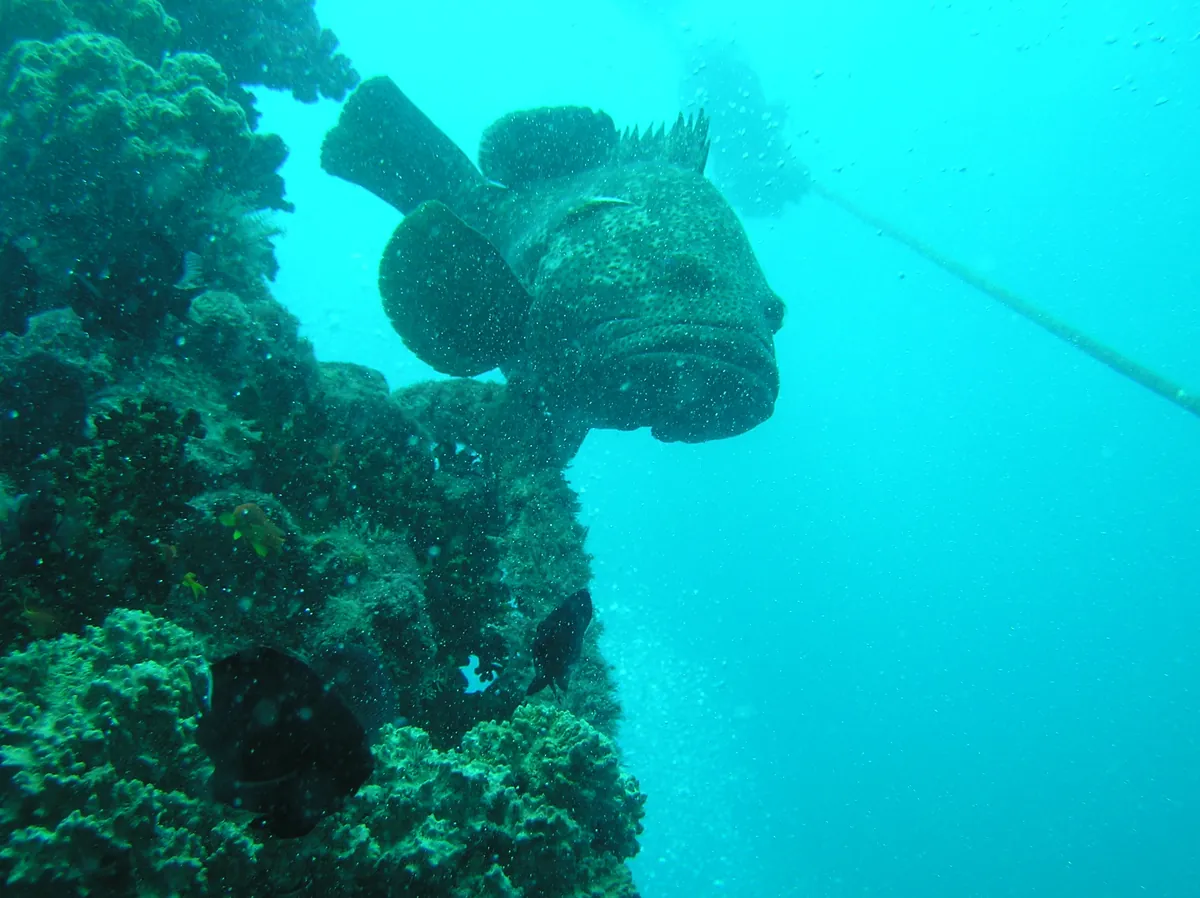
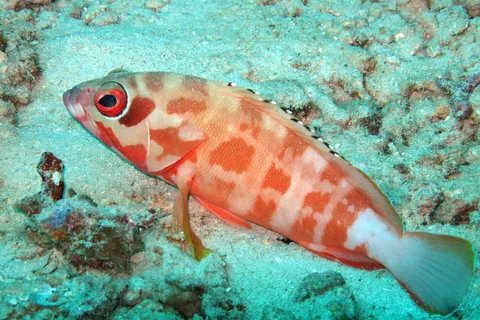
The giant grouper earns its name honestly: it is the largest bony fish found on any reef, growing up to 270 cm long and weighing as much as 400 kg. Meeting one face to face in a cave or under a wreck is an unforgettable moment.
Also known as: epinephelus lanceolatus, banded rockcod, bridlebass, brindle bass, brindle grouper, brindlebass, coral cod, dragon grouper, groper, grouper, mottled-brown sea bass, queensland groper, queensland grouper, reef cod, rock cod, rockcod, sea bass
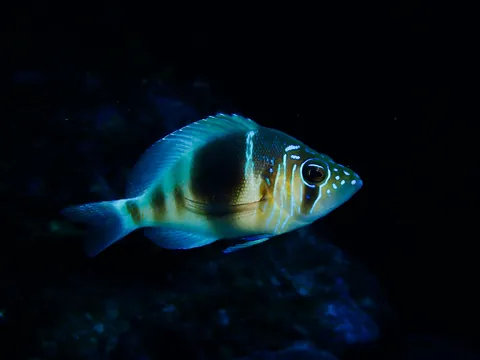
Adult giant groupers are so large that size alone usually rules out confusion with other reef groupers, since this is the biggest bony fish found on any reef. Juveniles look nothing like adults, and are best told apart from other young groupers by their bright yellow body marked with broad, irregular dark bars.
Adults have a robust, deep body in grayish-brown with a mottled pattern and darker fins. The head and gill cover have a convex profile. Small juveniles look completely different: they are yellow, with wide, irregular dark bars across the body and dark spots on the fins.
This grouper lives across the Indo-Pacific, from the Red Sea and East Africa to Australia and islands of the central Pacific. It lives on reefs, in caves, and around wrecks, from the surface down to about 200 metres, though it is usually found shallower than 50 metres. Adults are mostly solitary and hold territory on outer reefs and in lagoons, while secretive juveniles hide within reef crevices and are rarely seen.
Like most groupers, giant groupers start life as females and some later change into males. They gather in groups to spawn on a lunar cycle, with each spawning event lasting about a week. A dominant male and female begin the spawning, and other members of the group join in as it continues.
traumatogenic
A giant grouper named Bubba, kept at Chicago's Shedd Aquarium, was the first fish known to undergo chemotherapy.
Describe what you saw and we name it, then keep every species you find in your Oceandex.