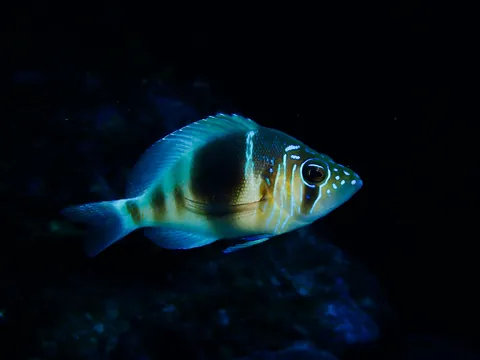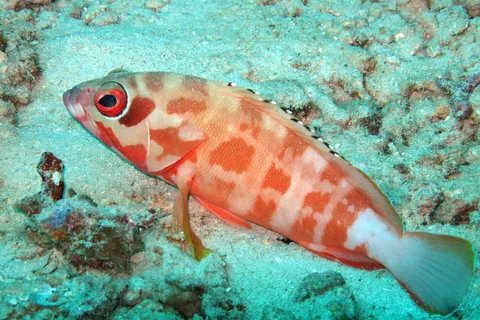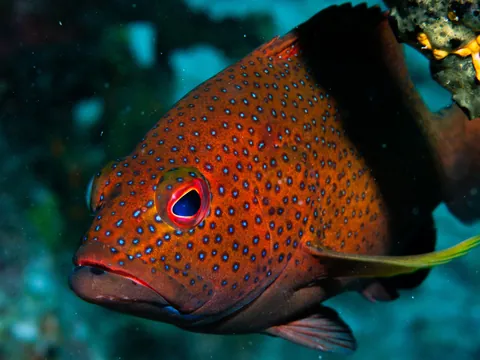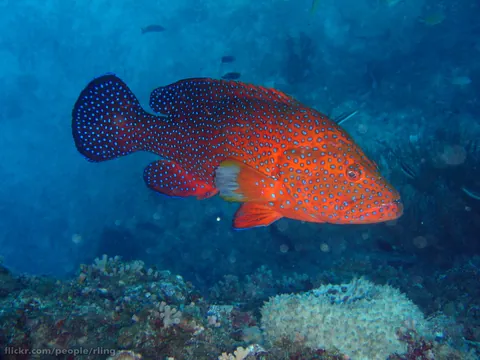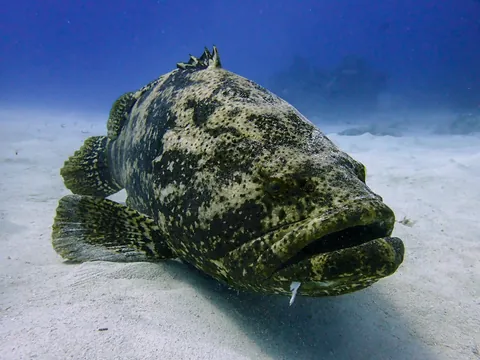
Atlantic goliath grouper
Epinephelus itajara
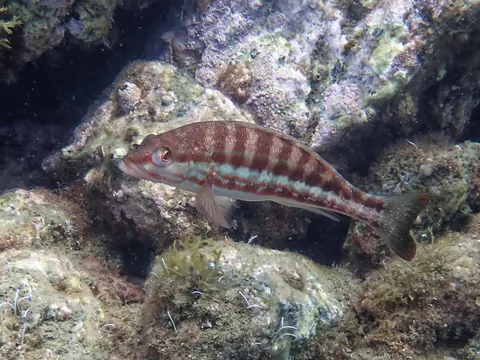
Epinephelus marginatus
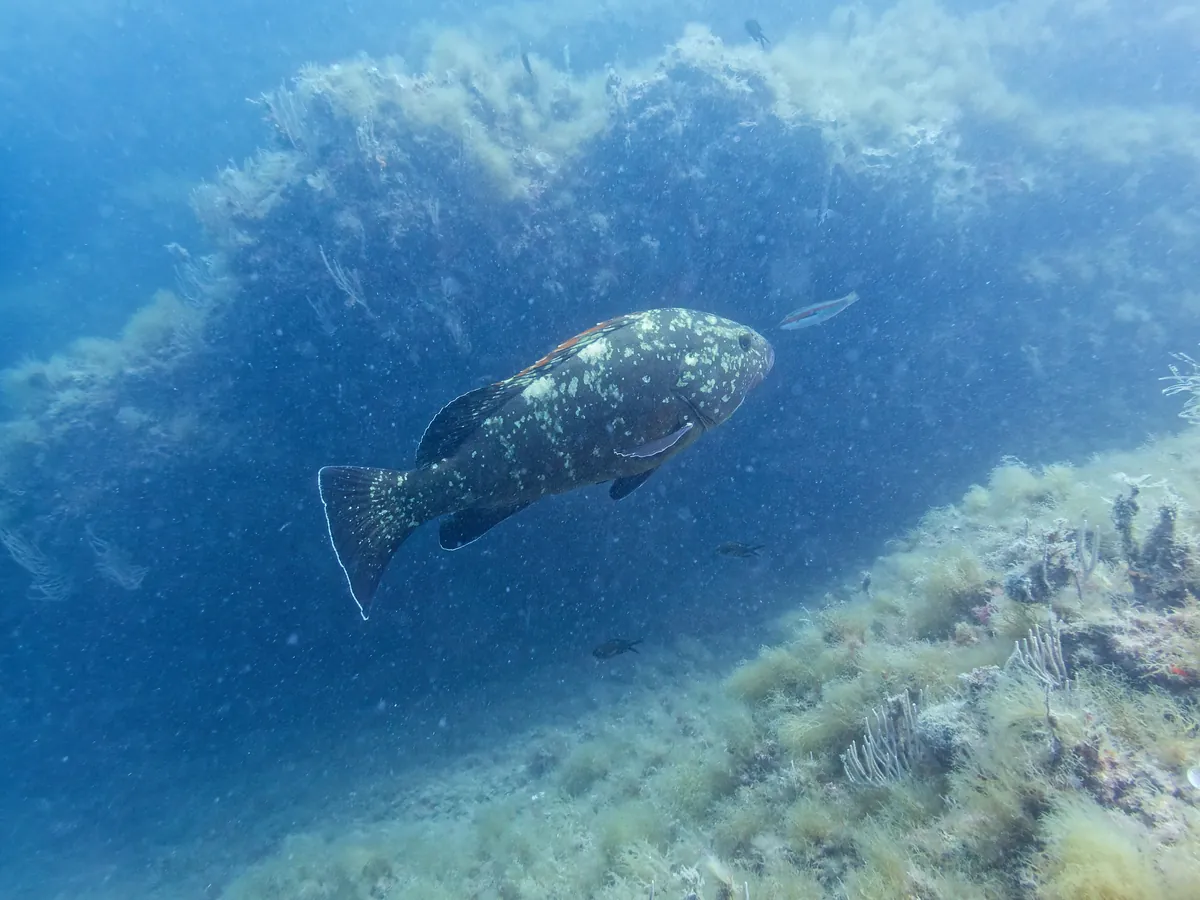
Meet one of the biggest fish you will find on a Mediterranean or eastern Atlantic reef. The dusky grouper has a heavy, oval body, a broad head, and a wide mouth with a jutting lower jaw, and it can weigh as much as 60 kg.
Also known as: dusky grouper, dusky perch, dusky sea perch, seabass, yellowbelly grouper, dusky perch, yellowbelly rockcod, duskey grouper, brown perch, dusky perch, yellowbelly rockcod, yellow belly
Large brown groupers can be hard to tell apart at a glance. Look for a dark streak running back from the corner of the mouth like a faint moustache, a mark other similar-sized groupers usually lack.
Its head and back are dark reddish-brown or grey, fading to a yellowish-gold underside. Irregular pale greenish-yellow, silvery-grey, or whitish blotches run down its flanks in loose vertical rows, standing out against the darker base colour. The fins are dark brown; the tail, anal fin, and often the pectoral fins carry a narrow white edge, while the pelvic fins are black-tipped. The leading part of the dorsal fin and the base of the pectoral fins are often edged in gold.
Dusky groupers live on rocky reefs, from shallow water down to very deep ground, though divers usually meet them in the upper part of that range. They often shelter near beds of Posidonia sea grass and hold a favourite cave or ledge for long periods. Young fish stay closer to shore, sometimes turning up in shallow rock pools, while adults move into deeper reef terrain. They occur through the Mediterranean and along the eastern Atlantic coast from Iberia south toward southern Africa, with a separate population on the south-western Atlantic coast of South America.
Adults are solitary and territorial, each holding a home range on the reef, though both adults and young fish sometimes enter brackish estuaries. They hunt crabs, octopuses, and other molluscs; as they grow bigger, fish, especially other reef species, make up a larger share of their diet.
Every dusky grouper starts life as a female. Later in life, larger and older individuals change sex and become males, though not all females make the switch. Outside the breeding season these fish are solitary, but they gather in small groups of a few dozen at traditional spawning sites on the reef.
The dusky grouper is listed as Vulnerable. Catches have fallen sharply across parts of its range, and it remains heavily fished in areas such as West Africa where little monitoring exists. Protective measures now include spearfishing bans, catch limits, and marine protected areas in parts of its range.
In the Mediterranean, small groups of dusky groupers gather each year at a few traditional sites, such as the Medes Islands in Spain, to spawn together.
Describe what you saw and we name it, then keep every species you find in your Oceandex.