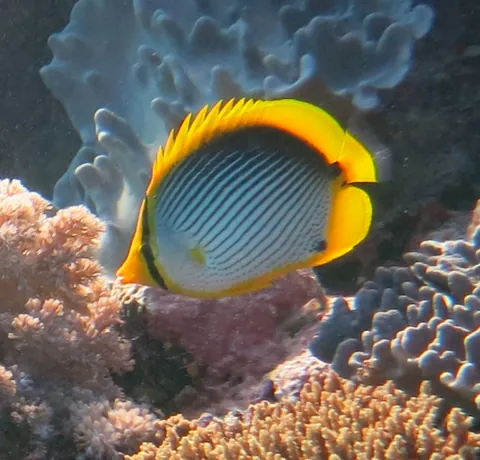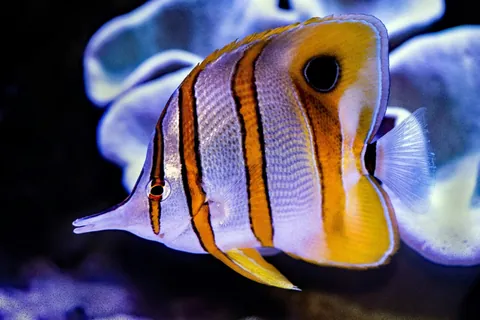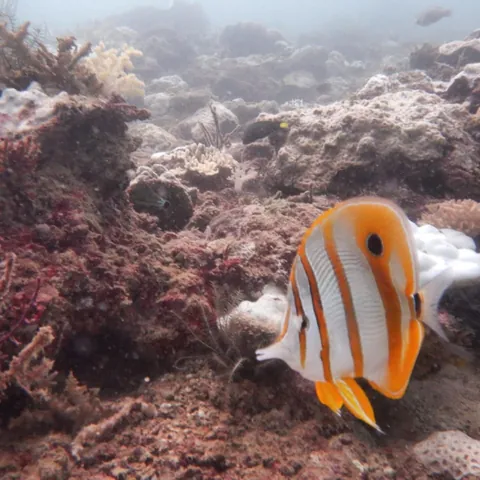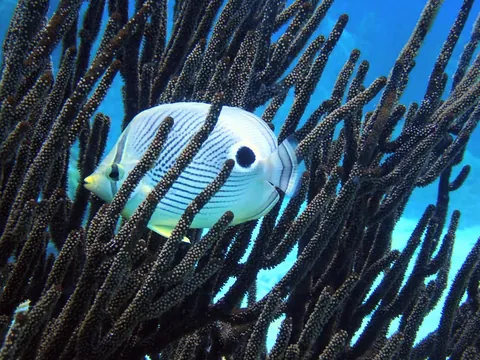
Banded Butterflyfish
Chaetodon striatus
Chaetodon trifascialis
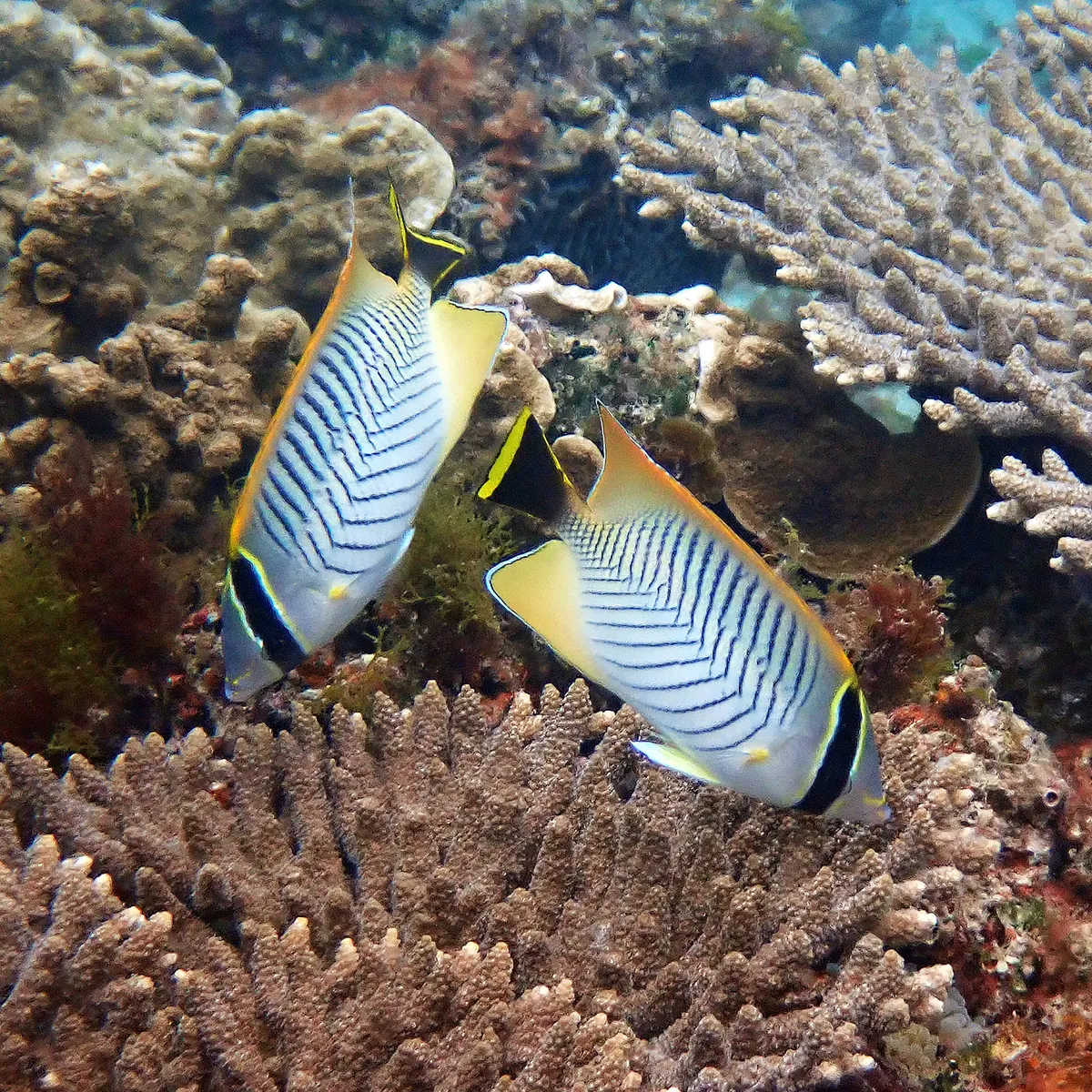
This butterflyfish stakes out a single coral head and rarely leaves it, feeding almost entirely on the coral itself. Its close bond with table and staghorn corals makes it a useful sign of healthy reef.
Also known as: chevroned butterflyfish, chevroned butterflyfish, chevron butterflyfish, rightangle butterflyfish, triangulate butterflyfish, v-lined butterflyfish, triangulate butterflyfish, redfin butterflyfish, chevron butterflyfish, rightangle butterflyfish, v-lined butterflyfish, oval butterflyfish, chevroned butterflyfish, right-angled butterfly-fish, chevron butterflyfish, right-angled butterfly-fish
It is often mixed up with the melon butterflyfish, the three-striped butterflyfish, or the three-banded butterflyfish. This is the only one of the four with fine, V-shaped chevron lines covering the whole body, rather than plain stripes or bands.
Its body is pale and elongated, covered in narrow dark chevron (V-shaped) markings. The tail is black with a yellow rear edge, and a black band with pale edges runs through the eye. Juveniles look different: they have a broad black band running from the rear of the dorsal fin to the rear of the anal fin, with a yellow tail base. It reaches a maximum length of 18 cm.
It lives on semi-protected seaward reefs and shallow lagoon reefs, closely tied to stands of tabular and staghorn Acropora coral, from about 2 to 30 m, usually shallower than 10 m.
It looks so different from other butterflyfish, being long-bodied and changing pattern completely as it grows, that scientists placed it alone in its own subgroup, Megaprotodon.
Describe what you saw and we name it, then keep every species you find in your Oceandex.