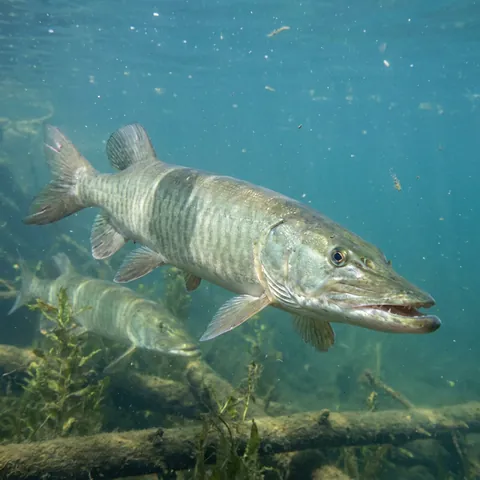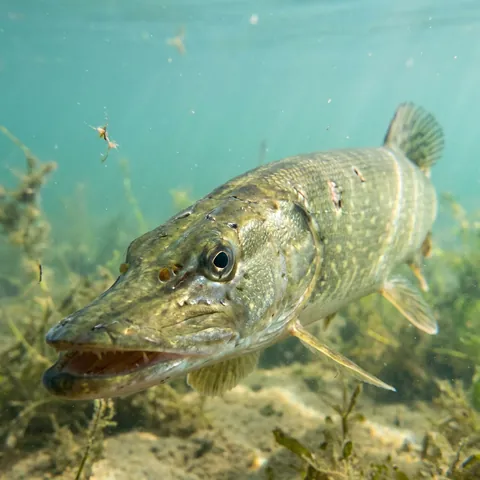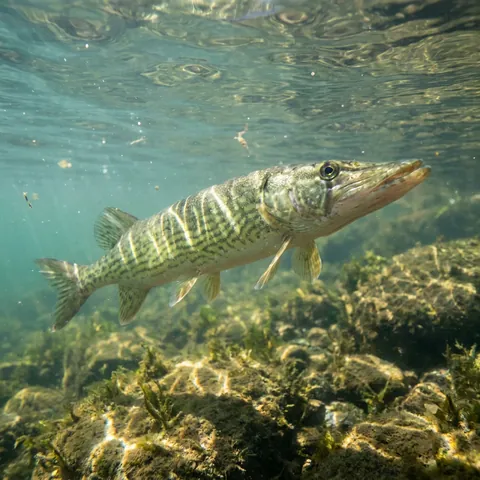
American Pickerel
Esox americanus
Esox niger
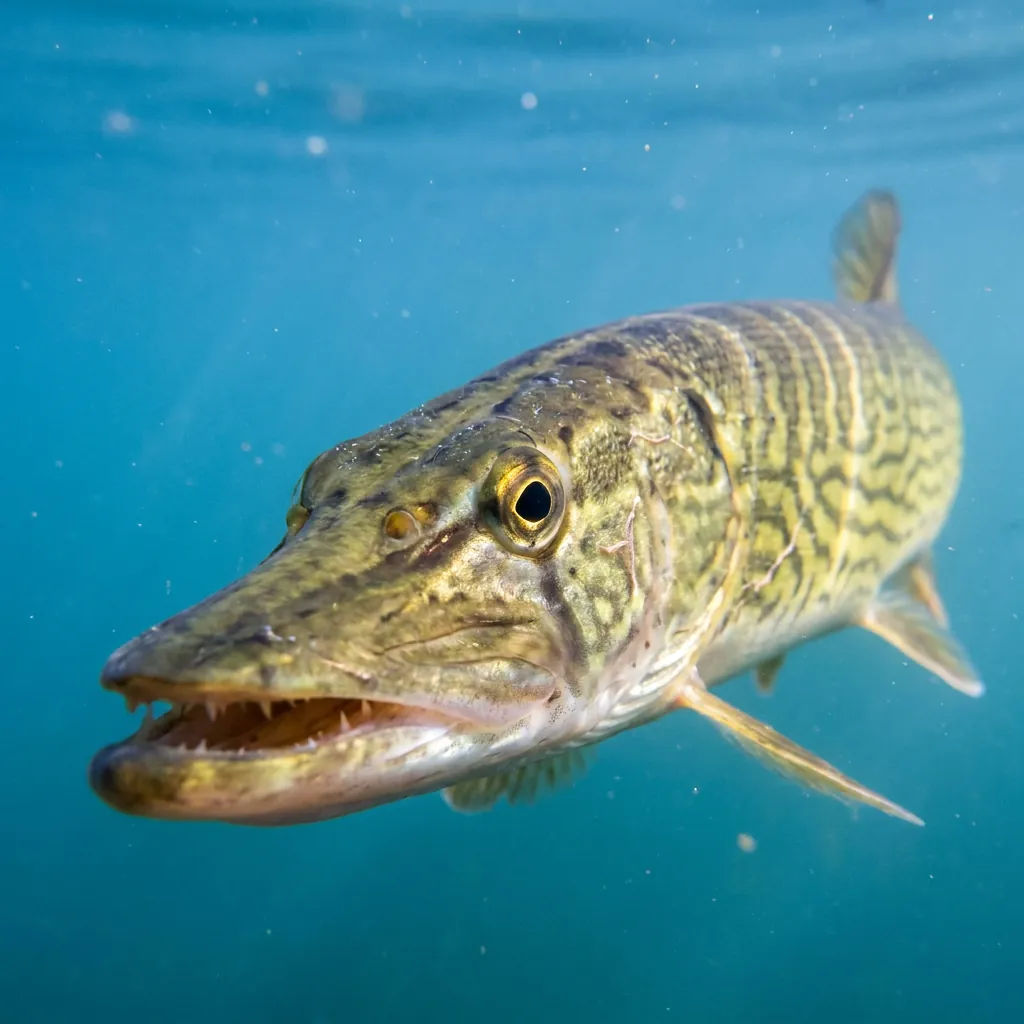
The chain pickerel waits motionless in weed beds before exploding into a short, fast strike at anything smaller that swims too close.
Also known as: pickerel
It closely resembles the smaller redfin and grass pickerels found in the same waters. The clearest difference is the dark mark under the eye: on this species it runs straight down, while on the other two it curves backward.
This fish has a dark, chain-like pattern crossing its greenish sides, and a long, slender body much like a northern pike. Unlike a pike, its cheeks and gill covers are fully covered in scales rather than only partly scaled.
It lives in creeks, rivers, lakes with plenty of vegetation, swamps, and other wetlands along the eastern side of North America, from southern Canada down to Florida and west to Texas. It tolerates both brackish and acidic water better than many freshwater fish.
It feeds mainly on smaller fish, lying in cover before lunging out and grabbing prey with its sharp teeth. It also eats frogs, snakes, crayfish, insects, worms, and small mammals such as mice, and will sometimes leap clear of the water to snatch a flying insect or a dangling fishing lure.
Spawning happens in flooded vegetation at the end of winter or start of spring, with fertilisation taking place outside the body as the adults stir eggs and sperm together with their tails. Neither parent guards the eggs. Newly hatched fry use sticky glands on their snouts to cling to plants until they finish absorbing their yolk sac and start hunting on their own.
A rare blue colour form of this fish, missing the usual chain-like pattern entirely, has been recorded in a population in New York.
Describe what you saw and we name it, then keep every species you find in your Oceandex.