Canif
Aeoliscus strigatus
About
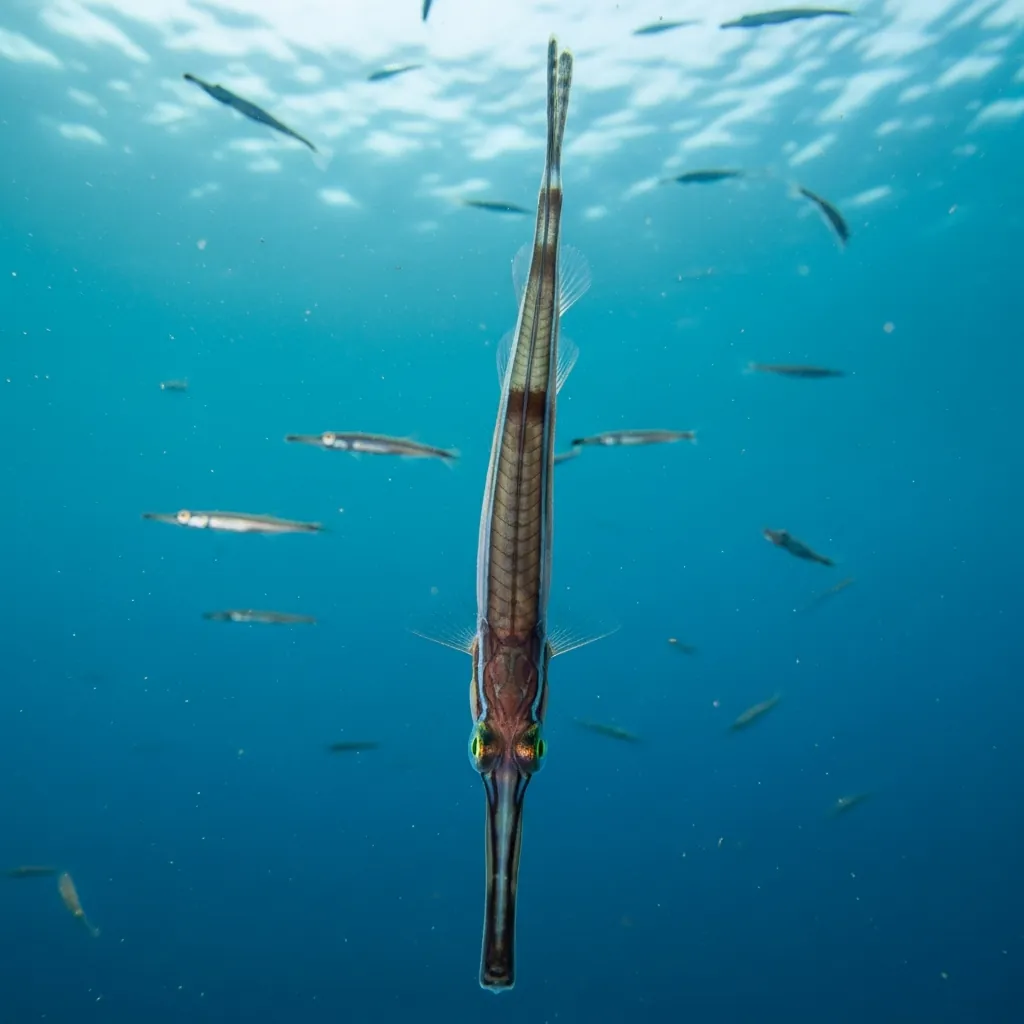
Hover over a seagrass bed or a sea urchin and you may swim past a group of these without noticing. Razorfish hang in the water nose-down, tail up, thin as a blade and nearly see-through. The whole group tilts and slides together, as if one animal. At 15 cm long and only millimetres thick, a razorfish seen edge-on is almost nothing at all.
Also known as: coral shrimpfish, jointed razorfish, jointed razorfish, shrimp fish, razorfish, coral shrimpfish, shrimpfish, hinged shrimpfish, razor fish, jointed razor-fish
- Length
- 15 cm
- Depth
- up to 42 m
How to tell it apart
Several close relatives share the same blade-like shape and the same head-down swimming, so neither one names the fish. The answer is at the very tip, where the spine sticks out past the tail. In this species the last part of that spine is jointed and can move, like a hinged blade tip, instead of being stiff all the way to the point. Get behind a hovering fish and watch the tip flick.
Appearance
The body is long, flat and so thin it is close to transparent, ending in a fine tube-like snout. The fins are small, clear and easy to miss. Along the back runs a case of thin bony plates. The plates carry on past the end of the body, over the tail, and finish in a sharp spine that points backwards. A dark brown to black band runs the length of the fish and straight through the eye. Body colour follows the surroundings: greenish yellow with soft brown stripes in seagrass, pale silver with a hard black stripe over sand, rubble or reef. Males and females look the same.
Habitat
Look for it in coastal waters of the Indo-West Pacific, from East Africa to Australia and southern Japan, and around the Caroline Islands. It is absent from the Red Sea. It lives over seagrass beds, sand and rubble patches, and on coral reefs, from 2 m down to 42 m. What it really needs is something spiky to hide in. Groups gather among the long spines of Diadema sea urchins, or in the branches of staghorn coral, and dart back to that cover when a bigger fish comes close. They feed on tiny crustaceans and other small animals drifting in the water.
Did you know?
Hiding inside a sea urchin is also how it hunts. The razorfish waits among the spines for small animals that come to feed on the urchin, then darts out and takes them, using the same shelter as both armour and ambush.
Log it in Into the Blue
Describe what you saw and we name it, then keep every species you find in your Oceandex.