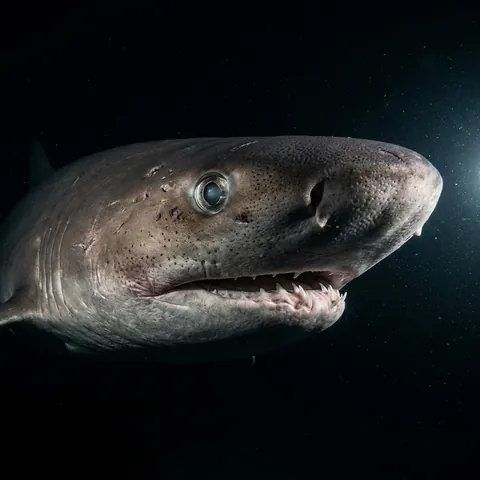
Bluntnose sixgill shark
Hexanchus griseus
Notorynchus cepedianus
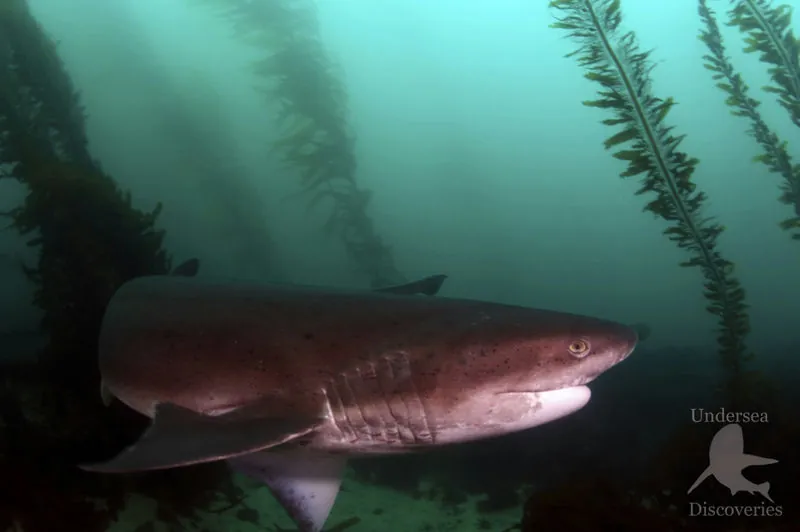
The broadnose sevengill shark is a big, powerful predator that can grow to 3 m long and 107 kg, with a common length of about 1.5 m. Unlike most sharks, it has seven gill slits instead of five, a sign of its ancient lineage.
Also known as: broadnose seven-gill shark, broadsnout, cowshark, broadsnout sevengill shark, broad-snout, broadhead seven-gill shark, broadnose shark, cow shark, broadsnouted seven-gill shark, tasmanian tiger shark, spottie, sevengill shark, seven-gilled shark, seven gilled shark, broadnose seven gill shark
It can be confused with other large grey sharks at a glance. Counting seven gill slits along the side of the head, instead of the usual five, confirms this species.
This is a large, heavy-bodied shark with a broad head, small eyes, and a short, blunt snout. Its single dorsal fin sits far back on the body, near the pelvic fins, and its tail has an unusually long upper lobe. The body is mottled grey to olive-brown with small black spots scattered over the back and fins, and pale below.
Lives on the continental shelf, from shallow bays and estuaries down to about 80 m, with occasional dives far deeper. It is a bottom-dweller, cruising slowly near the seabed and only occasionally rising to the surface. Older, larger sharks tend to move into deeper offshore water, while younger ones stay closer to shore over sand and kelp.
This shark is not a picky eater. It hunts other sharks, rays, bony fish, seals, and carrion on the seafloor, and will eat almost anything that fits in its mouth. It sometimes hunts in small packs to take down larger prey. After a big meal it can go for weeks without eating again while it digests.
The species is under pressure from fishing, both as a deliberate catch and as bycatch, along with hunting for its liver oil and hide. It is also harmed by water pollution, and heavy fishing once caused a local decline in San Francisco Bay.
Its species name, cepedianus, honours Bernard Germain de Lacépède, a French naturalist working in the late 1700s and early 1800s - the full scientific name literally means "Lacépède's back-snout".
Describe what you saw and we name it, then keep every species you find in your Oceandex.