Bonefish
Albula vulpes
About
Fishermen call the bonefish the grey ghost, and the name fits. It is a bright silver fish of shallow sand and mud, usually in 1 to 15 m of water, and it can reach about 104 cm. Watch a flat long enough and one will simply appear where a moment ago there was only sand.
Also known as: banana fish, bananafish, lady fish, tenny, salmon peel, indo-pacific bonefish, tarpon, tenpounder, banana, ladyfish, long-finned eel, roundjaw bonefish, common bonefish, west atlantic bonefish
- Length
- 1 m
- Weight
- max 10 kg
- Depth
- 1–15 m
How to tell it apart
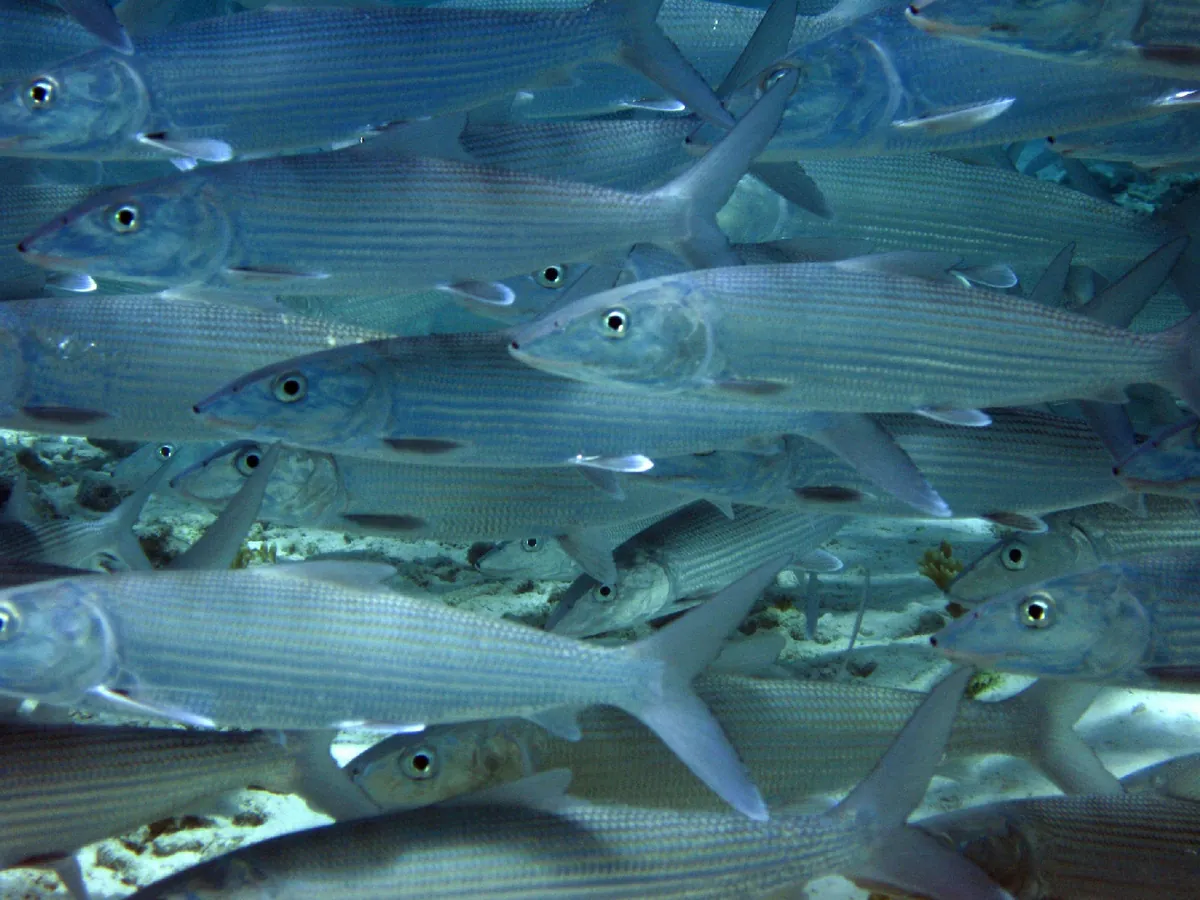
In the shallows you may first see only the tip of the dorsal fin cutting the surface as the fish feeds head-down. Against the other silvery fish on a flat, look at the head: that cone of a snout hangs out over the mouth, so the mouth opens underneath rather than at the front. Do not try to separate it from its close relatives by eye. That cannot be done in the water.
Appearance
A long, smooth, torpedo-shaped fish. The sides are bright silver and the back ranges from slightly darker to olive green that fades into the silver. Faint soft lines often run along the flank from the gills to the tail, made by light shading on the scales. The fins are dusky, and the base of each pectoral fin is often yellow. The snout is blunt and cone-shaped, and it sticks out past the mouth, which sits underneath the head.
Habitat
The bonefish lives in the warm western Atlantic, off southern Florida, in the Gulf of Mexico and around the West Indies. Its home is shallow coastal water, bays and estuaries over sand and mud. It is usually in 1 to 15 m, though it has been found as deep as 84 m. Look for it along edges and drop-offs and over clean, healthy seagrass, where crabs and shrimp are plentiful.
Behaviour
Bonefish move onto shallow mud and sand flats to feed as the tide comes in, then drop back out. They pick worms, shellfish, crabs and shrimp off the bottom. One favourite trick is to follow a stingray and grab the small animals it stirs up. Young and adult fish often shoal together, while big adults are usually alone or in pairs. The bonefish can also cope with water low in oxygen by gulping air into a swim bladder that works a little like a lung.
Did you know?
Bonefish were long thought to be one fish found worldwide. They turned out to be eleven species that no one can tell apart by looks: three in the Atlantic and eight in the Pacific. Of the three Atlantic ones, this is the biggest and the most widespread.
Log it in Into the Blue
Describe what you saw and we name it, then keep every species you find in your Oceandex.