Boarfish
Antigonia capros
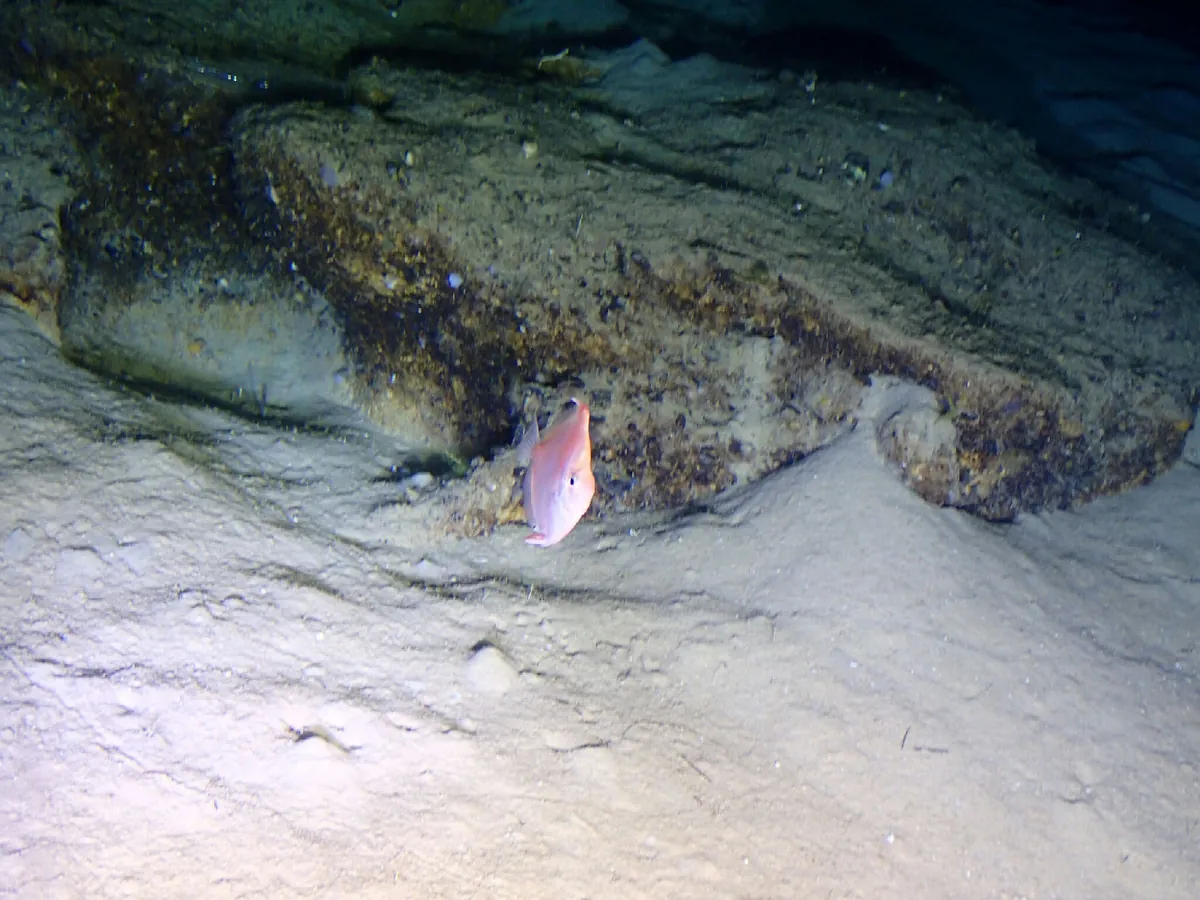
About
The boarfish is built like a coin standing on edge: a tall, almost diamond-shaped body squeezed flat from side to side. It is a fish of the twilight zone, living far below normal diving depths over rocky slopes, and it often gathers there in large numbers. At most 30.5 cm long and only 170 g, it is smaller and lighter than its bold orange-red colour suggests.
Also known as: deep-bodied boarfish, deepbody boarfish, robust deepsea boarfish, deepbody boarfish, robust deepsea boarfish
- Length
- 15 cm · max 30.5 cm
- Weight
- max 170 g
- Depth
- 100–300 m
How to tell it apart
Deep water holds several orange-red, deep-bodied fish, so colour alone settles nothing. Look instead for three dark red vertical bands: one across the eye, one over the middle of the body, and one on the narrow stalk in front of the tail. That evenly spaced set of three is fixed and does not fade with mood, unlike overall body colour.
Appearance
The body is deep and rhomboid, with both the back and the belly curving outwards. The head is small, with clear bony ridges that spread out from the centre and a raised crest along the nape. The eyes are large. The mouth is small, points upwards and can be pushed forwards to grab food. A single long dorsal fin runs down the back, matched by a long anal fin below, and the pectoral fins are rounded. The overall colour is orange red.
Habitat
The boarfish lives in warm waters worldwide, across the Atlantic, Indian and Pacific Oceans. It stays close to the bottom over rocky slopes and ledges. The full depth range runs from 50 to 900 m, but most fish are between 100 and 300 m. Adults keep near the seabed while young fish hang in open water above it. Small molluscs, crustaceans and drifting plankton make up the diet.
Did you know?
It is called a boarfish, but not because it looks like a boar. Its name capros means boar and was given only because early scientists thought it was a close relative of another fish, Capros aper.
Log it in Into the Blue
Describe what you saw and we name it, then keep every species you find in your Oceandex.