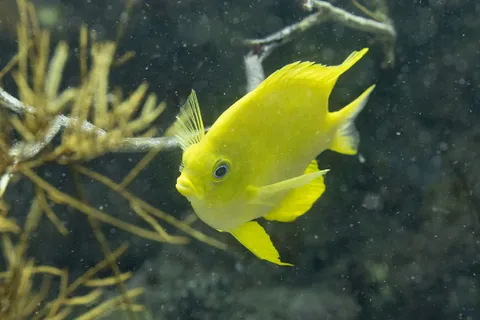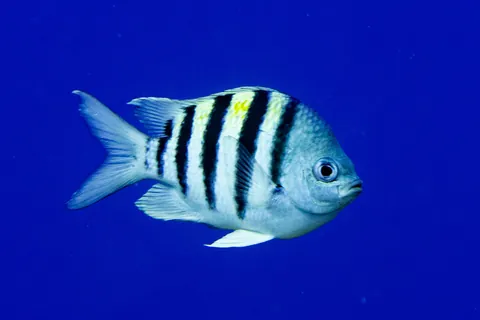
Atlantic Sergeant Major
Abudefduf saxatilis
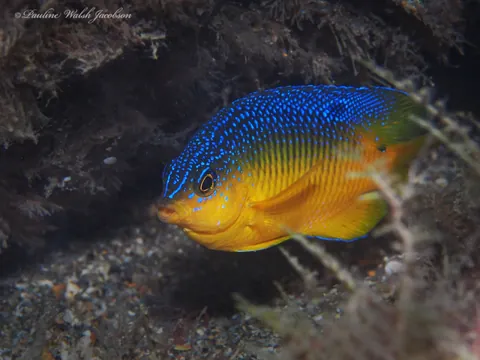
Chromis viridis
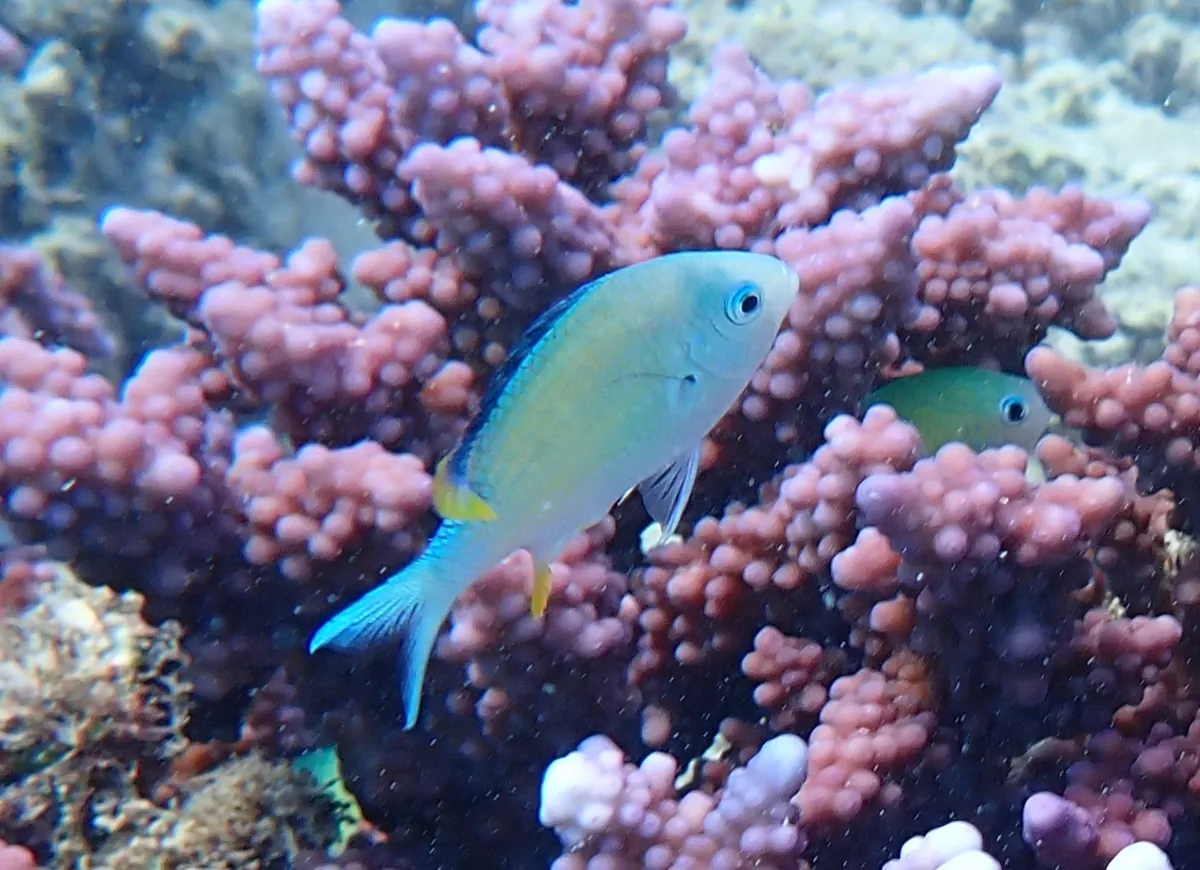
The blue green damselfish is one of the small, bright fish that hang in shimmering clouds over the reef. It lives in large groups above branching corals and darts down between the branches for cover at the first sign of danger.
Also known as: chromis viridis, blue green chromis, blue puller, blue-green chromis, blue-green puller, damselfish, green chromis, green damsel, green puller
Look for a shimmering cloud of small, plain green-blue fish sitting just above one thicket of branching coral in calm, shallow water. The mark to use is the lack of marks. The body is one even colour from head to tail, with no stripe, spot, or band anywhere, and no dark patch at the base of the tail. A single yellow fish with a dark rear end among them is a nesting male, not a different species.
This is a small fish, growing to about 10 cm. The whole body is a shimmering pale green to light blue, with no bars, spots or stripes to break it up. The colour shifts with the light, which is why a group can look green from one angle and blue from another. Breeding males are the exception: a nesting male turns yellow and goes dark, almost black, towards the tail, and the fins on his back and belly turn orange-brown.
The species lives across the tropical and subtropical Indo-Pacific, from the Red Sea and East Africa to the western Pacific. It uses sheltered water rather than exposed reef front: lagoons and shallow subtidal reef flats, always close to thickets of branching Acropora, the fast-growing staghorn and table corals. It is found from 1 to 20 m. Young fish stay tied to a single coral head.
Breeding happens on sand and rubble next to the reef, not on the coral itself. The male prepares a nest there and shares it with several females, so one nest holds the eggs of more than one female. The eggs are sticky and glue themselves to the bottom. The male then stays and guards them, fanning fresh water over them with his tail fin. He also eats the eggs that fail to hatch, which stops microbes growing in them and putting the rest of the clutch at risk.
harmless
Describe what you saw and we name it, then keep every species you find in your Oceandex.