Black ghost knifefish
Apteronotus albifrons
About
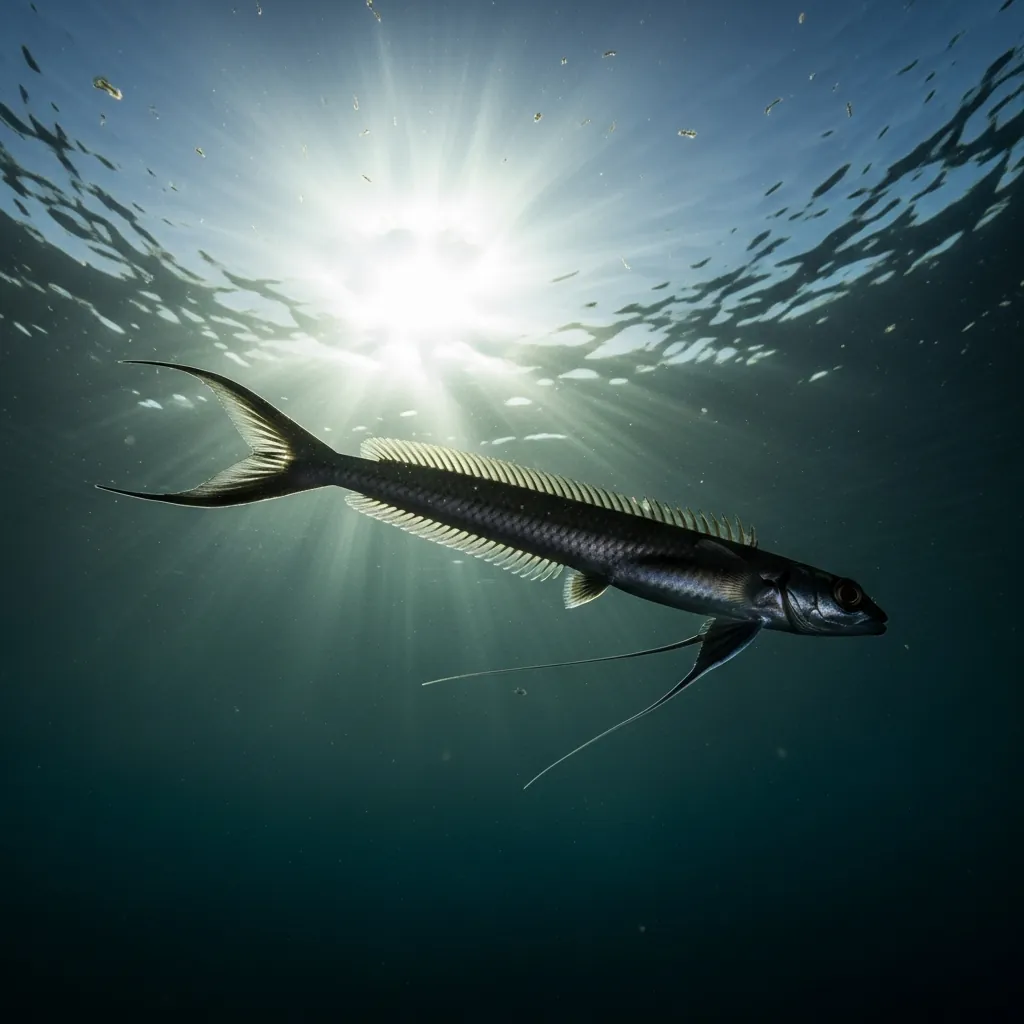
A black ghost knifefish looks less like a fish than a dark ribbon drifting over the sand. It has no tail fin and no fin on its back, and it can hold itself still in moving water as if it were parked. Big ones reach 50 cm. It belongs to warm water, between 23 and 28 C.
Also known as: black ghost, black ghost, black ghost knifefish, apteronotid eel, apteronotid eel
- Length
- 50 cm
- Temperature
- 23–28 °C
How to tell it apart
Several dark, ribbon-bodied knifefish share these rivers and all of them swim in the same odd, rigid way. Settle it at the back end. Look for the pair of pale rings around the rear of the body. They are there from young fish to adults, so a dark knifefish showing none of them is not this species.
Appearance
The body is long and flattened from side to side, with a short snout and a big mouth. The back is bare of fins. Instead, one long fin runs the whole length of the underside. There is no tail fin at the end. The fish is black all over apart from two pale rings that circle the rear of the body, one near the tail and one further forward. Many fish also carry a white line that runs from the snout over the top of the head.
Habitat
This is a South American river fish. It lives in creeks and river systems from Venezuela south to the Paraguay and Parana, taking in the Orinoco, the Guianas and the Amazon, and it is the most widespread fish of its family. Look for it in fast-flowing creeks over a sandy bottom. It uses both the open water and the bed itself.
Behaviour
It swims by sending waves down that long belly fin while the body stays stiff and straight. The result is startling. It can go forwards, backwards or sideways, hang in one spot, and even swim upside down, and it can reverse direction in under a second. It also makes its own electricity. An organ in the tail gives out a steady electrical signal, and sensors in the skin pick up how that signal bends around objects. The fish uses this both to feel its way and to talk to others of its kind.
Diet
It hunts at night, and it is a meat eater. The main food is insect larvae, small shellfish and small fish, and it will take shrimp as well. Because it hunts by electricity, darkness and muddy water cost it nothing. Prey is taken with a short, fast lunge, and the fish can work in tight, cluttered places where a stiffer swimmer would be stuck.
Conservation
Its status has not yet been assessed on the IUCN Red List. That does not mean it is safe. It is a popular aquarium fish, and many are still taken straight from the wild, with a large share of the Amazon ornamental catch never appearing in official export records. Heavy collecting of this kind can empty a river of a species even when no one has declared it at risk.
Did you know?
Engineers study this fish on purpose. Its ribbon fin lets it turn and reverse while the body stays rigid, and that trick is being copied into the design of underwater vehicles.
Log it in Into the Blue
Describe what you saw and we name it, then keep every species you find in your Oceandex.