Cardinal fish
Apogon imberbis
Pterapogon kauderni
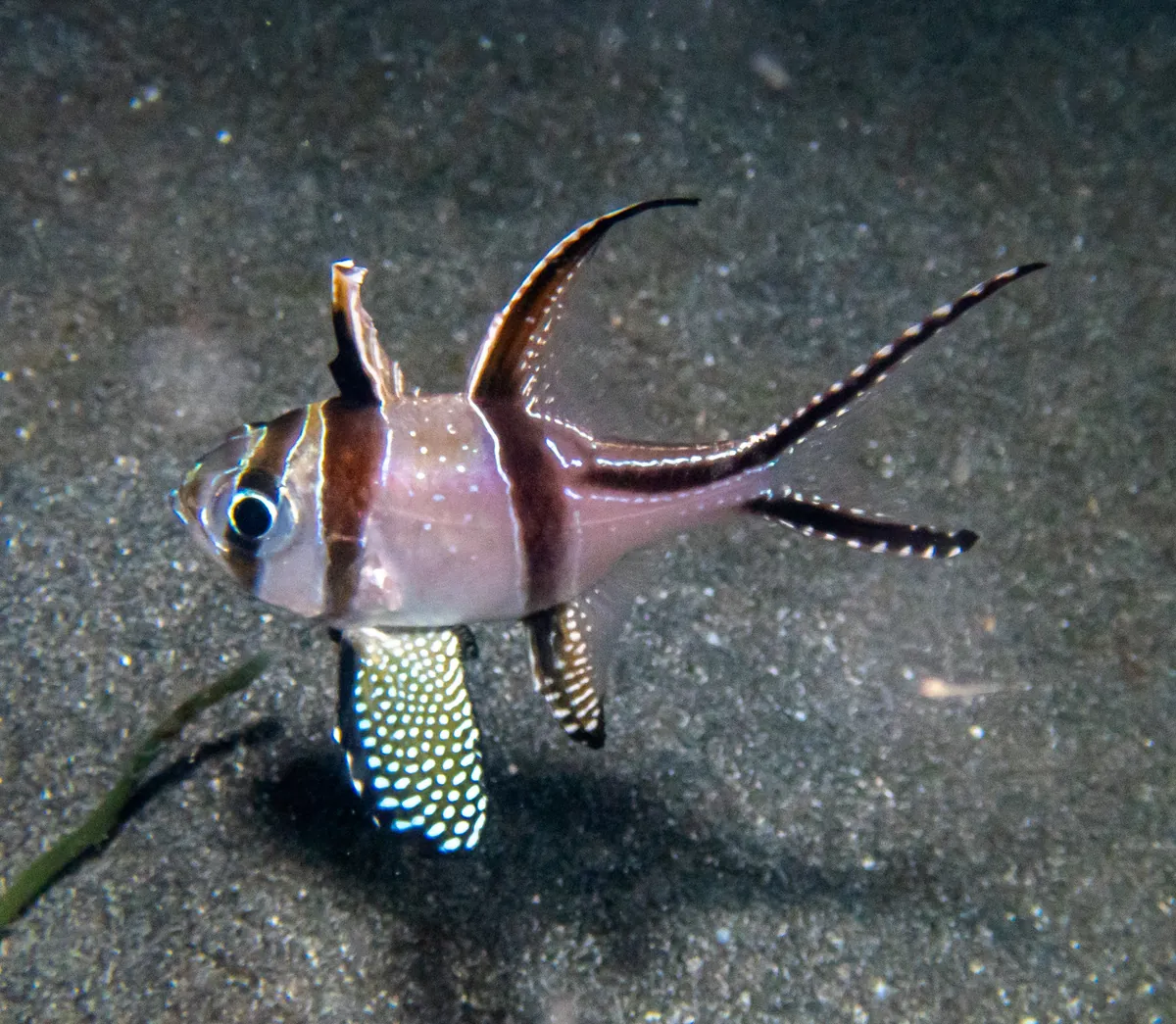
The Banggai cardinalfish is a small, strikingly marked reef fish found in only one small corner of Indonesia. It grows to just 8.6 cm, yet its bold pattern and flowing fins have made it one of the most recognisable fish in the aquarium trade.
Also known as: bangaii cardinalfish, banggai cardinal fish, pterapogon kauderni
It is easily told apart from every other cardinalfish species. Look for the combination of three white-edged black bars and the long, trailing dorsal and anal fin rays; no other cardinalfish shows both together.
Three black bars, each edged in white, cross its head and body. Its first dorsal fin is tasselled, and long, trailing rays extend from its second dorsal and anal fins, ending in a deeply forked tail. The fin edges carry white spots on a black margin, giving the whole fish a delicate, finely detailed look.
This species lives only around the Banggai Islands of Indonesia, with a few small populations introduced elsewhere by the aquarium trade. It stays in shallow water, usually between 1 and 2 metres deep and no deeper than 16 metres, across coral reefs, seagrass beds, and patches of open sand and rubble.
Unlike other cardinalfish, it is active by day rather than at night. It lives in small, stable groups of about nine fish, sheltering close to sea urchins, branching corals, or sea anemones. When threatened, it darts in among the spines or branches for cover, and if disturbed, it reliably returns to the same spot afterward.
It feeds on whatever small prey it finds near the bottom or drifting in the water, mostly tiny crustaceans called copepods, along with other small bottom-dwelling and planktonic animals.
The male is a mouthbrooder: after the female lays her eggs, he carries and protects them in his mouth until they hatch. Courtship begins with the female approaching the male, and mating pairs then guard a spawning spot away from the main group. Unlike most marine fish, the young never pass through a drifting larval stage; they grow inside the father's mouth and emerge ready to settle straight into a reef habitat.
harmless
Its young skip the drifting larval stage entirely, growing inside their father's mouth until they are large enough to settle directly onto the reef.
Describe what you saw and we name it, then keep every species you find in your Oceandex.