Wolf Eel
Anarrhichthys ocellatus
About
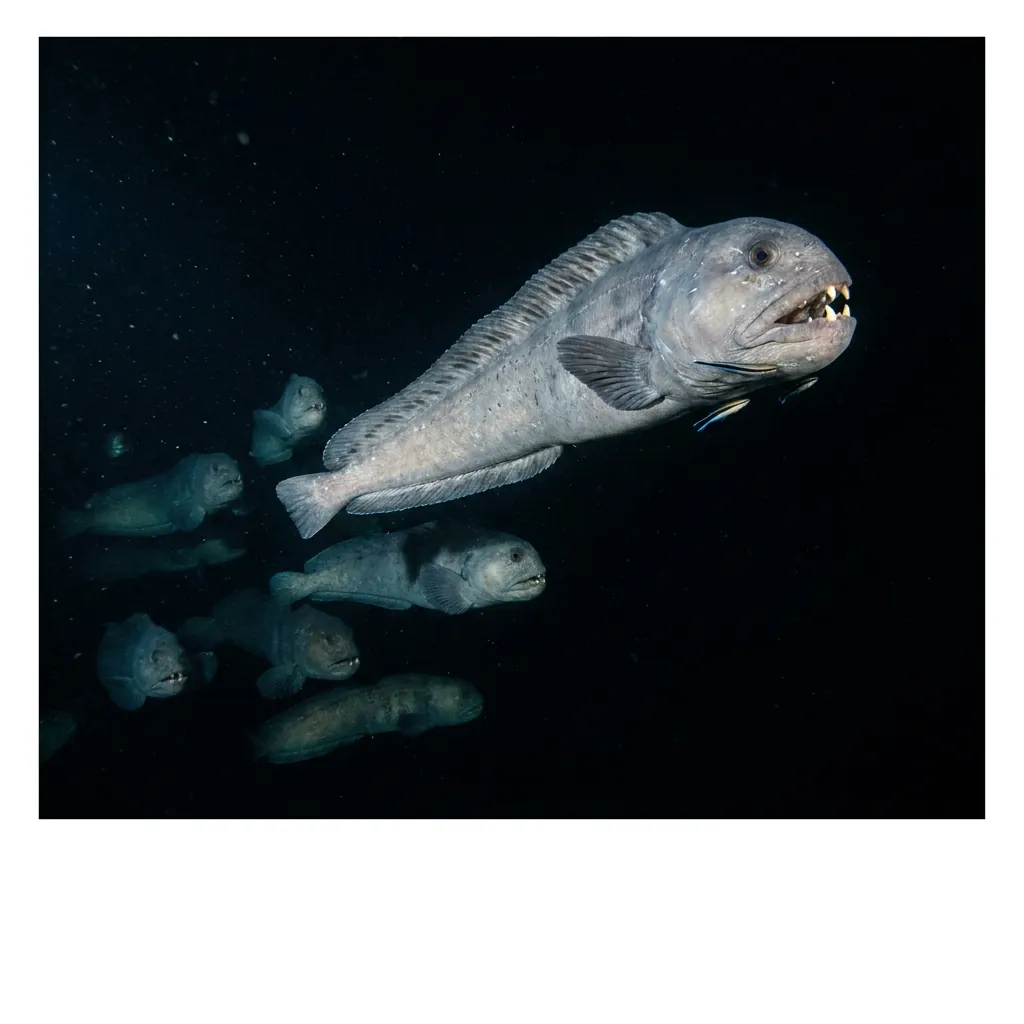
The wolf eel looks fierce but is usually calm and curious around divers. Despite its snake-like body, which can reach 240 cm and 18.4 kg, it is not a true eel at all.
Also known as: anarrhichthys ocellatus, doctorfish, northern wolffish, wolf-eel
- Length
- 2.4 m
- Weight
- max 18 kg
- Depth
- up to 226 m
How to tell it apart
Its eel-like body leads many divers to mistake it for a true eel, such as a moray. Check behind the head: the wolf eel has paired pectoral fins there, which true eels do not have.
Appearance
Young wolf eels are bright orange with large dark spots toward the tail; as they age, they turn grey, brown, or dark olive. A single long fin runs from the head almost to the tail tip, and the tail fin itself is small. Powerful jaws hold sharp teeth at the front and flatter crushing teeth further back. Males develop large lips and a bump on top of the head.
Behaviour
Adults are generally calm and curious, and rarely aggressive toward divers, though a large one can deliver a painful bite if provoked. A male and female often pair for life, sharing a den in a cave or rocky crevice. While guarding their eggs, one partner always stays behind while the other leaves briefly to feed.
Diet
It crushes hard-shelled prey such as crabs, sea urchins, mussels, and clams with its strong jaws, and also eats some fish. Given a choice, it prefers softer food like squid, since hard prey can wear down its back teeth.
Breeding
Wolf eels mate for life and breed from autumn through the end of winter, starting at around seven years old. The female lays a large mass of eggs, which the pair coils around and protects together in their den, taking turns to guard while the other feeds. The female also circulates water around the eggs and periodically turns them as they develop.
Is it dangerous?
generally gentle and curious if not provoked — powerful jaws, do not hand-feed
Did you know?
A wolf eel's bite reflex is so strong that it can still bite even after its head has been severed from its body.
Log it in Into the Blue
Describe what you saw and we name it, then keep every species you find in your Oceandex.