Walleye
Sander vitreus
About
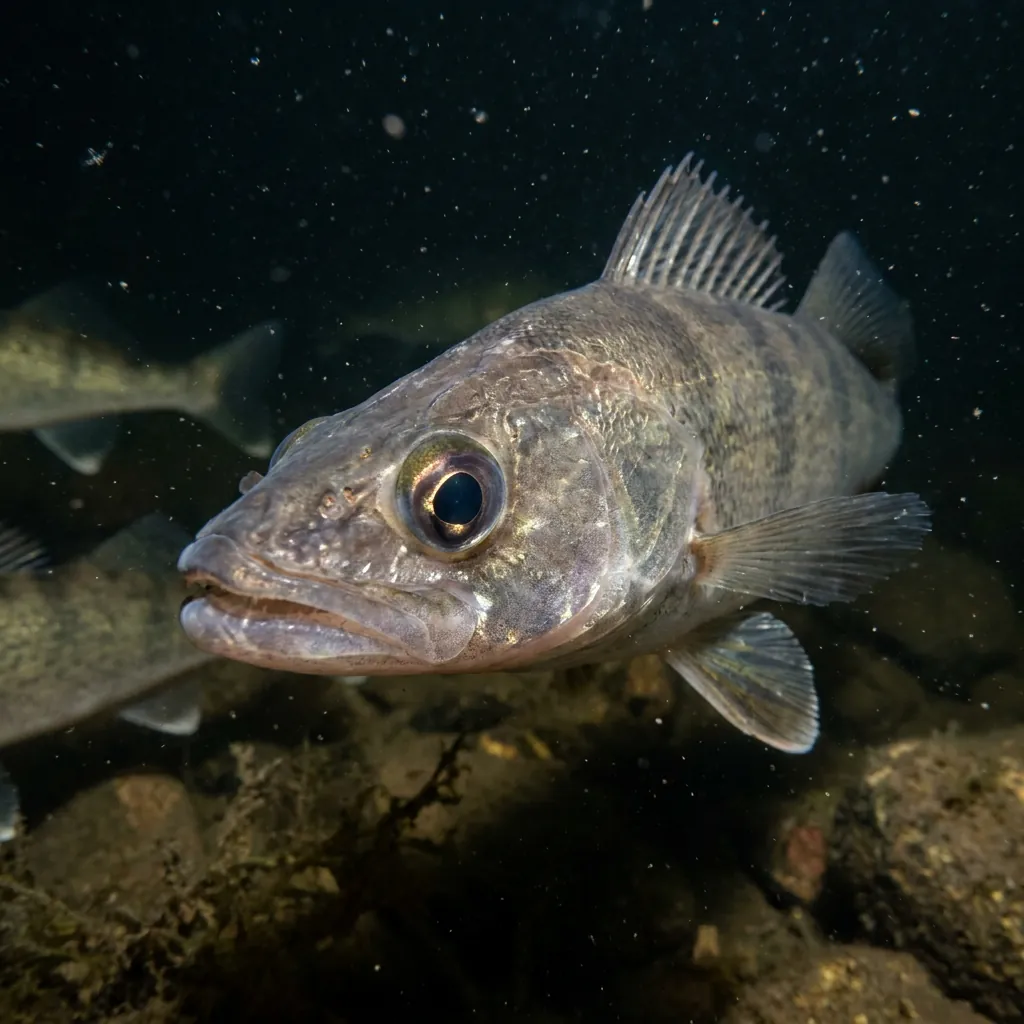
The walleye is a large, toothy predator of North American lakes and rivers, prized by anglers across its range. It can grow up to 107 cm long and over 11 kg, making it one of the biggest fish in many of the waters it shares with smaller native fish.
Also known as: blue pike, dory, european perch, glass eye, gray pike, green pike, jack salmon, marble eye, okow, pickerel, pike-perch, sander vitreus, wall-eyed pickerel, wall-eyed pike, wall-eyed pike-perch, walleye pickerel, walleye pike, walleyed pike, yellow pickerel, yellow pike, yellow pike perch, yellow pike-perch, yellow walleye
- Length
- 54 cm · max 1.1 m
- Weight
- max 11 kg
- Depth
- up to 27 m
How to tell it apart
It looks almost identical to the closely related sauger. The clearest underwater difference is a white tip on the lower lobe of the tail fin, which the walleye has and the sauger lacks.
Appearance
This fish is olive on top, fading to gold on the flanks and white on the belly, with five darker saddle-shaped patches crossing its back. It has a large mouth lined with many sharp teeth, and spiny front dorsal and anal fins.
Breeding
Males mature at three to four years old, with females maturing about a year later. Adults move into streams or shallow spawning grounds in late winter or early spring to lay eggs over gravel, rock, sand, or plants, and neither parent looks after the eggs or young afterward. A large female can lay an enormous number of eggs in one season.
Is it dangerous?
harmless to humans
Conservation
The walleye is listed as Least Concern. Hatchery programs raise and stock large numbers of walleye in parts of its range to support fishing.
Did you know?
Scientists once thought a blue-tinted walleye from the Great Lakes was its own separate species, the blue walleye. Careful study later showed it was never a different species at all, just a color form of the ordinary walleye.
Log it in Into the Blue
Describe what you saw and we name it, then keep every species you find in your Oceandex.