Tralhoto
Anableps anableps
About
Most fish look either up or down. The tralhoto does both at once. It hangs at the very top of the water with its bulging eyes cut in half by the surface, one half watching the sky and one half watching the murk below. It is a small fish, up to about 30 cm, and it spends its life in the thin band where air meets water.
Also known as: largescale foureyes, four-eyes, four-eyes, foureyed fish, largescale foureyes, four-eyes, striped foureyed fish, foureyed fish, foureye, star gazer, largescale foureyes, largescale four-eyed fish
- Length
- 14 cm · max 30 cm
- Weight
- max 400 g
- Temperature
- 24–28 °C
How to tell it apart
At the surface this is just a brown fish, and it shares its mudflats with a close relative that looks much the same. What sets the tralhoto apart from other surface fish is that it parks those split eyes exactly on the waterline and keeps them there. No other fish you meet on these flats sits with half its eye out of the water.
Appearance
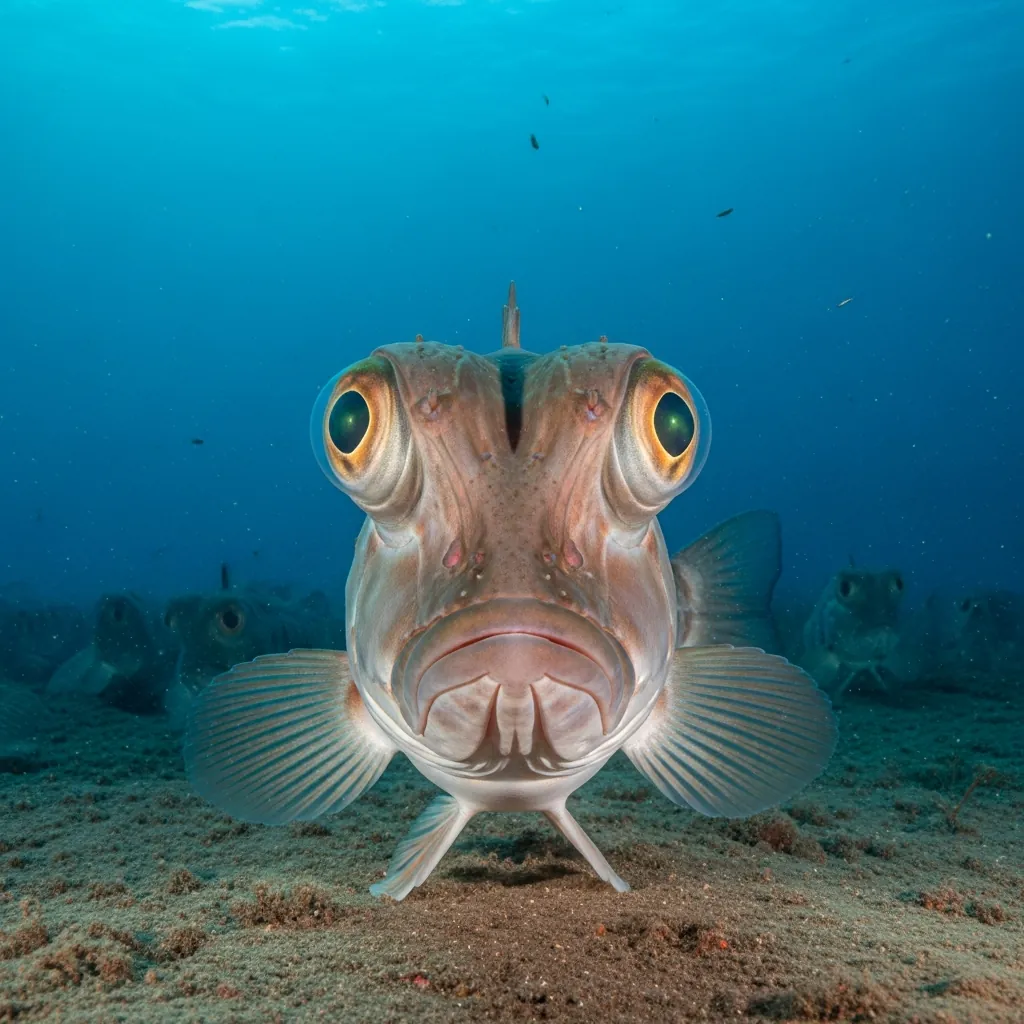
A slim, long-bodied fish, brown above and paler below. The eyes are the feature you cannot miss: they stick out well above the top of the head, and a band of tissue splits each one lengthwise so it shows two pupils. The upper pupil is the larger of the two. Females grow bigger and heavier than males. Males carry a long, narrow rod in place of the anal fin, with the tip bent to the left or right.
Habitat
The tralhoto lives in the warm western Atlantic and the southern Caribbean, from Trinidad and Venezuela down to the mouth of the Amazon. Look for it in estuaries and on coastal mudflats, in water around 24 to 28 C. It stays at the surface and almost never dives, though it must dip its eyes now and then to keep them wet. Groups of ten to fifty are normal. It can also hold out in fresh water for long spells.
Breeding
Females give birth to live young rather than laying eggs. Fertilising happens inside the body, and the male uses the bony rod formed from his anal fin to pass sperm. The young grow inside the ovary until they have used up the yolk sac, then are born. A female can breed more than once a year, with the later months seeming to be the busier time.
Did you know?
A female tralhoto cannot start a new brood while she is still carrying one. All her embryos are fertilised together and develop together, and only after they are born can new eggs be fertilised. Her close relative on the same mudflats does not work this way.
Log it in Into the Blue
Describe what you saw and we name it, then keep every species you find in your Oceandex.