Tarpons
tarpons_g391
Megalops atlanticus
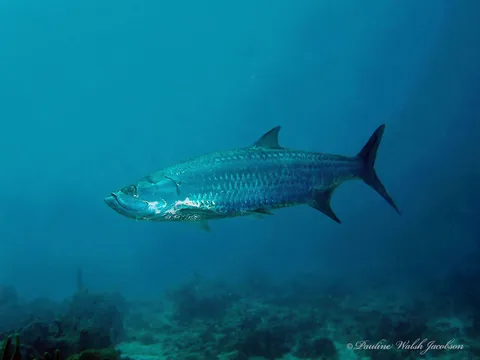
The tarpon is a giant, silver-plated fish that can gulp air at the surface like a fish breathing out of water. Divers who meet one in open, murky harbour water remember the encounter: a wall of armour-like scales cruising past.
Also known as: megalops atlanticus, atlantic tarpon, bass, cuffum, indo-pacific tarpon, madzorfloe, silverfish, silverking
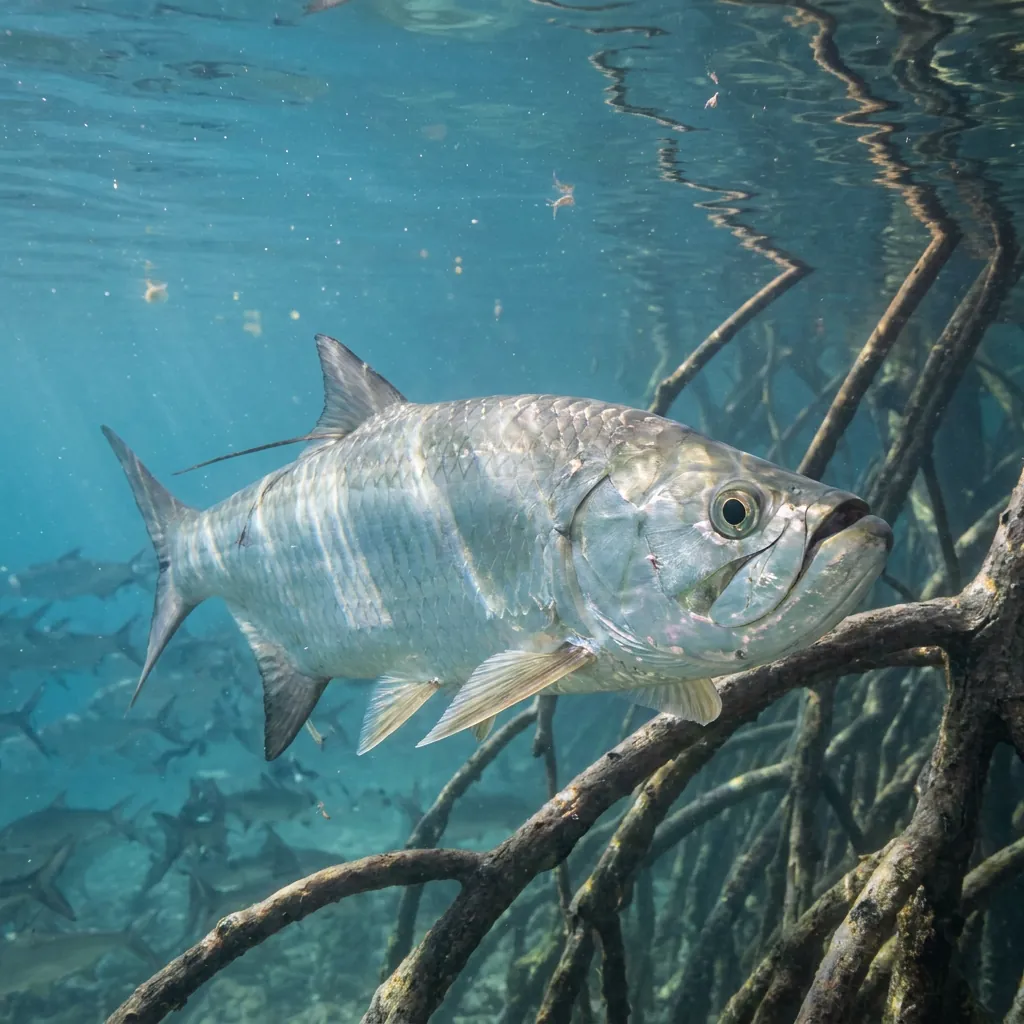
Tarpon can be mistaken for other large silver fish such as ladyfish, but the long, trailing filament on the back fin is unique among the fish it shares habitat with: no similar species combines that filament with such large, plate-like scales.
The tarpon reaches up to 250 cm in length and 161 kg in weight, though 130 cm is more typical. It is greenish or bluish on top and bright silver along the sides, covered in large, plate-like scales. The mouth is large and turned upward, with a bony plate on the tip of the lower jaw. The last ray of the dorsal fin (the fin on its back) is drawn out into a long, whip-like filament that trails almost to the tail.
Tarpon live in warm coastal waters, from the surface down to about 40 m, usually within the top 15 m. They favour the Gulf of Mexico, Florida, and the West Indies, and tolerate water from 10°C to 40°C, though they become sluggish in the cold. They move between the open sea, estuaries, and even water bodies temporarily cut off from it, tolerating a wide range of salinity along the way.
A tarpon can gulp air at the surface and hold it in its swim bladder, which works like a primitive lung. This lets it survive in low-oxygen water where other fish struggle. It often travels and rests in large schools that can return to the same spot for years. Diet shifts with age, from drifting larvae and small zooplankton as juveniles to fish, crabs, and shrimp as adults.
harmless to humans
When hooked, a tarpon is famous for throwing itself clear out of the water in spectacular leaps.
Describe what you saw and we name it, then keep every species you find in your Oceandex.