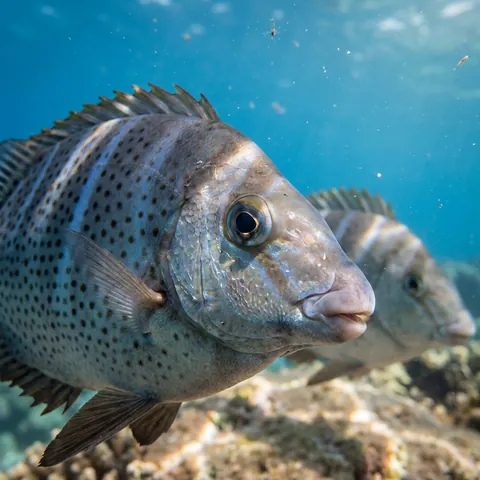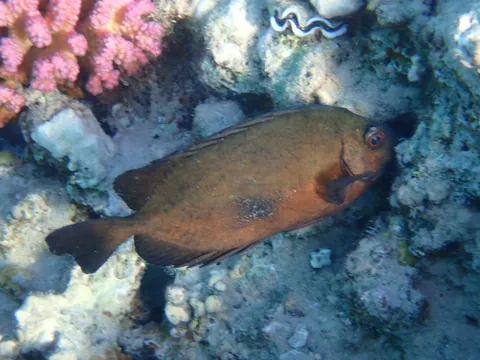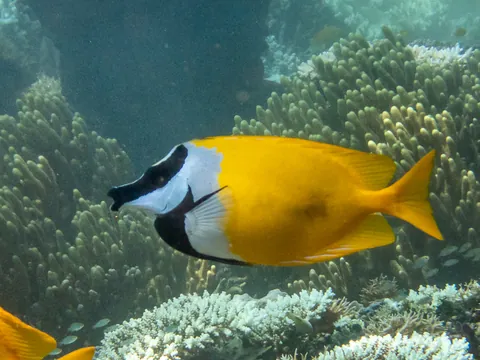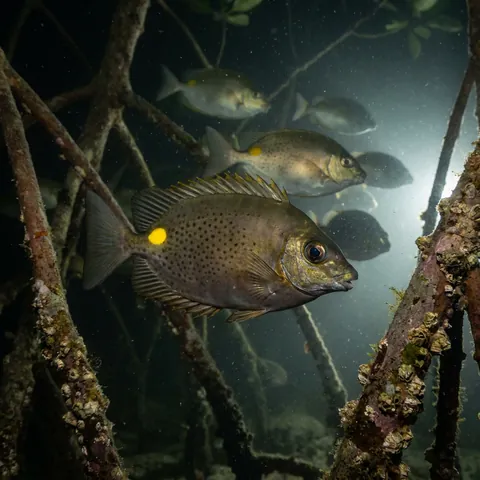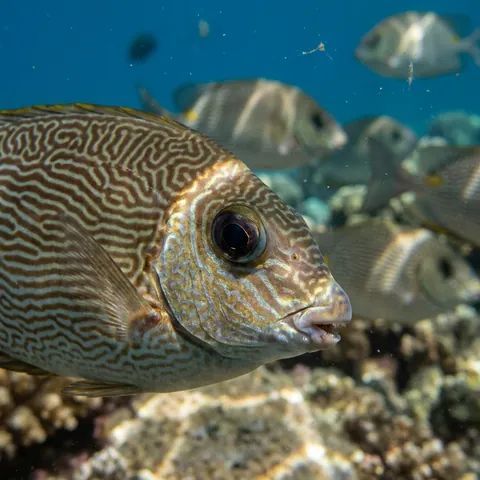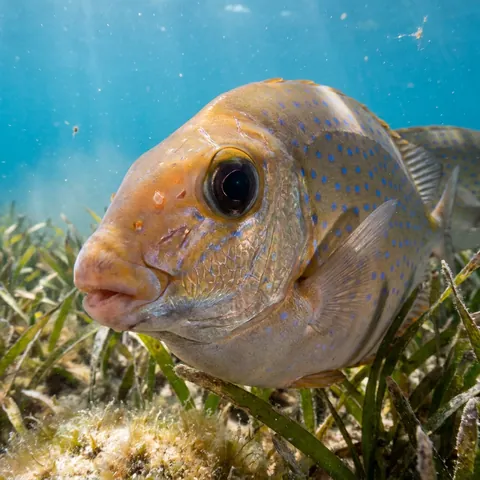
Blue-spotted spinefoot
Siganus corallinus
Siganus argenteus
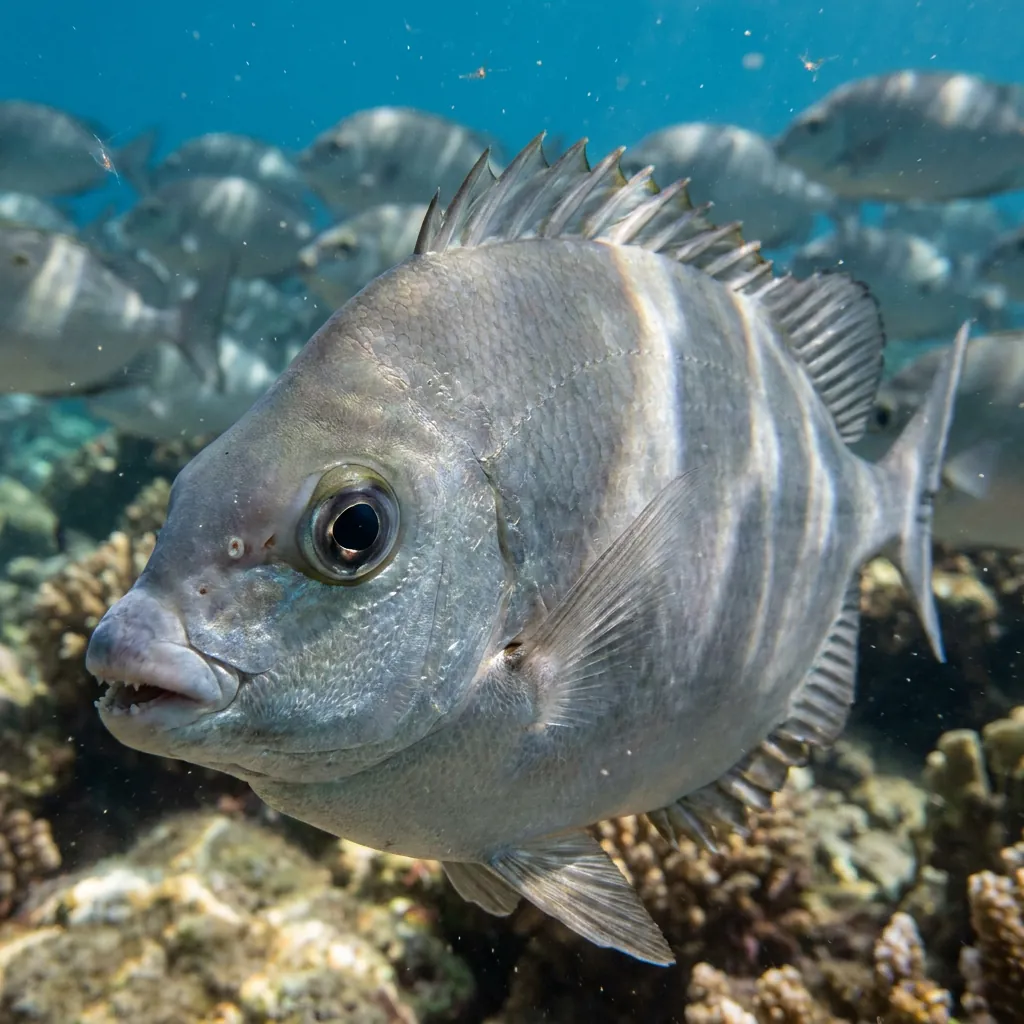
The streamlined spinefoot, also called the forktail rabbitfish, is a fast, silvery schooling fish of Indo-Pacific reefs, typically around 25 cm long and reaching up to 40 cm.
Also known as: forktail rabbitfish, streamlined spinefoot, streaked spinefoot, goldspotted spinefoot, silver spinefoot, silver rabbitfish, rabbitfish, streamlined spinefoot, streaked-spine foot, rabbitface spinefoot, mottled spinefoot, roman-nose spinefoot, marbled spinefoot, schooling rabbitfish, forktail rabbitfish, spinefoot, rabbitfaced spinefoot, streamlined spinefoot, forktail rabbitfish, silver spinefoot, schooling rabbitfish, schooling rabbit-fish
Several silvery, blue-backed rabbitfish species look alike in a school. Check the gill cover: this species has a distinct dark brown bar along its upper edge that similar rabbitfish lack.
This fish has a slender, oval, flat body that narrows to a deeply forked tail. It is blue on the upper body and silvery below, with scattered spots and curved lines, mostly on the lower sides. The eye has a silvery-yellow iris. The pectoral fin has a yellow patch at its base, and a yellow stripe runs along the base of the dorsal fin. When resting or alarmed, it can shift to a pale and dark brown mottled pattern, with diagonal bands across its sides.
This species lives on coastal and inner reef slopes, in lagoons, and among seagrass and seaweed beds, from the surface down to about 40 m in warm water. It favours surge zones at the reef edge, where waves stir the water, and open water just above the reef.
Streamlined spinefoots usually swim in large, fast-moving schools well clear of the bottom. Sometimes they all dive down together to graze on red and green algae. It is one of the few plant-eating reef fish that will sometimes eat an algae that is hard to stomach because of its chemicals, one that most other plant-eaters avoid. Unlike most of its rabbitfish relatives, it releases its eggs into open water rather than onto the reef, giving it a very long larval stage. Like other rabbitfish, it carries venomous spines, so it should not be handled.
This rabbitfish is one of the few plant-eating reef fish able to eat Chlorodesmis fastigata, an algae most plant-eaters avoid because of its chemicals. Even so, it is likely only a small, occasional part of its diet.
Describe what you saw and we name it, then keep every species you find in your Oceandex.