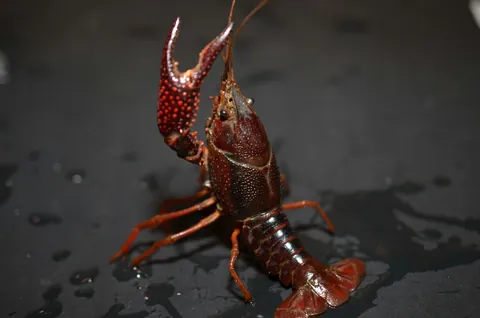
Red Swamp Crayfish
Procambarus clarkii
Pacifastacus leniusculus
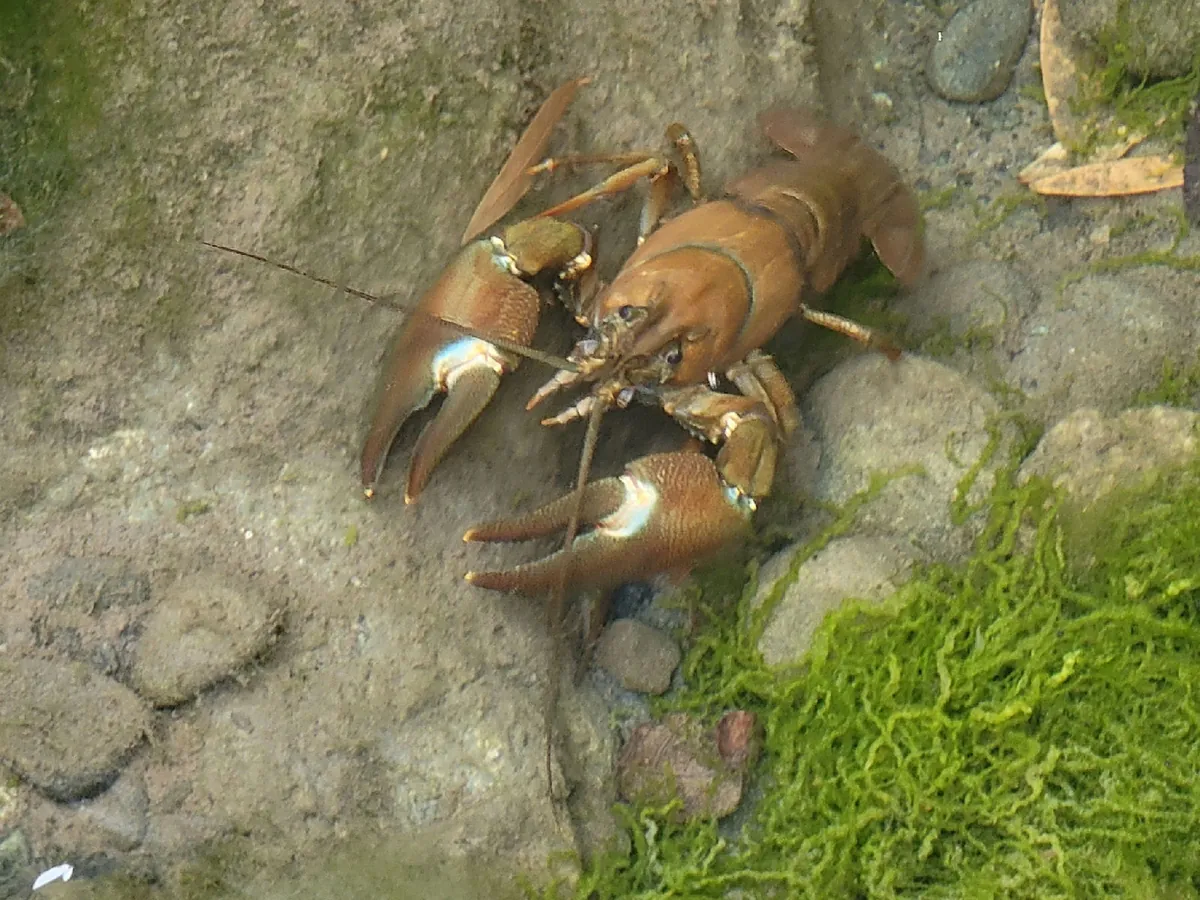
The signal crayfish is a bold, fast-moving freshwater crayfish that has spread far beyond its home rivers. It can reach 20 cm long, and its confident, often aggressive nature makes it easy to spot when it comes out to feed.
Also known as: Pacifastacus leniusculus; signal crawfish
It is often confused with the noble crayfish. Look at the shoulders of the carapace just behind the head: the signal crayfish has no row of spines there, while the noble crayfish does.
This crayfish has a smooth carapace, the hard shell covering its body, usually brown but sometimes bright red or blue. A pale, white to blue-green patch sits near the hinge of each claw. It grows to a common length of 12 cm and can reach 20 cm, with a top weight of 400 g.
It lives in rivers, streams, and lakes with a mix of rock, gravel, and sediment to hide in. Divers usually find it between 1 and 8 m deep, though it can go as deep as 20 m. It tolerates a wide range of water temperatures, from 2 to 24 degrees C, which helps it survive in many different rivers.
This crayfish is mostly nocturnal and does most of its feeding and moving after dark. It is more aggressive than many other freshwater crayfish and tends to win fights over food and shelter. In new surroundings it often hugs the edges of rocks and walls rather than crossing open ground, likely to avoid predators.
Not dangerous, but it pinches hard and will not back down. In many countries it is illegal to move one alive.
Its common name comes from that pale patch near the claw hinge, which reminded early observers of the white flags railway signalmen once used.
Describe what you saw and we name it, then keep every species you find in your Oceandex.