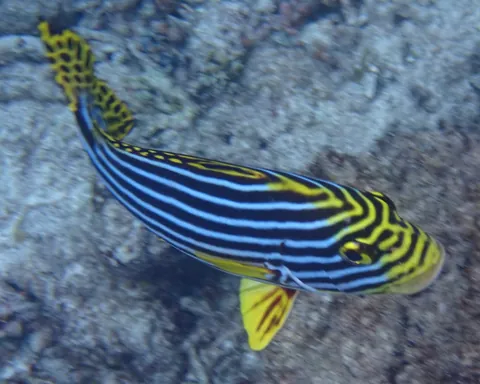
Sweetlips
sweetlips
Diagramma pictum
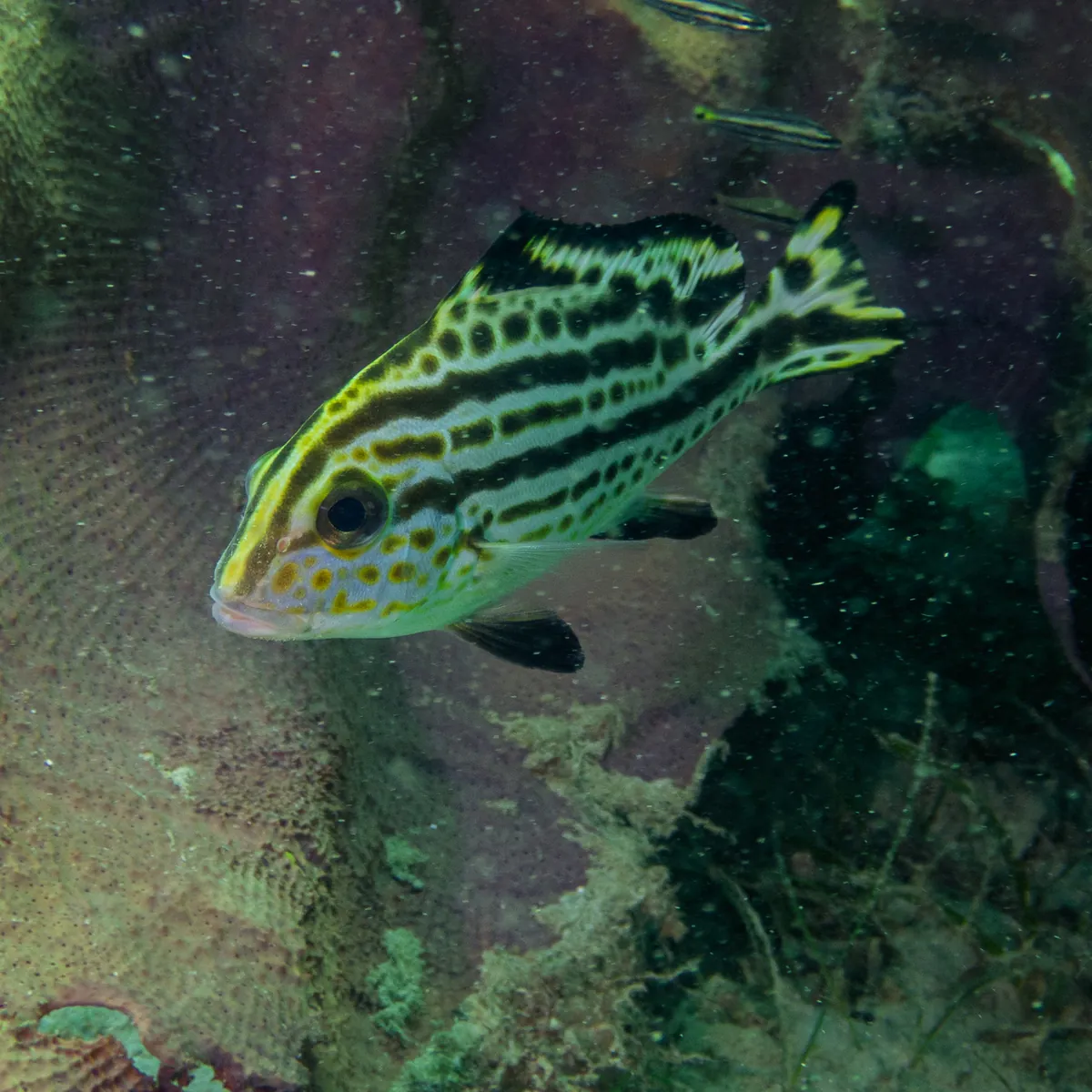
The painted sweetlips changes its whole look as it grows. It starts life as a bold black-and-white striper, then settles into a quiet blue-grey adult with a flash of orange inside its mouth.
Also known as: grunt, painted sweetlip, australian slatey, greysweetlips, painted thicklip, slate sweetlips, bluey, painted thick-lipped grunt, painted sweetlip bream, blackall, mother-in-law fish, smokey bream, painted blubber-lips, yellowdot sweetlips, slatey sweetlips, sweetlips, pointed sweet lip, trout sweetlips, moke, thicklip, sweetlip, slate bream, sailfin rubberlip, thicklip bream, morwong, painted sweetlip bream, painted blubber-lips, mother-in-law fish, smokey bream, slate bream, thicklip bream
A striped juvenile and a spotted adult can look like two different species entirely. At any age, check the mouth: the painted sweetlips has noticeably thick, fleshy lips, and if it gapes, the inside flashes vivid orange to red.
Adults grow up to 100 cm, though 55 cm is more typical, and can weigh up to 6,300 g. They are blue-grey with bright yellow to golden-orange spots, often lined up into patterns on the head, and have thick, fleshy lips that grow larger with age. The dorsal fin has a black edge, and the anal and pelvic fins have black tips. The inside of the mouth is vivid orange to red. Juveniles look completely different: they are silvery yellow underneath with clean black-and-white stripes running along the body, dorsal fin, and tail. As they grow, these stripes break up into small round spots before fading, sometimes staying visible on the tail fin the longest.
It lives across the tropical Indo-Pacific, from the Red Sea and East Africa to Japan and Fiji, though not around Australia. It favours open muddy, sandy, or silty bottoms in sheltered bays and estuaries, and around rock outcrops, wrecks, and rubble, often in murky water. It also turns up in shallow coastal water and on coral reefs, down to as much as 170 m, though it is most common in the top 50 m. Juveniles shelter in weedy areas.
Its scientific name, pictum, means "painted" - a nod to the bold black-and-white pattern of the juvenile, which looks nothing like the plain, spotted adult.
Describe what you saw and we name it, then keep every species you find in your Oceandex.