Pacific hatchetfish
Argyropelecus affinis
About
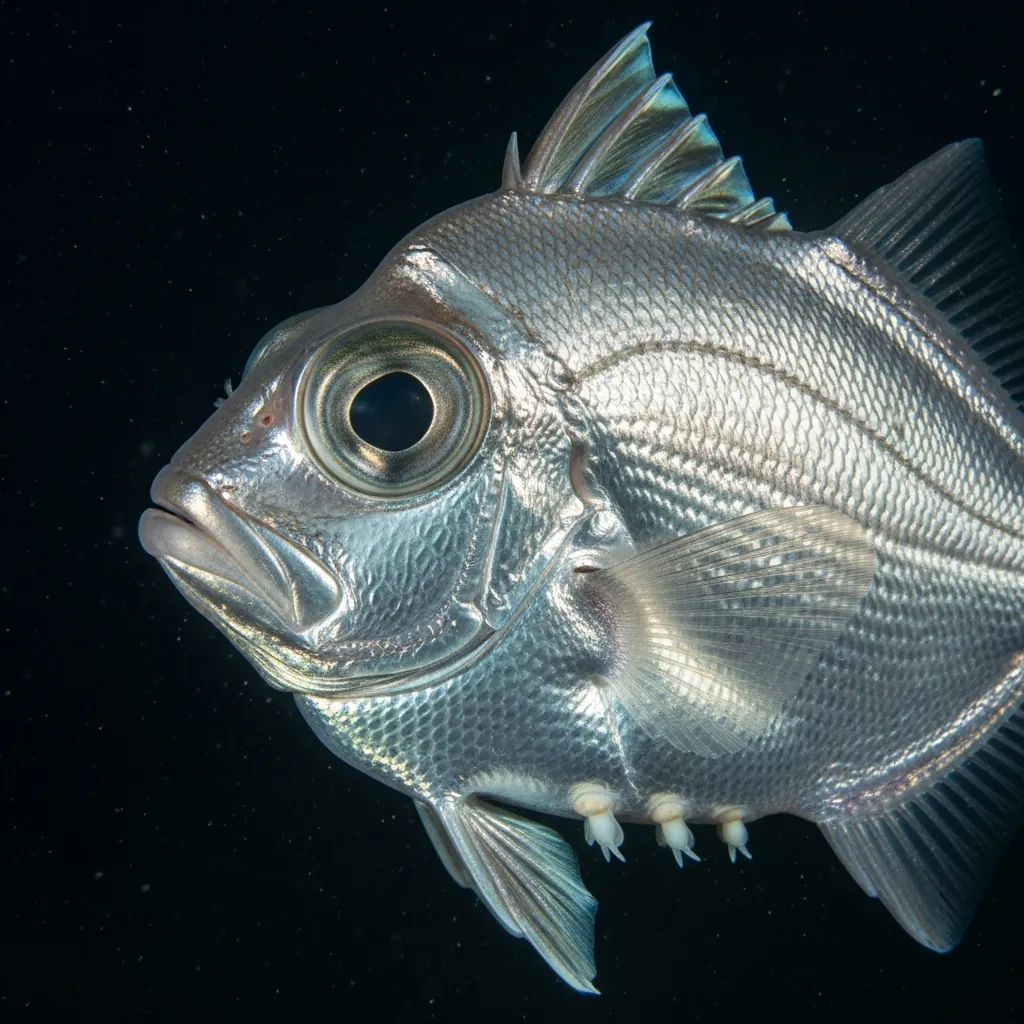
The Pacific hatchetfish is a thin silver sliver of a fish, no more than 8.4 cm long. Seen head on it is almost as flat as a coin, and the name comes from that hatchet-blade shape. It lives in the dark middle layers of the open ocean, where its eyes point straight up to watch for food passing overhead.
Also known as: pacific hatchetfish, slender hatchetfish, deepsea hatchetfish, deepsea hatchetfish, pacific hatchetfish, slender hatchetfish, deepsea hatchetfish
- Length
- 8.4 cm
- Depth
- 1–600 m
How to tell it apart
Several hatchetfish share this silver, flattened body and upward eyes, so shape alone will not name it. Check the area around the eye and gill cover: there is a short spine set just in front of the gill cover, but none behind the eye. That combination is the mark to look for.
Appearance
The body is silver on the sides and dark on the back, with darker colour along the lateral line, the sensory stripe running down the side. It is strongly flattened from side to side. The mouth opens almost vertically and the eyes are tubular and aimed upwards. There is a short spine in front of the gill cover and a row of small spines behind the belly. Along the underside, adults carry rows of photophores, small light organs set in the skin. The scales come off very easily. Behind the dorsal fin sits a small fleshy adipose fin.
Habitat
This is an open-ocean fish of the warmer parts of the Atlantic, Indian and Pacific Oceans. It keeps to midwater, away from the bottom and away from reefs. Records run from 1 m to about 3872 m, but it usually stays between 1 and 600 m. It sits deepest by day and comes shallower at night, so at least part of the population moves up and down each day.
Diet
It feeds on small drifting animals. Smaller fish take mainly copepods and ostracods, both tiny shelled crustaceans. Larger fish move on to krill, salps and arrow worms. Stomach studies also show a large share of small fish and fish larvae, so it is not a plankton feeder alone.
Log it in Into the Blue
Describe what you saw and we name it, then keep every species you find in your Oceandex.