Pacific Hake
Merluccius productus
About
The Pacific hake, also called Pacific whiting, is a silvery schooling fish of the open northeast Pacific that rises toward the surface at night to feed.
Also known as: north pacific hake
How to tell it apart
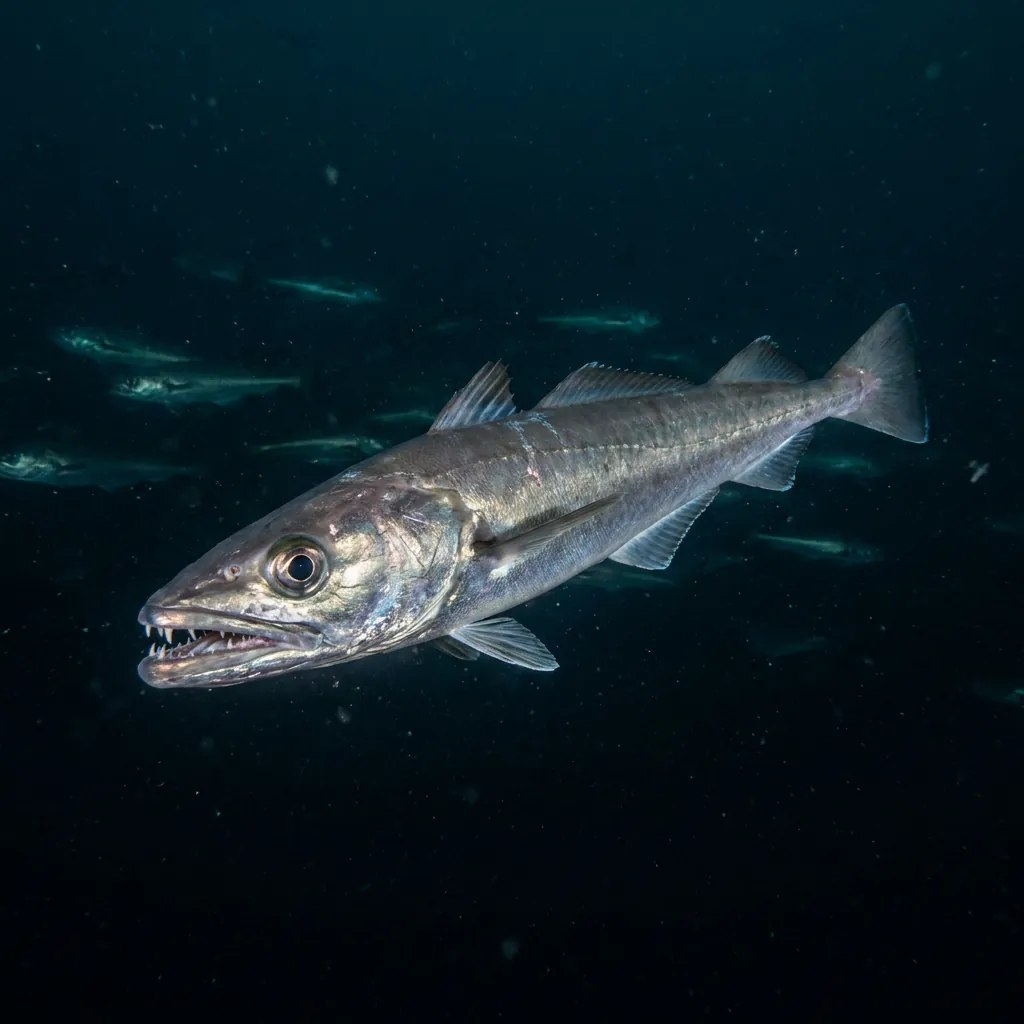
It can look like other silvery, schooling open-water fish at a glance. The long pectoral fins, reaching back to where the anal fin begins, are a useful check that many similar fish lack.
Appearance
It is metallic silver-gray with black speckling on the back and a pure silvery-white belly. It has two dorsal fins and a caudal fin that curves inward at the edge rather than being straight. Its pectoral fins are long, usually reaching to or past the start of the anal fin.
Habitat
This offshore fish moves up and down the water column each day, staying near the bottom by day and rising toward the surface at night to feed on fish and invertebrates.
Breeding
Pacific hake spawn between January and June, and may spawn more than once in a season. Different populations use different spawning grounds, and adults move north in spring and summer to feed before heading back south to spawn.
Did you know?
Its flesh contains an enzyme that breaks the tissue down unusually fast after death, so it must be rushed to processing plants and treated with an inhibitor before it can be used.
Log it in Into the Blue
Describe what you saw and we name it, then keep every species you find in your Oceandex.