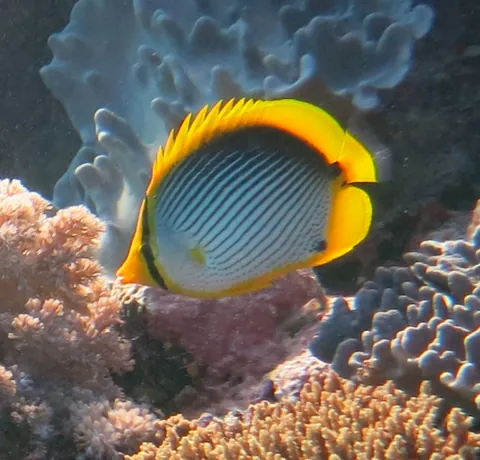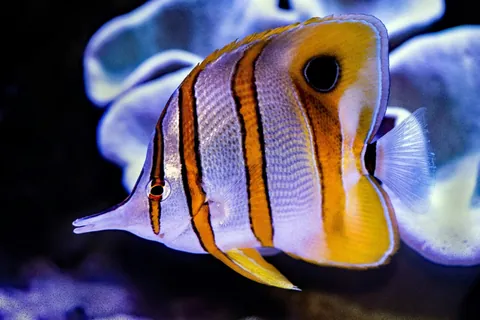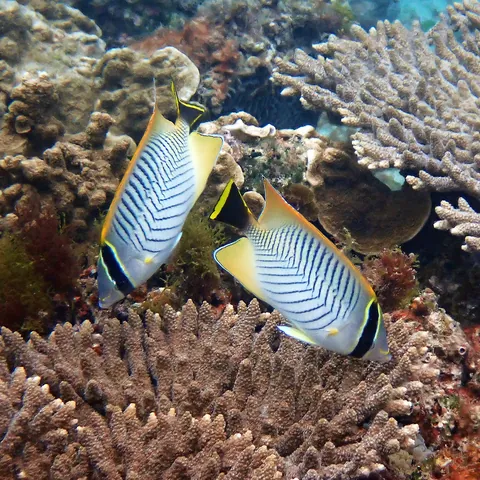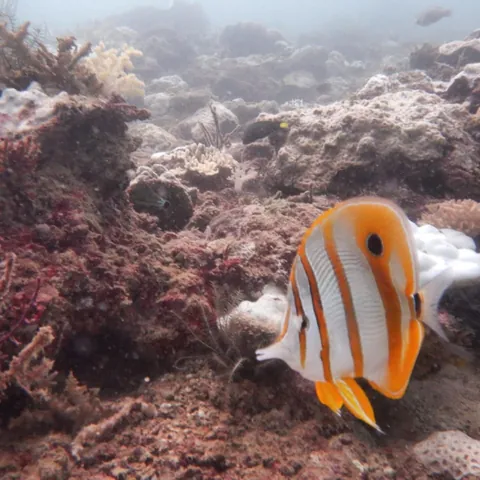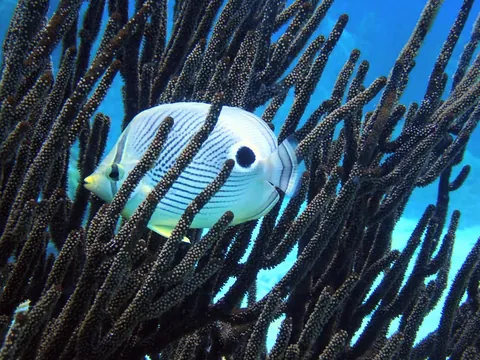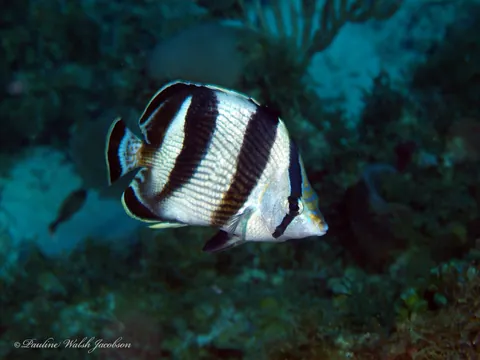
Banded Butterflyfish
Chaetodon striatus
Chaetodon lunulatus
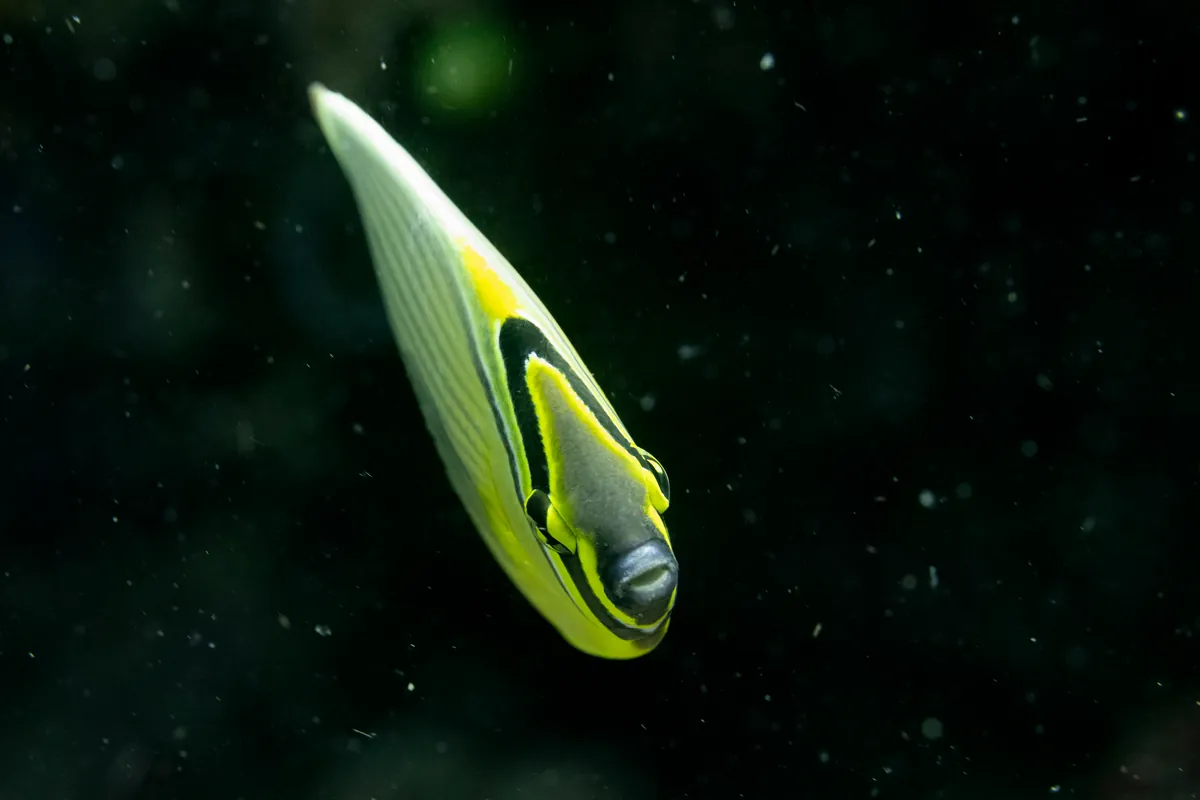
The oval butterflyfish is a small, disc-shaped coral reef fish of the Pacific, growing to about 14 cm. It is one of the most coral-dependent fish on the reef: it eats live hard coral and almost nothing else. Divers usually see it as a pair, moving slowly over coral-rich ground and picking at the coral surface.
Also known as: pacific pinstriped butterflyfish, redfin butterflyfish, striped butterflyfish, red-striped butterfly-fish, redfin butterflyfish, lineated butterfly-fish, pinstripe butterflyfish, pacific pinstriped butterflyfish, lineated butterfly-fish, red-striped butterfly-fish, pinstriped butterflyfish, striped butterflyfish, pinstripe butterflyfish
Look for a fixed pattern rather than the overall colour. Fine purple lines run almost lengthwise along a pink-and-yellow body, and a broad black band with a yellow edge crosses the whole rear of the fish through the back, belly and tail fins. Between the body and the tail fin, the tail base stays plain grey. That grey patch inside the dark rear band is the clearest mark at diving distance.
The body is deep and flat, pink on the back and shading to yellowish underneath, crossed by many narrow purple lines that run diagonally, almost level along the body. The head is yellow and a black bar runs down through the eye with a yellow edge. A broad black band, also edged in yellow, runs across the back of the fish through the dorsal, anal and tail fins. The dorsal and anal fins have a red outer edge with a black rim. The tail base is grey.
This fish lives in the tropical Pacific, from eastern Indonesia across to Hawaii, and from Japan in the north to Australia in the south. It stays close to the bottom on coral reefs, in lagoons rich in coral and on semi-sheltered seaward reefs, between about 3 and 30 m. Small juveniles are shy and hide among coral branches.
It feeds only on live hard coral, taking many different kinds, including branching and plate-forming corals. That narrow diet is a weakness. After coral bleaching events, when live coral dies, the physical condition of these fish drops and their numbers fall. Butterflyfish that eat other food do not show the same decline, so starvation is the likely cause.
Males and females look alike. Fish live alone or in pairs, and a pair is nearly always a male and a female. Pairs stay together for years. They swim side by side, usually within a couple of metres of each other and rarely far apart. The female feeds more often, while the male tends to lead when the two swim together. Eggs are laid rather than carried.
These fish greet each other with a signal. When two meet, one may tilt its tail up, a display used both in border arguments and with its own partner. An oval butterflyfish may attack a fish that fails to give the tail-up display. Fights only turn deadly over mates, never over food or shelter.
Describe what you saw and we name it, then keep every species you find in your Oceandex.