Otter
Enhydra lutris
About
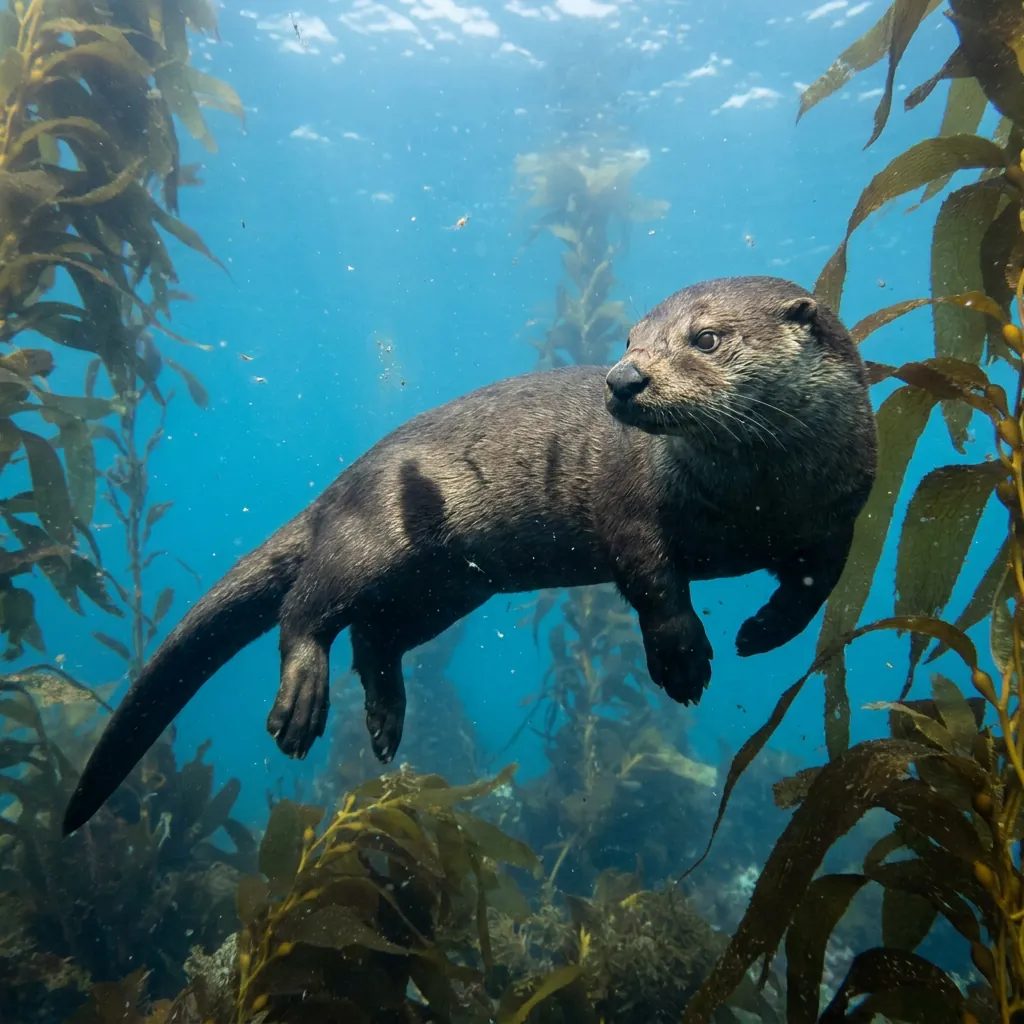
The sea otter is one of the smallest marine mammals, yet it survives cold Pacific waters with no blubber at all. Instead, it relies on the thickest fur of any animal on Earth to stay warm.
Also known as: enhydra lutris, sea otter
- Length
- 1.5 m
- Weight
- max 45 kg
- Depth
- up to 25 m
How to tell it apart
At the surface, sea otters are sometimes mistaken for seals or sea lions. The easiest way to tell them apart is posture: an otter floats flat on its back, often with its head, feet, and a paw holding food all held up out of the water.
Appearance
A large male sea otter can reach up to 148 cm long and weigh up to 45 kg; females are smaller. Its fur is extremely dense, with two layers: long, waterproof outer hairs and a short, thick underfur that traps air against the skin. It has short front legs with paw-like feet, larger webbed back feet, and no visible tail fin.
Habitat
Sea otters stay close to shore, usually within about a kilometre of the coast, in waters up to 25 m deep. They favour rocky coastlines, kelp forests, and barrier reefs that offer shelter from heavy seas, though some live over mud, sand, or silt bottoms. Each otter keeps to a home range just a few kilometres long, year-round.
Behaviour
Sea otters are active by day, foraging for a few hours before dawn and again in the afternoon, then resting through the middle of the day. They spend much of their time grooming, working air and water through their fur to keep it insulating. When resting, they gather in single-sex groups called rafts, sometimes wrapping themselves in kelp so they do not drift away.
Diet
A sea otter dives to the sea floor to hunt, usually for about a minute at a time. It is the only marine animal known to lift and turn over rocks with its front paws while searching for prey, and it digs into mud for clams and plucks snails from kelp. It carries food, and sometimes a rock for cracking shells, in a loose pouch of skin under its foreleg, then floats on its back at the surface to eat.
Breeding
Males hold territory and mate with multiple females that pass through it. A male and female bond only for the few days the female is fertile, and the male often holds her head or nose in his jaws during mating, which can leave visible scars. Births happen year-round, with timing that varies between populations, and pregnancy length can stretch out because the fertilised egg does not implant right away.
Conservation
Fur hunting that began in the 1740s cut the sea otter's population from as many as 300,000 down to just 1,000 to 2,000 animals. Numbers have since recovered across much of its former range, one of the best-known marine conservation successes, but the species is still classed as endangered. The biggest ongoing threats are oil spills, which strip the fur of its insulating power, along with orca predation, poaching, and drowning in fishing gear.
Did you know?
The sea otter is the only marine mammal that catches fish with its forepaws instead of its teeth.
Log it in Into the Blue
Describe what you saw and we name it, then keep every species you find in your Oceandex.